
Hot Water Systems for Apartments and Units in Sydney
Apartment living in Sydney comes with a unique hot water puzzle. No roof access for solar, tight balconies, riser cupboards measured in centimetres, and a strata committee that needs to sign off before you touch a thing. This guide walks Sydney unit owners and renters through the systems that actually fit, the strata steps that actually work, and the suburb-by-suburb realities of upgrading hot water in places like Parramatta, Chatswood, Bondi, Pyrmont and North Sydney.

In This Guide
Roughly one in three Sydney homes is now an apartment, and most of those buildings were plumbed before today's hot water options existed. We get calls every week from owners in Pyrmont and North Sydney whose 15-year-old electric storage tank has finally let go, and from Bondi renters whose landlord is wondering whether a continuous flow unit will even fit on the balcony. The honest answer is: it depends on your building, your lot, and your strata.
The good news is that there is almost always a workable upgrade path. Compact tankless (continuous flow) units, slimline electric storage tanks, and a new generation of small-footprint heat pumps are all designed with apartments in mind. The hard part is usually paperwork, not plumbing.
What you'll learn in this guide:
- Whether your unit has an individual or shared central system
- Exactly which strata approvals you need under NSW law
- The 4 hot water systems that actually fit Sydney apartments
- Realistic 2026 installed prices for unit installs
- Suburb-specific notes for Parramatta, Chatswood, Bondi, Pyrmont and North Sydney
Can I Upgrade My Hot Water System in a Sydney Apartment?
Short answer: usually yes, but rarely on your own. The first question to settle is who actually owns the hot water system serving your unit. If it sits inside your lot and only feeds your taps, it's almost always your responsibility to maintain and replace. If it sits in a plant room and feeds multiple units, it's owners corporation property.
Most Sydney apartments built since the late 1990s have individual hot water units inside each lot. You'll typically find them in one of four spots: a laundry cupboard, a kitchen bulkhead, a balcony recess, or a small external service cupboard accessed from the corridor. Older buildings, particularly red-brick walk-ups in places like Bondi and Coogee, sometimes still run shared gas-fired central systems with a master tank in the basement.
How to tell what you have
- Check inside your lot for a tank, white wall-mounted gas unit, or small heat pump cabinet.
- Look at your utility bills: an individual gas or electricity charge for hot water suggests an individual system.
- Ask the strata manager for a copy of the building's hydraulic plan or strata plan.
- Check the body corporate budget for a "hot water" or "centralised plant" line item, which usually means shared.
Quick test
If your hot water keeps running when the rest of the building loses gas or power, you're likely on a shared system. If it stops with your unit's electrics, it's individual.
Do I Need Body Corporate Approval?
Almost every hot water swap in a Sydney apartment touches common property in some way. The wall the unit hangs off, the balcony slab, the gas riser, the water mains, the drain to the floor waste — all of those are usually common property under the strata plan. That means you need approval before a plumber lifts a spanner.
The three approval pathways
Cosmetic work (no approval needed)
Like-for-like swap of an internal electric tank that doesn't touch common property. Rare for hot water but possible in some new buildings with dedicated lot risers.
Minor renovations (Section 110, simple majority)
The standard pathway for most apartment hot water replacements. The owners corporation passes a resolution at a general meeting (or by delegation to the committee in many by-laws). Expect 4–8 weeks from application to approval.
Major renovations (special resolution, 75% majority)
Required when work changes the building's external appearance, drills new holes through external walls, runs a new gas line through common areas, or relocates a unit's hot water position. Heat pumps installed on balconies usually fall here because of the noise and visual change.
What to include in your strata application
- Cover letter explaining the existing unit's age and reason for replacement
- Specification sheet for the new system (brand, model, dimensions, weight, noise rating)
- Licensed plumber's quote and licence number
- Public liability insurance certificate ($10–20 million is standard)
- SafeWork NSW Notice of Intent to do plumbing work, if required
- Site plan showing exact location and any pipework changes
- Proposed by-law for the new fixture (your strata manager will draft this)
Don't skip the by-law
If your new unit is in a different position to the old one, ask the owners corporation to register a by-law assigning maintenance and repair responsibility to your lot. Without it, you can end up arguing about who pays when the new unit leaks five years from now.
NSW Strata Laws on Common Property and Hot Water
The rules that govern apartment hot water sit inside the Strata Schemes Management Act 2015 (NSW) and the related Strata Schemes Management Regulation 2016. They apply to every residential strata scheme in Sydney.
Key sections worth knowing
- Section 106: The owners corporation must properly maintain and keep common property in good repair. If your hot water issue is on common pipework, that's their bill, not yours.
- Section 108: Changes to common property generally need a special resolution (75% in favour at a general meeting).
- Section 110: Minor renovations (most hot water swaps) only need a simple majority and can be delegated to the strata committee.
- Schedule 3 by-law model: Many buildings use it as a template for granting permission with maintenance conditions attached.
When NSW Fair Trading gets involved
If the owners corporation refuses approval unreasonably, or fails to maintain common pipework that's wrecking your hot water supply, you can lodge a dispute with NSW Fair Trading and, if needed, escalate to the NSW Civil and Administrative Tribunal (NCAT). Most cases are settled at mediation, which is usually free.
Plumbing must still meet AS/NZS 3500.4
Approval from your strata doesn't replace compliance. Every apartment hot water installation in Sydney must follow NSW Fair Trading plumbing rules, including AS/NZS 3500.4 hot water installation, a tempering valve to deliver water at 50°C maximum, and a Certificate of Compliance lodged within 48 hours of completion.
Which Systems Work in Apartments Without Roof or Outdoor Space?
Solar hot water is essentially off the table for apartments because you don't own the roof. That leaves four practical options. Here's how they stack up for Sydney units.
1. Continuous flow (tankless) gas
The most popular upgrade in Sydney apartments. A wall-mounted box about the size of a microwave, usually installed on the balcony or in an external service cupboard. No tank means no floor space lost and no chance of a tank leak inside the lot.
Best for: Units with an existing gas connection and balcony or external wall access. See our full tankless hot water systems guide.
Watch out for: Required clearances around the unit (typically 300mm sides, 1m front), flue routing, and noise from the fan during operation.
2. Slimline electric storage
Tall, narrow tanks (25L–80L) designed for laundry cupboards and kitchen bulkheads. Cheap to buy, simple to install, and works in any apartment with a 240V circuit.
Best for: Studios, 1-bedroom units, and like-for-like replacements where the existing tank is in a cupboard. More detail in our electric hot water systems page.
Watch out for: Higher running costs than gas or heat pump on full peak tariffs, and capacity limits if more than two people share the unit.
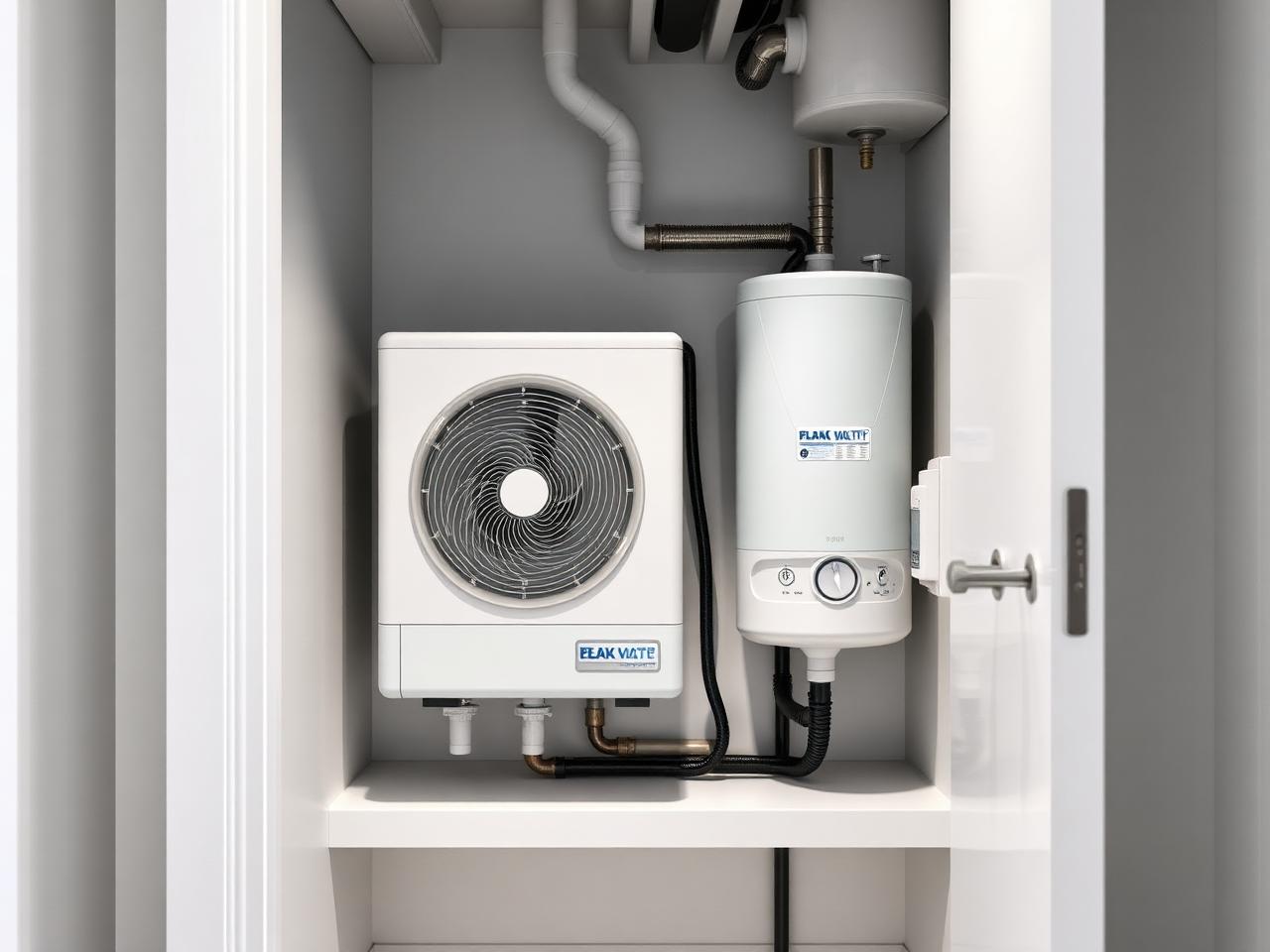
3. Compact integrated heat pump
A new generation of small (80L–170L) all-in-one heat pumps fits on balconies and in garage cages. Roughly a third of the running cost of resistive electric, plus access to NSW Energy Savings Scheme rebates.
Best for: Owner-occupiers planning to stay 5+ years, units with balcony space, and buildings phasing out gas. See our dedicated heat pump hot water page.
Watch out for: Fan noise (typically 37–48 dB) often triggers a major renovation vote in strict buildings, and the condensate drain needs a route to a floor waste.
4. Electric continuous flow (single-point)
Small under-sink or single-bathroom electric instant units. Usually only practical for studios or as a backup, because whole-of-unit electric continuous flow needs three-phase power that most apartments don't have.
Best for: Studios, granny suites within larger units, or boosting hot water to a remote ensuite.
Watch out for: Limited flow rate, and the electrician may need to upgrade your switchboard.
Our default recommendation for Sydney units
If you have gas and a balcony, fit a 20–26L/min continuous flow unit. If you don't have gas, fit a compact heat pump where the strata will allow the noise rating, otherwise a slimline electric tank. Book a site assessment with our hot water installation team before you commit, because the right answer often changes once we see the lot.
Suburb Notes: Parramatta, Chatswood, Bondi, Pyrmont & North Sydney
Sydney's high-density suburbs each have their own quirks when it comes to apartment hot water. Here's what we run into most often.
Parramatta
Mostly newer high-rise stock with individual gas continuous flow units already in service cupboards. Like-for-like swaps are usually approved within a fortnight. Buildings around Eat Street and Phillip Street often share a common gas riser, so any change in flow rating may need a hydraulic check.
Chatswood
A mix of 1980s walk-ups (often shared electric central plant) and modern towers. Owners in older blocks frequently want to break away to individual systems but find it's only practical when the whole building upgrades. Heat pumps are increasingly approved on north-facing balconies.
Bondi
Older red-brick units near Campbell Parade still use small electric storage tanks tucked above stoves or inside laundry cupboards. Salt corrosion shortens system life noticeably here, so we typically recommend a stainless-lined or vitreous enamel tank with a sacrificial anode, and we book extra service intervals for any heat pump installed within a kilometre of the beach.
Pyrmont
Heritage-converted warehouses are common, which means tight ceiling clearances and limited gas supply per unit. Continuous flow upgrades often hit gas-sizing limits and we end up recommending a compact heat pump or upgraded slimline electric instead.
North Sydney
Lots of mid-rise commercial conversions where each unit has its own balcony service cupboard. Continuous flow gas is the most popular upgrade, but several newer all-electric buildings around Miller Street are heat-pump-only by by-law, so check before you spec a gas unit.
How Much Does Apartment Hot Water Installation Cost in Sydney (2026)?
Apartment installs almost always cost a little more than a free-standing house equivalent because of access, parking, and trade insurance requirements. These are realistic 2026 installed prices for Sydney units.
| System | Capacity | Installed Price |
|---|---|---|
| Slimline electric storage | 25–80L | $1,400 – $2,200 |
| Continuous flow gas | 16–26 L/min | $2,600 – $3,800 |
| Compact integrated heat pump | 80–170L | $3,500 – $5,200 (before rebate) |
| Single-point electric instant | Per outlet | $900 – $1,600 |
Hidden costs to budget for
- Strata works application fee: $0 – $400
- Hydraulic engineer letter (if requested by committee): $300 – $900
- After-hours building access or lift booking: $150 – $400
- Crane or hoist for high-floor heat pumps: $400 – $1,200 (rare)
- Tempering valve upgrade if existing one is older than 5 years: $180 – $260
Rebates that apply to apartments
NSW apartment owners are eligible for the same rebates as house owners, including the NSW Energy Savings Scheme heat pump rebate (typically $400–$1,000 off) and federal Small-scale Technology Certificates worth another $400–$900. Both are point-of-sale discounts when you use an accredited installer. Read our full breakdown in NSW Hot Water Rebates 2026.
Don't forget your warranty
Apartment installs benefit from the same manufacturer warranties as houses (5–10 years typical), but make sure your invoice references the strata lot and unit number. Strata managers sometimes ask for proof of installation when arranging building insurance.
Frequently Asked Questions
Can I upgrade my hot water system in a Sydney apartment?
Yes, in most cases. If your unit has its own individual hot water system inside the lot, you can usually replace it with the owners corporation's written approval. If your building runs a shared central system, you can't change it on your own. Always check your strata by-laws and submit a works application before booking installation.
Do I need body corporate or strata approval to change a hot water system?
Almost always, yes. Hot water systems usually involve common property (the wall, balcony, riser cupboard, water and gas connections, or drainage). Under the NSW Strata Schemes Management Act 2015, any work that affects common property needs owners corporation approval, typically through a Section 110 minor renovations or major renovations process.
Which hot water systems work in apartments without roof or outdoor space?
The three best options are continuous flow (tankless) gas units, slimline electric storage tanks (25L–80L), and compact integrated heat pumps designed for indoor or balcony installation. Solar hot water is rarely viable in units because you don't have private roof access. Tankless units are the most popular choice in Sydney apartments because they free up floor space.
How much does it cost to install a new hot water system in a Sydney unit?
Installed prices in 2026 typically range from $1,400 for a like-for-like small electric storage swap to $3,800 for a continuous flow gas unit on a balcony, and $3,500 to $5,200 for a compact heat pump. Strata-related costs (engineering reports, certifier fees, after-hours building access) can add $300 to $1,200.
Can I switch from a shared central hot water system to my own?
Usually not as an individual owner. Shared central plant is common property and is governed by the owners corporation. To switch your unit to an individual system, you generally need a special resolution at a general meeting, hydraulic engineering sign-off, isolation of your lot from the central loop, and a new metered gas or electricity supply. Most owners only pursue this if the building is planning a system-wide upgrade.
What size hot water system do I need for a 1 or 2 bedroom apartment?
For a 1 bedroom unit (1–2 people), a 16L/min continuous flow unit, a 50L electric storage tank, or an 80L compact heat pump is usually enough. For a 2 bedroom unit (2–3 people), step up to 20–26L/min continuous flow, 80L electric storage, or a 120L heat pump. Avoid undersized continuous flow units if you have an ensuite plus main bathroom running together.
Conclusion
Upgrading hot water in a Sydney apartment is rarely complicated technically. The hard part is the paperwork, the strata process, and matching the right system to a tight space. Once you know whether you're on an individual or shared system, the rest is mostly a sequence of well-trodden steps.
For most Sydney units in 2026, a continuous flow gas unit on the balcony is still the easiest, fastest, and most space-efficient upgrade. Where gas isn't available or the building is going all-electric, a compact heat pump (with strata's blessing on noise) gives you the lowest running costs. A slimline electric tank remains the budget option that almost always fits.
Whatever you choose, get the strata application in early, use a licensed plumber who has done apartment work in your suburb before, and make sure the certificate of compliance lands in your strata records.
Key takeaways
- Identify whether you have an individual or shared central system before doing anything else
- Most apartment hot water swaps need a Section 110 minor renovations approval
- Continuous flow gas remains the most popular Sydney apartment upgrade
- Compact heat pumps are getting traction in newer all-electric buildings
- Budget an extra $300–$1,200 for strata, access and compliance costs