
Is Gas Hot Water Banned in NSW? Sydney Homeowner Guide 2026
Is gas hot water being banned in NSW? Existing homes are safe, but new buildings face restrictions. Learn what Sydney councils have changed, what it costs to switch, and how to claim every rebate.

Table of Contents
If you live in a Sydney home with a gas hot water system, you have probably heard the rumors. Council bans. Electrification deadlines. Gas prices climbing again. Winter 2026 is nearly here, and the question on every kitchen table is whether that reliable old gas unit in the backyard is about to become a very expensive problem.
The short answer is this. Gas hot water is not banned for existing homes anywhere in NSW. Not yet. But the rules for new buildings are changing fast, and the financial case for keeping gas is getting weaker every quarter. Sydney households that stay on gas are paying roughly 40% more for hot water than households that switched to a heat pump in 2025. If your gas unit is more than eight years old, the question is not whether you will replace it. It is when, and with what.
This guide explains exactly what is happening with NSW gas policy, which Sydney councils have already moved to all-electric new builds, what it costs to replace a gas hot water system in 2026, and how to claim every rebate you are entitled to.
What Is Actually Changing in NSW?
The NSW Government is not banning gas in existing homes. What is changing is the rules for new construction. Several Sydney councils have adopted planning controls that require new residential buildings to be all-electric. The NSW Gas Decarbonisation Roadmap, due for release in late 2026, will lay out the long-term plan for fossil gas in the state energy mix. Until then, individual councils are setting their own rules.
The City of Sydney was the first major council to act. In October 2025, Council approved new planning controls that ban gas appliances in new residential buildings from 1 January 2026. This initially covered indoor appliances like cooktops and heaters. From 1 January 2027, the ban extends to outdoor gas appliances, which includes gas hot water systems. The rules do not apply to existing homes, renovations, or industrial uses.
North Sydney Council followed with a similar draft amendment to its Development Control Plan in late 2025. Waverley, Randwick, and Inner West councils have also signaled support for all-electric new builds. These are planning controls, not state law. Each council sets its own timeline, and the rules only bind developers of new residential buildings.
At the state level, the NSW Government has committed to delivering a gas decarbonisation roadmap by late 2026 through its Consumer Energy Strategy. The roadmap will explore how to reduce gas emissions without putting additional pressure on household energy bills. It does not mean an immediate statewide ban on residential gas use.
The existing gas network will continue to operate for decades. NSW Treasury has stated that households already connected to gas will not be disconnected. The policy focus is on new connections and encouraging voluntary switching through rebates and price signals.
Does the Gas Ban Affect Existing Homes?
No. If you already own a home with a gas hot water system, none of the current council bans or state policies force you to remove it. The City of Sydney has explicitly stated that the new all-electric planning controls do not apply to existing buildings. You can keep your gas unit running until it fails, and you can replace it with another gas unit if you choose to.
However, there are practical reasons why replacement timing matters. Gas network tariffs in NSW include a fixed daily supply charge that you pay regardless of how little gas you use. For many Sydney households, that supply charge alone costs $280 to $380 per year before a single litre of gas is burned. When you add usage charges, which IPART data shows have risen steadily, a family of four in Sydney can easily spend $700 to $950 per year just on gas hot water.
The real question for existing homeowners is financial, not legal. Every year you stay on gas, you are paying a premium compared to modern electric alternatives. Heat pump hot water systems now cost a third as much to run as gas storage units. Solar PV diverters can heat water with free rooftop sunshine. The economics have shifted, and they have shifted decisively.
Some Sydney strata buildings are voluntarily voting to remove communal gas hot water systems during major renovations. If you live in an apartment with a gas boiler, check with your strata committee about upcoming capital works plans.
Which Sydney Councils Are Going All-Electric?
As of May 2026, the following Sydney councils have adopted or proposed all-electric planning controls for new residential buildings. If you are building a new home in these areas, gas hot water will not be an option.
- City of Sydney: All-electric new residential buildings from 1 January 2026. Outdoor gas appliances including water heaters banned from 1 January 2027.
- North Sydney Council: Draft Development Control Plan amendment exhibited in late 2025 for all-electric new residential development.
- Waverley Council: Publicly supports all-electric new builds and has introduced indoor air quality provisions restricting indoor gas appliances.
- Randwick City Council: Has endorsed electrification targets for new developments in line with state climate goals.
- Inner West Council: Supports transition away from fossil gas in new residential construction through planning policy.
Suburban councils in Western Sydney, the Hills District, and the Central Coast have not introduced similar bans. New homes in Penrith, Blacktown, Gosford, and Wyong can still install gas hot water if the developer chooses to. The patchwork nature of these rules means your ability to choose gas depends heavily on where you live.
For homeowners in affected council areas, the practical impact is limited to new builds and major renovations that trigger development approval. If you are renovating an existing kitchen in Surry Hills or replacing a failed hot water unit in Neutral Bay, the all-electric planning controls do not apply to you.
What Does This Mean for Your Hot Water Bills?
The financial picture for Sydney gas households has deteriorated sharply over the past two years. According to IPART monitoring data, residential gas demand in NSW is falling as more households switch to electricity. As the customer base shrinks, the fixed costs of maintaining the gas network are spread across fewer bills. That means higher supply charges for everyone who stays.
A typical Sydney household on a gas storage hot water system now pays between $700 and $950 per year for hot water alone. That includes the daily supply charge, which can be 90 to 110 cents per day regardless of usage. Gas instantaneous systems are slightly more efficient but still cost $550 to $750 per year when supply charges are included.
Compare that to the alternatives. A modern heat pump hot water system costs $250 to $380 per year to run in Sydney, even without solar. With rooftop solar and a PV diverter, that can drop below $100 per year. An electric storage tank on controlled load tariff costs $480 to $650 per year. The gap is widening, not closing.
Annual Hot Water Running Costs in Sydney (2026)
| System Type | Annual Cost | 10-Year Cost |
|---|---|---|
| Gas Storage (existing) | $700 to $950 | $7,000 to $9,500 |
| Gas Instantaneous | $550 to $750 | $5,500 to $7,500 |
| Electric Storage (off-peak) | $480 to $650 | $4,800 to $6,500 |
| Heat Pump (grid only) | $250 to $380 | $2,500 to $3,800 |
| Heat Pump + Solar Diverter | $80 to $150 | $800 to $1,500 |
Costs include supply charges for gas systems. Based on Ausgrid, Endeavour Energy, and Jemena network tariffs as of May 2026.
The data is clear. Over a ten-year period, a Sydney household that replaces a gas storage system with a heat pump saves roughly $4,500 to $6,000 in running costs alone. That does not include the rebate incentives, which can reduce the upfront cost of the new system by $1,000 or more.
Your Replacement Options: From Gas to Electric
When your gas hot water system fails, or when you decide the running costs are no longer acceptable, you have three main replacement paths. Each suits a different household profile, budget, and roof situation.
Option 1: Electric Storage Tank
The simplest swap. An electric storage tank fits in the same footprint as your old gas cylinder, connects to the same plumbing, and runs on a dedicated circuit. If your home already has off-peak or controlled load tariff wiring, the running costs are moderate. Without controlled load, daytime heating on standard tariff is expensive. This is the best budget option for households that want the lowest upfront cost and plan to upgrade to solar or a heat pump later.
Option 2: Heat Pump Hot Water System
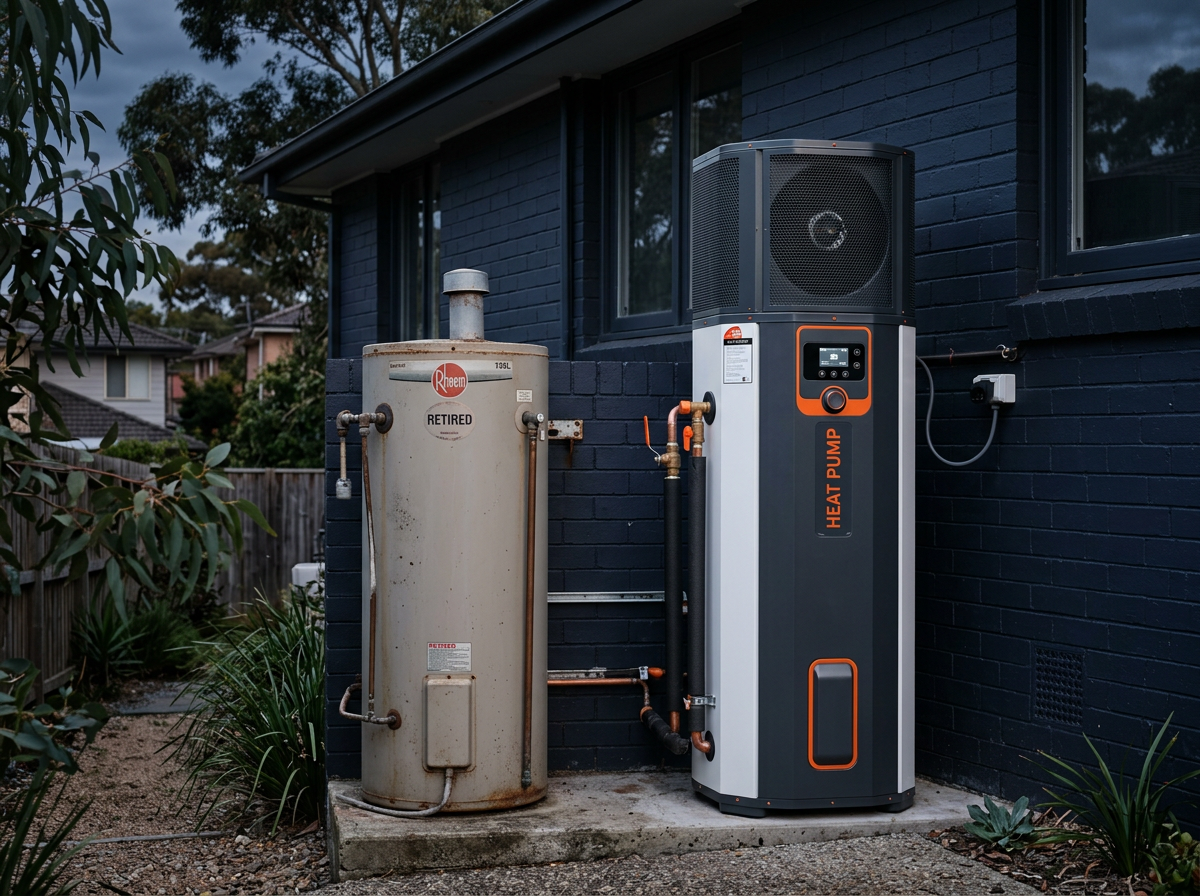
The smart long-term choice. A heat pump hot water system works like a refrigerator in reverse, extracting heat from the air and transferring it to your water tank. It uses roughly one-third the electricity of a standard electric storage unit. Modern units from Rheem, Rinnai, and Stiebel Eltron operate reliably in Sydney winters and come with warranties of 5 to 6 years on the cylinder and 2 to 3 years on the compressor.
Heat pumps do make some noise. The outdoor fan unit produces roughly 45 to 55 decibels, similar to a quiet conversation. Sydney councils have noise restrictions for outdoor units, but most reputable installers position the unit to comply without drama. A heat pump also needs clearance around it for airflow, so very tight courtyards in terrace houses may need a compact split-system unit instead of a monoblock.
Option 3: Solar Hot Water or Solar-Ready Electric
For homes with good north-facing roof space, a solar hot water system with evacuated tubes or flat plate collectors delivers the lowest ongoing energy cost of any system type. The downside is higher upfront cost, typically $4,500 to $7,000 installed. A solar-ready electric tank with a PV diverter is a middle path: lower upfront cost than full solar thermal, but still captures free rooftop energy on sunny days.
Many Sydney homeowners are now pairing a heat pump with rooftop solar. The heat pump draws power during the day from solar generation, effectively giving you free hot water from March to October. In winter, it runs on grid power at off-peak rates. This hybrid approach delivers the best of both technologies.
How Much Does Switching Cost in 2026?
The cost to switch from gas to electric hot water depends on what you are switching to, whether your electrical board needs upgrading, and whether you need new pipework. Here are the realistic installed prices our Sydney technicians are quoting in May 2026.
- Electric storage tank replacement: $1,100 to $2,200. Lowest upfront cost. Uses existing plumbing. May require a new dedicated electrical circuit if the old gas unit had no power nearby.
- Heat pump hot water system: $2,800 to $4,500 installed. Includes unit, plumbing, electrical connection, and compliance certificates. Premium brands like Stiebel Eltron WWK sit at the upper end. Standard Rheem and Rinnai models sit in the middle.
- Solar hot water system: $4,500 to $7,000 installed. Includes evacuated tubes or flat plate collectors, tank, pump station, and frost protection for cooler Sydney mornings.
- Electrical board upgrade: $400 to $1,200 if needed. Older homes with fuse boxes instead of safety switches often need a partial or full switchboard upgrade to safely handle a heat pump or electric tank.
- Gas capping and disconnection: $150 to $350. A licensed gas fitter must safely cap the old gas line and issue a compliance certificate. This is not optional.
The total switch cost from a failed gas unit to a new heat pump typically lands between $3,200 and $5,000 after rebates. That is comparable to replacing the old gas unit with a new one, which costs $1,800 to $3,200. The difference is the heat pump pays back the extra cost through lower bills in 3 to 4 years, then saves you money every year after that.
For a more detailed breakdown of installed prices by system type, see our 2026 hot water system cost guide.
NSW Rebates and Incentives That Cut Your Costs
NSW households switching from gas to efficient electric hot water have access to multiple rebate and incentive programs in 2026. The key is knowing which ones you qualify for and how to stack them.
NSW Energy Savings Scheme (ESS)
The ESS provides rebates for replacing old gas or electric hot water systems with energy-efficient alternatives. In 2026, households replacing a gas storage system with a heat pump can receive rebates of $300 to $640 depending on the system size and efficiency rating. The rebate is applied at the point of sale by accredited installers, so you do not need to apply separately.
Small-scale Technology Certificates (STCs)
Federal STCs apply to heat pumps and solar hot water systems. The number of certificates depends on the system size, efficiency, and your zone. Sydney is in Zone 3, which generates a healthy certificate yield. In 2026, STCs are worth roughly $35 to $40 each, and a typical heat pump installation generates 20 to 35 certificates. That is $700 to $1,400 off the installed price, claimed automatically by your installer.
Local Council Incentives
Some Sydney councils offer additional sustainability rebates for households switching from gas to electric appliances. The City of Sydney and Inner West Council have both run electrification incentive programs in 2025 and 2026. Check your local council website before you book an installation. The rebate may require pre-approval, so do not leave it until after the work is done.
For a complete guide to every available rebate, eligibility rules, and application steps, read our NSW hot water rebates 2026 guide.
When Should You Replace Your Gas Hot Water System?
There are three clear signals that it is time to replace a gas hot water system. The first is age. If your unit is over ten years old, internal corrosion and valve fatigue mean a failure is likely within the next two winters. The second is rising bills. If your gas hot water costs have jumped 20% or more in the past year despite similar usage, the burner efficiency has degraded and the unit is burning more gas to produce the same heat.
The third signal is physical. Rust around the base of the tank, water pooling under the unit, a pilot light that will not stay lit, or a burner that roars instead of humming are all signs of imminent failure. Do not wait for a complete breakdown in the middle of a cold Sydney morning.
If your gas unit is still under warranty and working well, there is no urgent need to switch. The financial penalty of staying on gas is real but gradual. A family of four pays roughly $300 to $400 more per year on gas hot water compared to a heat pump. Over five years, that is $1,500 to $2,000. If your unit is only three years old, running it until failure is a reasonable financial decision. If it is eleven years old, replacing it before winter with a heat pump locks in long-term savings and avoids a mid-winter emergency.
We always tell Sydney customers the same thing. If your gas unit is under eight years old and running well, budget for a heat pump in your next financial year. If it is over eight years old, start getting quotes now. Emergency replacements in July cost more because you are paying rush rates and have no time to compare installers or claim rebates properly.
Frequently Asked Questions
Is gas hot water completely banned in NSW in 2026?
No. Gas hot water is not banned for existing homes anywhere in NSW. Some Sydney councils, including the City of Sydney, have banned gas appliances in new residential buildings from 1 January 2026 for indoor appliances and 1 January 2027 for outdoor appliances including water heaters. Existing homes with gas hot water systems are not affected by these planning controls.
Will I be forced to replace my gas hot water system?
No. There is no current NSW legislation that forces homeowners to remove working gas hot water systems from existing properties. The bans apply only to new buildings in certain council areas. However, rising gas prices, falling solar costs, and generous rebates mean many Sydney homeowners are choosing to switch voluntarily for long-term savings.
What is the cheapest replacement for a gas hot water system?
An electric storage tank is usually the cheapest upfront replacement for a failed gas unit, with installed prices starting around $1,100. A heat pump hot water system costs more initially, from $2,800 to $4,500 installed, but delivers the lowest running costs over ten years. With NSW rebates of up to $640 plus federal STCs, a heat pump often works out cheaper than staying on gas within three to four years.
Can a plumber switch my gas hot water to electric?
Switching from gas to electric hot water requires both a licensed plumber and a licensed electrician. The plumber handles the water connections, pipework, and compliance with AS3500 plumbing standards. The electrician handles the dedicated circuit, safety switch, and compliance certificate. A single contractor with dual licensing can do both, but most jobs need two trades. Always use a licensed professional who can issue the required compliance certificates.
How long does a gas hot water system last in Sydney?
Gas storage hot water systems typically last 8 to 12 years in Sydney, while gas instantaneous units can last 10 to 15 years with regular maintenance. Coastal areas like Bondi and Cronulla see slightly shorter lifespans due to salt air corrosion. If your unit is over ten years old, budgeting for replacement is sensible regardless of policy changes.
Are heat pumps reliable enough to replace gas in winter?
Yes. Modern heat pumps work reliably in Sydney winters, where overnight temperatures rarely drop below 5 degrees Celsius. Units with an ambient operating range down to minus 7 degrees Celsius are standard in the Sydney market. A quality heat pump will produce the same 60 degree Celsius tank temperature as a gas system, even during a cold July morning in the Blue Mountains or the Upper North Shore.
Make the Switch on Your Terms
NSW is not banning gas hot water in existing homes. No council can force you to remove a working system. But the financial reality is shifting beneath your feet. Gas supply charges are rising, electricity from rooftop solar is effectively free, and heat pump technology has reached a price and reliability point where staying on gas is the expensive option.
The smartest move for Sydney homeowners in 2026 is to plan the switch before an emergency forces your hand. Get quotes while your current unit is still running. Compare rebates. Speak to a licensed installer about whether your switchboard needs an upgrade. When the old gas unit finally fails, you will have a heat pump ready to install the same day, and you will never look back at a gas bill again.
For more detail on the switching process, read our complete guide to switching from gas to heat pump hot water in NSW.
Ready to Replace Your Gas Hot Water System?
Our licensed Sydney plumbers install heat pumps, electric tanks, and solar hot water systems across Sydney, the Central Coast, and Newcastle. Free quotes, upfront pricing, same-day service available.
Related Articles
Step-by-step guide to switching from gas to heat pump hot water.
Complete guide to ESS, STCs, and council incentives.
Installed prices for every system type in Sydney.
Gas vs electric vs heat pump running costs.