
Heat Pump Hot Water Cost vs Gas vs Electric: 2026 Running Costs Compared
Electric vs Gas vs Heat Pump vs Solar — Real annual costs, savings strategies, and 10-year total ownership calculations for NSW households.

Your hot water system might be silently draining hundreds—or even thousands—of dollars from your household budget every year. For most Australian families, hot water accounts for 15-30% of total energy bills, making it the second-largest energy expense after heating and cooling.
Yet when selecting a hot water system, many homeowners focus solely on upfront installation costs, overlooking the far more significant long-term running costs. A cheaper electric storage system might seem like a bargain at $1,500 installed, but it could cost you $1,200+ annually to operate—while a $4,500 heat pump system might run for just $300-400 per year.
Understanding hot water system running costs isn't just about saving money. As Australia transitions toward cleaner energy and electricity prices continue their upward trajectory, choosing the right system has never been more critical. With NSW government rebates offering up to $2,500 off energy-efficient systems in 2026, the economics of hot water have fundamentally shifted.
This comprehensive 2026 guide breaks down the real running costs of every hot water system type available in Australia. We'll show you exactly what each system costs to operate, reveal hidden expenses most homeowners miss, and demonstrate how to cut your hot water bills by up to 70% with the right choices.
2026 Annual Running Costs at a Glance
Quick Answer: Annual Running Costs
- ● Traditional Electric Storage: $1,200 - $1,500/year (HIGHEST)
- ● Electric Instantaneous: $800 - $1,100/year
- ● Gas Instantaneous: $450 - $650/year
- ● Gas Storage Systems: $400 - $600/year
- ● Heat Pump Systems: $300 - $400/year (MOST EFFICIENT)
- ● Solar Hot Water: $50 - $200/year (LOWEST — with good solar access)
Potential savings from switching: $700-1,400/year · Average 4-person household: 150-200L/day
Understanding What Drives Hot Water Running Costs
Energy Source and Pricing
The primary driver of running costs is your energy source—electricity, natural gas, LPG, or solar. In NSW, electricity costs approximately $0.25-0.65 per kWh depending on your tariff (peak, off-peak, or controlled load), while natural gas costs around $0.03-0.05 per megajoule. These pricing differences fundamentally determine system economics. According to Sustainability Victoria's water heating cost calculator, running costs vary significantly by system type.
Household Size and Usage Patterns
A single person uses roughly 50L of hot water daily, while a family of four consumes 150-200L. Peak usage times also matter—if your family showers during peak electricity pricing (2-8pm), your costs multiply significantly. Discover the right hot water tank size for your household to optimise efficiency.
Water Temperature Settings
Most systems default to 65-75°C, but the optimal temperature is 60°C. Every 5°C above 60°C adds approximately 5-8% to your running costs while increasing system wear.
Seasonal Variations
Hot water costs vary by season. Winter running costs can be 30-50% higher than summer as incoming water temperature drops from 20-25°C to 10-15°C, requiring more energy to reach the target temperature. Seasonal temperature variations from Bureau of Meteorology data show why preparing your system for winter is essential.
System Efficiency and Age
A brand-new electric storage system might operate at 85-90% efficiency, while a 10-year-old system may have dropped to 60-70% efficiency due to sediment buildup and deteriorating insulation. This efficiency loss increases running costs by 20-30% or more.
Standby Heat Loss
Storage systems (electric and gas) continuously lose heat through tank walls, even when not in use. Quality insulation minimises this, but standby losses still account for 10-20% of total energy consumption.
Tariff Structure
NSW households can access different electricity tariffs. Standard peak rates ($0.40-0.65/kWh), off-peak hot water rates ($0.15-0.25/kWh), and time-of-use pricing dramatically affect your bills. Heat pumps on off-peak controlled load rates are exceptionally economical.
Electric Storage Hot Water Running Costs: The Most Expensive Option
Annual Running Costs: $1,200 - $1,500
For a typical 4-person household. Electric storage systems remain Australia's most common hot water solution, but they're also the most expensive to run.
How It Works
A large insulated tank (typically 125-315L) stores heated water maintained at 60-70°C by electric heating elements. The system cycles on periodically to maintain temperature, consuming energy 24/7 regardless of actual hot water usage.
Detailed Cost Analysis for 4-Person Household
| Cost Factor | Value |
|---|---|
| Average daily hot water consumption | 180L |
| Energy required (15°C → 60°C) | ~9-11 kWh/day |
| Annual energy consumption | 3,300-4,000 kWh |
| Peak electricity rate ($0.40/kWh) | $1,320-1,600/year |
| Off-peak controlled load ($0.20/kWh) | $660-800/year |
| Standby heat loss | 10-15% of total |
Cost-Saving Strategies for Electric Storage
- Switch to off-peak controlled load tariff: Saves $500-800/year vs peak rates
- Reduce temperature to 60°C: Saves 5-10% annually ($60-150)
- Add tank insulation blanket: Reduces standby losses 25-35% ($120-180/year)
- Install timer for heating cycles: Ensures heating only during off-peak ($100-200/year)
- Regular maintenance and flushing: Maintains efficiency, saves 10-15% ($120-200/year)
The Long-Term Reality
Even with optimisation, electric storage systems remain the most expensive option. Over a 10-year lifespan, you'll spend $12,000-15,000 on running costs alone—far exceeding the system's purchase price. For most households, switching to heat pump or gas technology delivers superior economics.
Gas Storage Hot Water Running Costs: The Middle Ground
Annual Running Costs: $400 - $600
For a typical 4-person household (natural gas). LPG Systems: $800 - $1,200/year (LPG costs 2-3x more than natural gas).
How It Works
Similar to electric storage, but a gas burner beneath the tank heats water. Gas systems heat faster and more efficiently than electric elements, resulting in significantly lower energy costs. Explore our comprehensive gas vs electric hot water system comparison guide.
Detailed Cost Analysis
| Cost Factor | Value |
|---|---|
| Average daily gas consumption | 120-150 MJ |
| Annual gas consumption | 44-55 GJ |
| Natural gas rate ($0.03/MJ) | $440-550/year |
| Gas supply charges | $60-100/year |
| Total annual cost | $400-600/year |
| Burner efficiency | 75-85% (modern systems) |
Advantages Over Electric
- • 60-70% lower running costs
- • Faster recovery time
- • Less affected by electricity price increases
- • No reliance on off-peak schedules
Hidden Costs to Consider
- • Gas connection: $1,500-3,000 (if needed)
- • Annual gas safety inspections: $120-200
- • Higher servicing costs: $180-250
- • Pilot light consumption: $50-80/year
The Verdict: Gas storage systems deliver excellent value for households with natural gas connections. Over 10 years, you'll spend $4,000-6,000 on running costs—significantly less than electric, though heat pumps still edge ahead in efficiency.
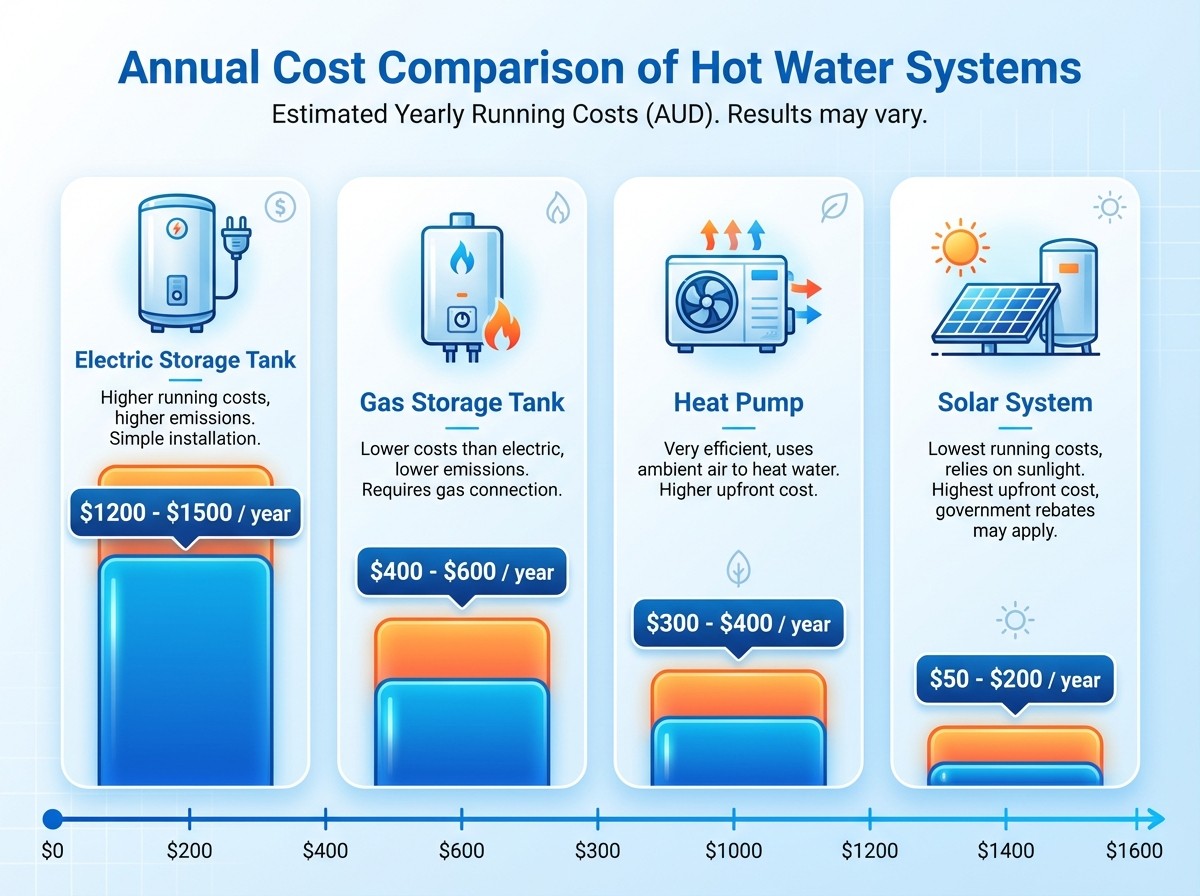
Annual running cost comparison for a typical 4-person Australian household. Results may vary based on usage, tariffs, and system efficiency.
Heat Pump Hot Water Running Costs: The Efficiency Champion
Annual Running Costs: $300 - $400
For a typical 4-person household. Heat pump systems represent the sweet spot of efficiency and cost savings, earning them the title of most cost-effective hot water technology for most Australian households.
How It Works
Heat pumps extract heat from the surrounding air (like a reverse air conditioner) and transfer it to water. This process is 3-4 times more efficient than directly heating water with electricity. Learn more about energy-efficient heat pump hot water systems for your Sydney home.
Detailed Cost Analysis
| Cost Factor | Value |
|---|---|
| Energy required | 2.5-3.5 kWh/day (vs 9-11 kWh electric) |
| Annual electricity consumption | 900-1,300 kWh |
| Controlled load rate ($0.22/kWh) | $198-286/year |
| Peak rate ($0.40/kWh) | $360-520/year |
| Average total cost | $300-400/year |
| Energy efficiency (COP) | 300-400% |
Cost Comparison vs Other Systems
- 70-75% cheaper than electric storage ($900-1,100/year savings)
- 30-40% cheaper than gas storage ($100-200/year savings)
- Comparable to solar in optimal conditions
- 10-year savings: $9,000-11,000 vs electric storage
2026 NSW Rebates Make Heat Pumps Even More Attractive
With NSW government rebates of up to $2,500, heat pump systems now cost $2,000-3,000 after rebates—meaning they pay for themselves within 3-4 years through energy savings alone. NSW Climate and Energy Action reports typical heat pump savings of $600-800/year.
Factors Affecting Heat Pump Costs
- Climate: Performance drops 20-30% below 5°C, but Australia's mild climate makes this rarely an issue
- Electricity tariff: Controlled load tariffs offer best value ($200-300/year vs $360-520 on peak)
- Household usage: Best for medium to high usage; light users may find gas instantaneous competitive
The Verdict: For most Australian households, heat pumps deliver the best balance of running costs, environmental performance, and reliability. The combination of 70% running cost savings, generous rebates, and 10-15 year lifespan makes them the standout choice in 2026.
Solar Hot Water Running Costs: The Long-Term Winner
Annual Running Costs: $50 - $200
For a typical 4-person household (electric or gas booster energy only). Solar hot water systems have the lowest running costs of any technology—when conditions are right.
How It Works
Solar collectors (flat plate or evacuated tubes) on your roof absorb sunlight and transfer heat to water, stored in an insulated tank. On cloudy days or during high-demand periods, an electric or gas booster supplements heating.
Detailed Cost Analysis
| Cost Factor | Value |
|---|---|
| Solar contribution (Sydney) | 60-80% of annual needs |
| Electric booster cost ($0.22/kWh) | $154-308/year |
| Gas booster cost | $90-150/year |
| Best case (sunny, good system) | $50-120/year |
| Worst case (partial shade, old system) | $200-400/year |
Ideal Candidates
- • North-facing roof, zero shading
- • High consumption (4+ people)
- • Owner-occupier, long-term residence
- • Sunny climate (Sydney, Brisbane, Perth)
When Solar Doesn't Make Sense
- • Shaded or non-north facing roof
- • Small household (1-2 people)
- • Short-term residence or rental
- • Complex roof structure
The Verdict: Solar hot water delivers unbeatable running costs ($50-200/year), but only if your property suits it perfectly. For most households, heat pumps now offer similar or better economics without the need for perfect solar access, making them the more practical choice in 2026.
Gas Instantaneous (Tankless) Running Costs
Annual Running Costs: $450 - $650
For a typical 4-person household (natural gas). Gas instantaneous systems heat water on demand, eliminating standby energy losses.
How It Works
When you turn on a hot tap, water flows through a heat exchanger where a gas burner instantly heats it to the desired temperature. No storage tank means zero standby losses. Choosing a gas instantaneous system? Learn which flow rate suits your needs.
When It Makes Sense
- • Large households (3+ bathrooms)
- • Commercial applications
- • Space-constrained installations
- • High hot water usage
When It Doesn't
- • Small households (1-2 people)
- • Low hot water usage
- • No natural gas (LPG: $900-1,400/yr)
Electric Instantaneous Running Costs: Rarely Worth It
Annual Running Costs: $800 - $1,100
For a 4-person household. Electric instantaneous systems eliminate standby losses but require massive power draws (18-27 kW), resulting in high running costs and limited practical applications.
The Verdict: For whole-house hot water, electric instantaneous systems offer no advantages over heat pumps while costing 2-3x more to run. They're a niche solution limited to point-of-use applications, commercial three-phase installations, or emergency backup systems.
How to Cut Your Hot Water Running Costs by Up to 50%
Regardless of which system you have, these strategies can significantly reduce your hot water running costs. Professional maintenance preserves efficiency and reduces running costs—book your service today.
1. Optimise Your Temperature Setting (Save $80-200/year)
Set your system to exactly 60°C—hot enough to prevent Legionella bacteria but no hotter. Every 5°C above 60°C adds 5-8% to your running costs.
2. Switch to Off-Peak or Controlled Load Tariff (Save $300-700/year)
If you have an electric system, switching from peak to controlled load tariff can cut your costs by 50-60%. This single change can save $300-700 annually.
3. Fix Leaks Immediately (Save $100-300/year)
A dripping hot tap wastes 3-5L/hour, costing $100-300 annually. A leaking tempering valve can waste even more.
4. Insulate Your Pipes (Save $50-120/year)
Pre-slit foam insulation costs $50-100 and pays for itself within 12 months by reducing heat loss during distribution.
5. Install Water-Efficient Fixtures (Save $150-300/year)
Low-flow showerheads (WELS 3-star) and tap aerators reduce consumption by 30-40% without sacrificing performance. Initial cost: $80-150.
6. Reduce Shower Duration (Save $200-400/year)
Reducing showers from 8 to 5 minutes saves ~30L per shower. For a 4-person household, that's 43,800L/year—worth $200-400.
7. Cold Water Laundry (Save $100-180/year)
Modern detergents work effectively in cold water. Switching eliminates 15-20% of household hot water consumption.
8. Annual System Maintenance (Save $120-250/year)
Professional maintenance—flushing sediment, checking anodes, cleaning burners—prevents efficiency degradation that costs far more than the $150-250 service fee.
9. Timer Control for Storage Systems (Save $100-200/year)
A timer prevents heating during peak periods and unnecessary overnight heating. Particularly effective for electric storage.
10. Consider System Replacement (Save $700-1,100/year)
If you have an old electric storage system, replacing it with a heat pump (after $2,500 rebate) pays for itself within 3-4 years. Get professional heat pump installation with rebate assistance.
Total Cost of Ownership: The 10-Year Reality Check
Understanding total cost of ownership—not just running costs—reveals the true economics of each system type. Manufacturers like Rheem provide running cost calculators to help compare system economics. Understanding your hot water system warranty coverage is also essential for long-term planning.
| Cost Component | Electric Storage | Gas Storage | Heat Pump | Solar (Electric Boost) |
|---|---|---|---|---|
| Purchase & Installation | $1,800 | $2,200 | $4,500 | $6,000 |
| Less Rebates | — | — | -$2,500 | -$1,500 |
| 10-Year Running Costs | $12,000 | $5,000 | $3,500 | $1,200 |
| Maintenance (10yr) | $1,500 | $2,000 | $2,200 + $1,500* | $2,500 + $300† |
| 10-YEAR TOTAL | $15,550 | $9,200 | $9,200 | $8,500 |
*Compressor replacement ~year 8. †Glycol replacement every 3-5 years. Energy Rating labels help consumers compare system efficiency.
The Bottom Line
Solar hot water edges ahead in total cost if you have perfect conditions, but heat pumps offer nearly identical economics ($9,200) without requiring ideal roof access. Both absolutely crush electric storage ($15,550), which costs nearly double over 10 years. For most households in 2026, heat pumps deliver the best overall value. The Clean Energy Regulator administers the Small-scale Technology Certificates program that reduces system costs.
Frequently Asked Questions About Hot Water Running Costs
Q: What is the cheapest hot water system to run in Australia?
Heat pump systems are the cheapest to run for most households at $300-400/year, followed closely by solar hot water ($50-200/year if conditions are ideal). Traditional electric storage is the most expensive at $1,200-1,500/year.
Q: How much does hot water cost per month on average?
For a typical 4-person household: Electric storage $100-125/month, Gas storage $35-50/month, Heat pump $25-35/month, Solar $5-20/month. Your actual costs vary based on usage, tariffs, and system efficiency.
Q: Is it cheaper to run gas or electric hot water?
Gas hot water is significantly cheaper to run—$400-600/year vs $1,200-1,500/year for electric storage. However, heat pump hot water (electric-powered) is even cheaper at $300-400/year, making it the most cost-effective electric option. Read our full gas vs electric comparison.
Q: How much can I save by switching from electric to heat pump?
A typical 4-person household saves $900-1,100 per year. Over 10 years, that's $9,000-11,000 in savings. With NSW rebates reducing upfront costs by $2,500, payback period is just 2-3 years.
Q: Do off-peak hot water tariffs really save money?
Yes, substantially. Off-peak controlled load electricity costs $0.15-0.25/kWh vs peak rates of $0.40-0.65/kWh—a 50-70% saving. For electric systems, this can reduce annual costs from $1,500 to $700-900. Contact your retailer to switch tariffs.
Q: What factors affect hot water running costs the most?
The three biggest factors are: system type and energy source, household size and usage patterns, and electricity or gas tariff structure. Compare the best hot water systems available in Australia.
Take Control of Your Hot Water Costs Today
Understanding hot water system running costs empowers you to make financially smart decisions that save thousands of dollars. The gap between the most expensive (electric storage at $1,200-1,500/year) and most efficient systems (heat pumps at $300-400/year) represents $900-1,100 in annual savings—money that stays in your pocket.
As we approach winter 2026, hot water costs will surge as systems work harder to heat colder incoming water. If you're currently running an old electric storage system, now is the ideal time to assess your options. With NSW government rebates offering up to $2,500 off heat pump installations, the economics have never been more compelling.
📞 Ready to Cut Your Hot Water Costs? Get Expert Advice
- Free energy cost assessment and system recommendation
- Up to $2,500 NSW rebate application assistance
- Professional heat pump, gas, and solar installation
- System optimisation and efficiency upgrades
- Annual maintenance to preserve efficiency
- 24/7 emergency service throughout Sydney