

Heat Pump Hot Water Noise Sydney: NSW Rules & Fixes 2026
It is 5:42am on a cold June morning in Earlwood. The heat pump on the side of the brick veneer next door clicks over, the fan spins up, and a low compressor hum starts vibrating through the bedroom wall of the unit across the fence. By the time the homeowner notices the polite note in the letterbox a week later, the neighbour has already filed a complaint with Inner West Council. This is the most common heat pump conversation we have in Sydney winters in 2026, and it has nothing to do with the unit being faulty.
Heat pumps cycle hardest when the outside air is coldest. The 2025 NSW gas hot water phase-out has put thousands of new units onto Sydney side passages, courtyards and townhouse decks where the old gas storage tanks used to sit silently. The acoustics of those locations were never tested for a fan and a compressor running at dawn. This guide is the technical and legal reality of heat pump noise in Sydney: what the NSW EPA actually requires, what councils enforce, how loud the popular units really are, and the fixes that work before a complaint becomes a Noise Abatement Direction.
Why Heat Pump Noise Became a Sydney Issue in 2026
Two things changed in the last 18 months. From 1 January 2025, no new residential gas hot water systems can be installed in NSW new builds, and from 1 January 2027 the ban extends to replacements in existing dwellings. The Energy Savings Scheme rebates lean heavily toward heat pumps, so the like-for-like swap most Sydney homes are making is gas storage out, heat pump in.
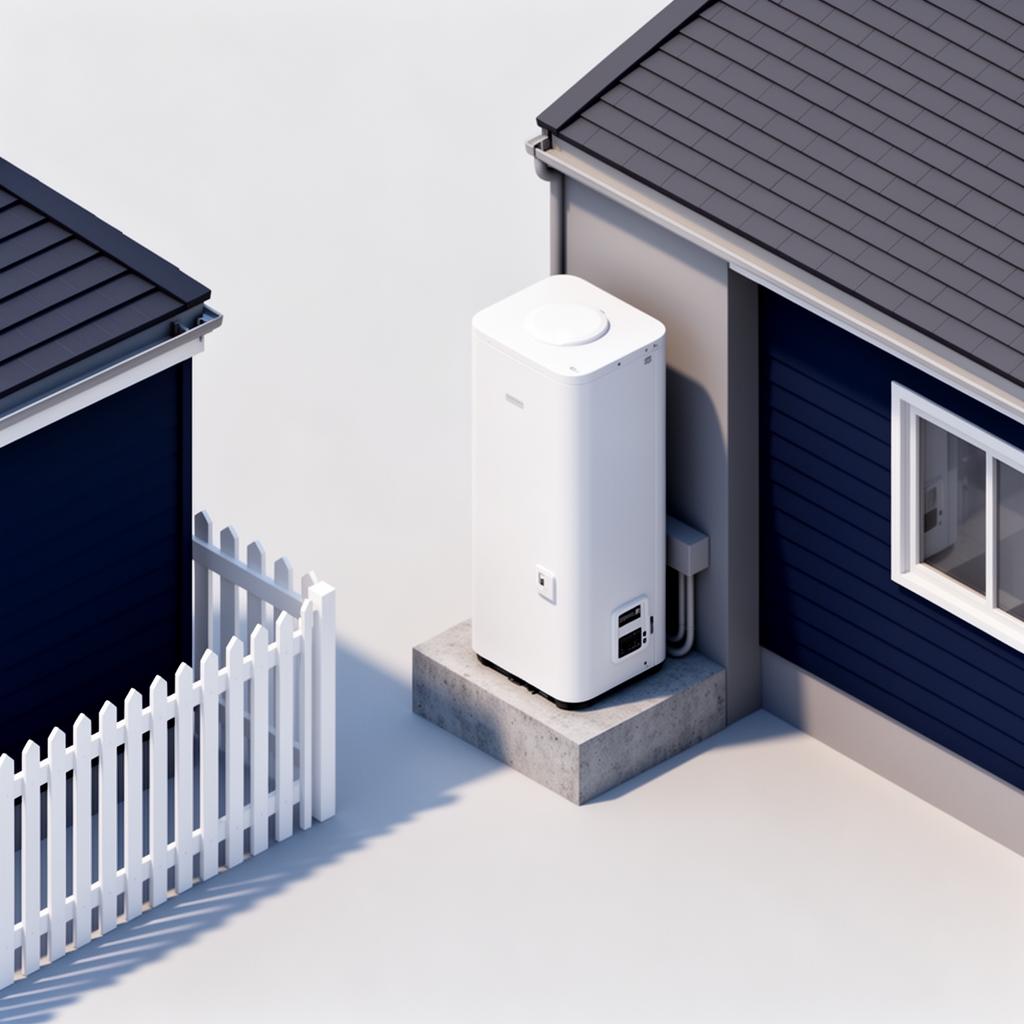
The problem is the install location. Old gas storage units lived in side passages 450mm off the boundary fence because they were silent. A heat pump put in exactly the same spot is suddenly 1.2 metres from a neighbour's bedroom window with a fan and a refrigerant compressor running through the night. Inner West, Ku-ring-gai, Lane Cove and Northern Beaches councils have all reported a sharp rise in noise complaints in the 2025 to 2026 financial year. Our own callout data for unit relocations from poor original installs is up more than fourfold.
Winter is when this peaks. A heat pump pulls heat out of ambient air. When the air is 6°C at 5am in Penrith, the compressor works harder and longer to lift the tank to the 60°C scheduled by the off-peak controller. That is exactly when the rest of the street is asleep.
How Loud Heat Pump Hot Water Systems Actually Are
Manufacturer noise ratings are measured in a sound-treated lab at 1 metre. Real-world Sydney installs sound louder because hard surfaces (brick walls, colorbond fences, concrete paths) reflect the sound rather than absorb it. Use the table below as the planning starting point, then add 3 to 6 dB(A) for a hard-walled side passage.
| Unit | Type | Manufacturer dB(A) at 1m |
|---|---|---|
| Reclaim CO2 | Split CO2 | 37 |
| Sanden Eco Plus | Split CO2 | 38 |
| iStore 270L | Integrated R134a | 48 |
| Rheem MPi-325 | Integrated R134a | 49 |
| Rinnai Enviroflo 250 | Integrated | 50 |
| Aquatech / Emerald budget integrated | Integrated | 52 – 55 |
For reference, a quiet suburban bedroom at night sits around 25 to 30 dB(A). A normal conversation at 1 metre is about 60 dB(A). The 12 dB(A) gap between a Reclaim and a budget integrated unit sounds small on paper, but psychoacoustically it is roughly double the perceived loudness. That gap is the single biggest predictor of whether a Sydney install draws a complaint.
The NSW Rules That Actually Apply
Three separate legal layers sit on top of any Sydney heat pump install. Most homeowners only learn about them after a complaint lands. They are not optional.
1. The NSW Noise Control Regulation
The Protection of the Environment Operations (Noise Control) Regulation 2017 sets prohibited hours for fixed mechanical plant on residential premises. A heat pump compressor and fan are fixed mechanical plant. The unit cannot be audibly heard inside a neighbour's habitable room (bedroom, lounge) during these hours:
- Monday to Friday: 10pm to 7am
- Saturday, Sunday and public holidays: 10pm to 8am
"Audibly heard" is the legal trigger, not a decibel reading. If the neighbour can hear the hum lying in bed with the window closed, the regulation has been breached. The EPA publishes the full text and complaint pathway on the NSW EPA residential noise page.
2. Australian Standard AS/NZS 2107 Daytime Limits
Outside prohibited hours, councils apply a "background plus 5 dB(A)" rule. They measure the existing background noise at the receiving property (typically 35 to 40 dB(A) in a suburban Sydney street) and require the heat pump to add no more than 5 dB(A) over that background, measured at the boundary. In practice this caps installs at around 45 dB(A) at the boundary line during the day.
3. Local Council Setbacks and Consent
Every Sydney council has different setback rules in its Local Environmental Plan. The common pattern is:
- Minimum 450mm from a side or rear boundary
- 1 metre recommended from any habitable window on a neighbour's property
- No installation under a bedroom window or against a shared townhouse wall without an acoustic report
- Heritage Conservation Areas (parts of Glebe, Balmain, Paddington, Hunters Hill) require approval before any external plant install
A standard like-for-like replacement is usually exempt development, but only if the new unit meets the noise rules. If it does not, you need a Complying Development Certificate or full DA before install. We cover the broader replacement process in our switch gas to heat pump guide.
How Distance Actually Reduces Noise
This is the most useful piece of physics in the whole noise conversation. Sound pressure level drops by approximately 6 dB(A) for every doubling of distance from a point source in free field. In a typical Sydney side passage, the real-world drop is closer to 4 to 5 dB(A) because of wall reflections, but the principle holds.
What that means for a 50 dB(A) integrated unit:
- 1 metre from the unit: 50 dB(A)
- 2 metres from the unit: ~45 dB(A)
- 4 metres from the unit: ~40 dB(A)
- 8 metres from the unit: ~35 dB(A), at or below typical suburban background
Moving a unit from 1m to 4m off the neighbour's bedroom wall is the difference between a breach and full compliance. On most Sydney lots the unit cannot move 4 metres because the side passage is only 1.2 metres wide. That is when acoustic screening or unit selection becomes the answer.
Five Fixes That Actually Work
Before you spend money on relocation, run the cheapest fixes first. They resolve roughly 70% of the complaints we see.
1. Move the Heating Cycle to Daytime
Every modern heat pump has a timer. Set it to run between 10am and 4pm. The compressor is also more efficient in warmer ambient air, so you typically save on running cost while eliminating the dawn complaint entirely. If your unit is on a controlled-load tariff (Endeavour Energy's CL1 or Ausgrid's Tariff 41), ask your electrician to switch it to a continuous tariff so the timer can override the off-peak window. We cover the tariff trade-offs in our off-peak vs heat pump guide.
2. Isolate the Vibration
A surprising amount of perceived noise is structure-borne vibration, not airborne sound. If the unit is bolted directly to a brick wall or sitting on a wooden deck, the low-frequency hum travels through the building structure into adjoining rooms. Replace any rigid mounts with rubber anti-vibration feet (about $40 a set), and ensure the unit sits on a 75mm concrete pad isolated from the wall. This alone often drops perceived noise by 3 to 5 dB(A).
3. Fit an Acoustic Louvre or Absorptive Screen
A purpose-built acoustic enclosure with absorptive lining (mineral wool behind perforated metal) typically gives 6 to 10 dB(A) of attenuation on the screened side. The trap to avoid is solid screening, wrapping a heat pump in a solid timber box restricts airflow, drops the COP, and can void the warranty. Acoustic louvres allow airflow while breaking the line-of-sight sound path. Budget $600 to $1,400 fitted for a residential acoustic screen.
4. Relocate to a Better Position
For split CO2 units (Reclaim, Sanden), the compressor module can be moved independently of the storage tank. We regularly relocate Sanden compressors from a 600mm side setback to a rear corner 3 to 4 metres from any neighbour's window. Refrigerant lines can run up to 15 metres on most CO2 systems, so the install options are wider than people assume. Relocation cost in Sydney runs $480 to $950 depending on pipe run and pad work.
5. Swap to a Quieter Unit
If you are still in the install or warranty window and the noise is genuinely the unit, the cheapest long-term fix is a swap to a CO2 split system. A Reclaim at 37 dB(A) or Sanden Eco Plus at 38 dB(A) is roughly half the perceived loudness of a 50 dB(A) integrated unit. The price difference is real (around $1,200 to $1,800 more installed), but the rebate stack under the NSW Energy Savings Scheme and the federal STC scheme typically claws back $1,000 to $2,000 of that gap. See our best hot water brands comparison for the full specs side-by-side.
What Happens When a Neighbour Complains
The complaint pathway in NSW is well-defined. Knowing the sequence helps you act before the cost escalates.
- Informal notice. The neighbour usually puts a note in the letterbox or knocks on the door. Take this seriously. A polite conversation and a timer change at this stage resolves most cases.
- Council noise complaint. If the issue continues, the neighbour can lodge a complaint with the local council noise officer. Council will inspect, often at the prohibited-hours window, and take a decibel reading at the affected property boundary.
- Noise Abatement Direction. If the unit breaches the regulation, council can issue a written direction requiring the noise to stop or be reduced within a specified time. Ignoring it triggers fines under the regulation, currently $200 on-the-spot, up to $3,300 for a continuing offence by an individual.
- Noise Abatement Order from a Local Court. If council direction is ignored, the neighbour or council can apply to the Local Court for a binding order. At this point, costs escalate quickly and the homeowner is usually required to relocate or replace the unit.
Two notes Sydney homeowners often miss. First, you do not need to wait for council, if the install plumber breached consent conditions or did not meet AS/NZS 5149 acoustic requirements, the warranty path against the installer is real. Second, strata-titled properties have additional by-laws; the Owners Corporation can require removal even if council finds no breach.
Choosing the Right Install Location Before You Buy
The cheapest noise fix is the one done before the unit goes in. When we quote a heat pump replacement in Sydney, the conversation starts with three site facts: where the bedrooms are next door, what the side passage width is, and where the existing electrical and water connections sit.
Best install positions, in order of preference:
- Rear corner of the lot, 3+ metres from any neighbour's habitable window, on an isolated concrete pad
- Side passage on the non-bedroom side of the neighbouring house (check via a quick walk before install)
- Garage external wall, vented to the outside, with acoustic mount
- Rooftop on a flat-roof terrace home (requires structural sign-off but acoustically excellent)
Positions to avoid:
- Directly opposite or under a neighbour's bedroom window
- In a corner where two brick walls form an "L", the corner amplifies low-frequency noise back at the neighbour
- Against a shared townhouse or duplex party wall without an acoustic isolation mat
- On a timber deck or suspended timber floor frame
If you are planning the swap as part of the gas-to-electric transition, our NSW gas ban guide walks through the full timeline and rebate stack.
Costs to Fix a Noisy Heat Pump in Sydney
| Fix | Typical Sydney price (fitted) |
|---|---|
| Anti-vibration feet and pad isolation | $140 – $260 |
| Timer reconfiguration and tariff switch | $180 – $320 |
| Acoustic louvre / screen install | $640 – $1,400 |
| Relocation (split CO2 compressor) | $480 – $950 |
| Relocation (integrated unit, new pad and lines) | $1,200 – $2,400 |
| Replacement with quiet CO2 unit (net of rebates) | $1,800 – $3,600 |
For most installs we attend, the answer is a combination of timer change, anti-vibration mounts and a single-side acoustic louvre, under $1,500 all-in and resolved in a half-day visit.
The Winter 2026 Bottom Line
Heat pumps are the right answer for Sydney hot water in 2026, but only if they are installed with acoustics in mind. The NSW noise regulation is enforceable, councils are actively investigating complaints, and the dawn cycling pattern of a heat pump in winter is the exact failure mode the regulation was written for.
If you are about to replace a gas system, spend ten minutes walking the boundary before you sign the install quote. If you already have a unit and a complaint has landed, run the timer change and anti-vibration fix first, most cases resolve there. If they do not, plan the relocation or screen install before council issues a Noise Abatement Direction. The fixes are well-understood and the costs are knowable. Doing nothing is the only path that turns a $300 problem into a $5,000 one.
For broader hot water planning ahead of the colder months, the winter hot water checklist and the heat pump winter performance guide cover the energy and reliability side of the same install.
Useful external references for compliance and product specs: NSW EPA neighbourhood noise, NSW Noise Control Regulation 2017, NSW Energy Savings Scheme, NSW exempt and complying development, Reclaim Energy product specs, Sanden Eco Plus specifications, NSW Fair Trading strata living.