
Heat Pump Hot Water in Sydney Winter: Real Performance, COP and What to Expect in 2026
Sydney mornings are dropping toward 5 degrees again. Every winter we field the same call: my new heat pump worked perfectly in February, but the showers feel weaker in July. Here is what actually happens inside the unit when the air gets cold, what the real Sydney coefficient of performance looks like, and how to set yours up before the first frost lands.

A Castle Hill homeowner called us last Tuesday, frustrated. Her family had switched from gas to a heat pump in late February, and for ten weeks the system was perfect. The bills halved, the showers were strong, and she had recommended us to two neighbours. Then last week the first cold front pushed Sydney overnight lows to 6 degrees, and the morning shower felt noticeably softer. She thought the unit was failing. It was not. It was doing exactly what physics told it to do.
Sydney is moving onto heat pump hot water faster than any city in the country. The 2026 NSW gas restrictions, the Energy Savings Scheme rebate, and the collapsing solar feed-in tariff have made it the default replacement for tired electric and gas tanks across the metropolitan area. But almost every brochure quotes summer numbers, and almost every cold-shower complaint we attend in June, July and August comes from a system that was sized, placed or programmed for a January day. This guide walks through the real winter behaviour of a Sydney heat pump in 2026, the honest coefficient of performance you can expect, and the small setup choices that decide whether your first cold snap is uneventful or expensive.
Why Sydney Owners Ask About Heat Pumps in May
May is the month every Sydney household notices the hot water bill again. The afternoon sun has dropped low enough that solar contribution thins out, evening showers stretch from five minutes to nine, and incoming mains water arrives at the tank around 14 degrees instead of the 22 it ran at in February. The heat pump now has to lift water through a 46 degree differential to hit the 60 degree storage setpoint, not 38. That single number explains most of what people feel as winter approaches.
The same call comes in every year. People who switched in summer want to know if their unit is broken. People still on gas or old electric want to know if a heat pump can actually carry a Sydney winter before they spend $4,000. The answer to both is the same. A properly sized and placed Sydney heat pump runs all twelve months without trouble. A unit chosen on price alone, or bolted into a damp side passage with no airflow, will struggle from June onwards. The difference is decided at the quote stage, not in the warranty period.
How a Heat Pump Heats Water at 4 Degrees Outside
A heat pump hot water unit is a small reverse-cycle air conditioner running backwards. The compressor takes refrigerant at low pressure and low temperature, squeezes it into a high-pressure gas, and that gas now carries enough thermal energy to heat the water in the tank through a coiled exchanger. The cold air outside is the energy source. The cooler that air, the harder the compressor works to extract usable heat from it.
At 22 degrees ambient, a Sydney unit transfers around four to five kilowatt-hours of heat for every one kilowatt-hour of electricity drawn. At 7 degrees on a Penrith winter morning, that ratio falls to roughly three to one. At 2 degrees, which is rare in Sydney but happens in the Blue Mountains foothills, it can drop near two to one. Even the worst case beats a resistive electric element, which can never exceed one to one regardless of season. The unit is still pulling free heat from the cold air. It is just doing more compressor work to get it.
The implication for owners is simple. The colder the air, the longer the heat-up cycle. A summer recovery from a 60 percent tank to full takes 90 minutes. The same recovery on a 6 degree morning runs 150 to 180 minutes. If the family showers back-to-back at 7 am and the timer is set to recover overnight, a winter morning can leave you with the second person standing in lukewarm water. The fix is almost always tank size, timer schedule or placement, not the compressor.
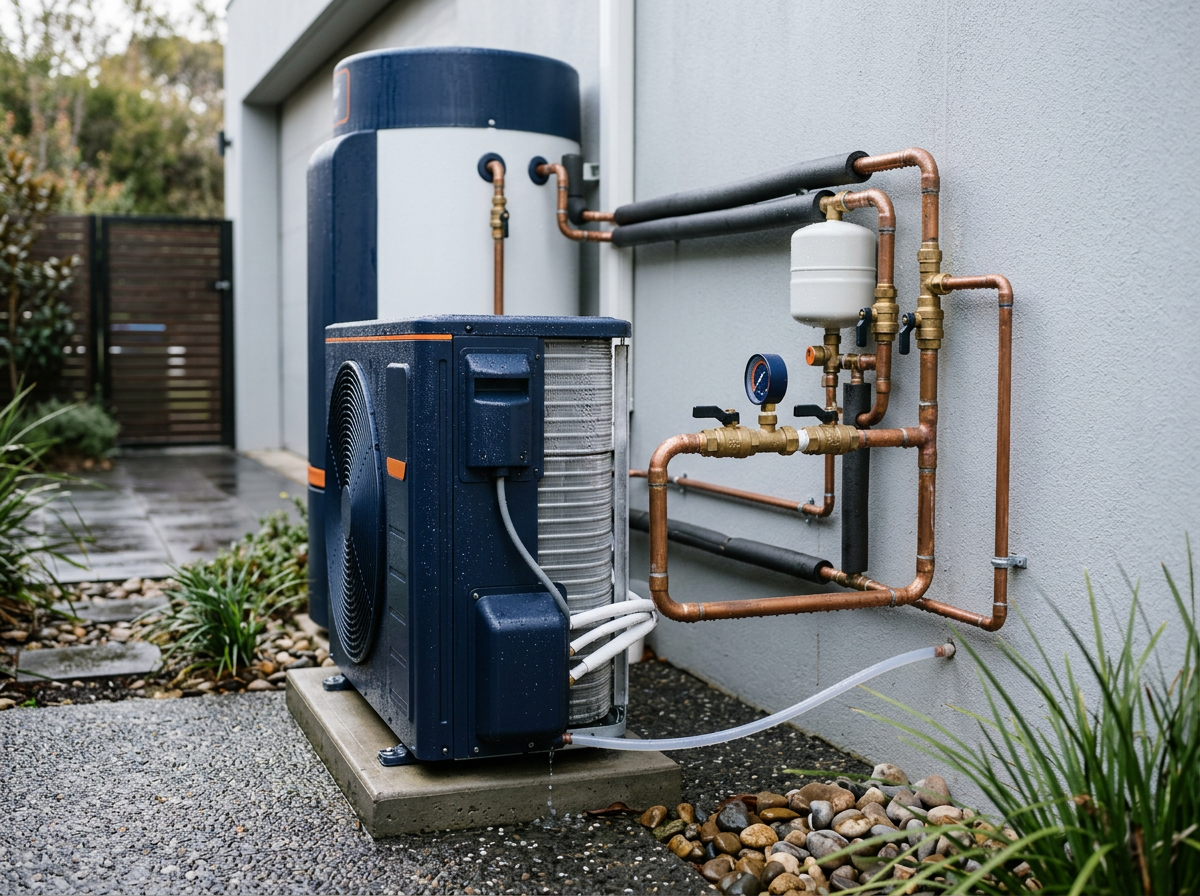
A typical Sydney install: the outdoor compressor sits clear of the wall on a concrete pad, with insulated copper running up to the cylinder.
Real Sydney Winter COP, Not the Brochure Number
Coefficient of performance is the single most lied-about figure in the hot water industry. Brochures quote up to 5.0, sometimes 6.0. Those numbers are measured at 19 to 22 degrees ambient with mains water at 21, which is October in Sydney, not July. The honest annual average for a Sydney metropolitan home is 3.6 to 4.0. The honest July average is 2.6 to 3.4. Below are the field readings we record across our service fleet, grouped by the four brands we install most.
Reclaim Energy CO2 (R744 refrigerant)
Holds the highest cold-weather COP we measure, typically 3.2 to 3.4 in July. CO2 refrigerant works better at low ambient than synthetic blends. Premium price, premium winter behaviour.
Sanden Eco Plus
Also CO2-based, very similar winter performance at 3.0 to 3.2. Quietest unit on the market. Long lead times in 2026 due to global demand.
iStore 270L (R290 propane)
Mid-range pricing, R290 propane refrigerant gives respectable cold performance at 2.9 to 3.1. Strong rebate eligibility through the Energy Savings Scheme.
Cheap R410A imports
Budget brands often sit at COP 2.4 to 2.6 in July, sometimes lower if the unit is exposed to wind. The summer figure on the box still reads 4.8. Read field reviews, not stickers.
A real-world annual COP of 3.5 means every kilowatt-hour of grid power buys 3.5 kilowatt-hours of heat in the tank. On a Sydney electric tariff of 32 cents per kilowatt-hour, that is hot water at roughly 9 cents per useful kilowatt-hour. Compare that to gas at around 14 cents per useful kilowatt-hour after burner losses, or to a controlled-load resistive element at 22 cents. The winter dip is real, but the worst month of a heat pump still costs less than the average month of the alternatives. The Australian Government energy.gov.au hot water comparison uses the same maths.
Quick rule of thumb
If a quote claims annual savings of 80 percent against your old electric tank, the salesperson is using brochure COP. The honest figure for Sydney is 65 to 72 percent against resistive electric, and 35 to 50 percent against gas. Beat that promise with caution.
Where to Place the Outdoor Unit on a Sydney Block
Placement decides as much winter performance as the brand on the box. The compressor needs to draw a steady volume of ambient air through the evaporator coil, then expel that same air, now several degrees colder, away from the intake. A unit jammed into a narrow side passage starves itself. It re-ingests its own cold exhaust, the apparent ambient temperature drops to 2 or 3 degrees, and the COP collapses for the rest of the morning. We see this most often on inner-west terrace blocks where there is genuinely no other spot, and on Hills District homes where the original electric tank sat in a tight enclosure.
The minimum airflow envelope every quality manufacturer specifies is 600 millimetres in front of the fan, 300 millimetres behind, and 600 millimetres above the unit. Our preferred Sydney install puts the unit on a north or east-facing exterior wall, on a concrete pad raised 100 millimetres off the ground for drainage and cyclonic-rated brackets where the home is exposed. Avoid south-facing walls in suburbs like Mosman or Manly that catch winter southerly wind, because wind chill knocks another 1 to 2 degrees off the effective ambient.
Condensate is the second placement question. A working heat pump produces around 1 to 2 litres of cold condensate per heating cycle in winter, the same way a reverse-cycle aircon drips outside in summer. The pipe must run to a legal stormwater point under AS/NZS 3500, not into a garden bed where it will pool and freeze on a cold morning. Frozen condensate has caused two of the failed defrost cycles we attended last winter.
Defrost Cycles, Noise and the Neighbour Question
On Sydney mornings below 5 degrees with high humidity, the evaporator coil can pick up a thin layer of frost. Every quality unit handles this automatically by reversing refrigerant flow for three to six minutes, melting the frost, then resuming normal heating. You will hear the fan stop, a brief hiss, and possibly some water dripping. The cycle is short and the stored hot water in the tank does not cool noticeably. It is a feature, not a fault.
Noise is the more common neighbour issue, especially for early-rising units that fire at 4 am to beat the time-of-use tariff. A modern Sanden or Reclaim measures 48 to 51 decibels at one metre, similar to a household fridge. A budget import can hit 58 decibels and feel sharper because the fan and compressor both run on the same casing. The NSW EPA residential noise limit at the boundary is 45 decibels between 10 pm and 7 am. Distance helps fast. Six metres of clear air drops a 50 dB source to about 35 dB at the listener, which is whisper-quiet.
- Run between 10 am and 3 pm. No neighbour complaint has ever come from a midday compressor cycle.
- Mount on rubber anti-vibration pads. Brick walls amplify low-frequency hum into adjoining bedrooms.
- Avoid the shared fence wall. A 1 metre offset cuts perceived noise next door by half.
Sizing for a Cold Sydney Morning
Heat pump sizing in Sydney follows a different rule than gas. A gas instantaneous unit cares about flow rate at the second tap. A heat pump cares about stored litres at the moment of peak demand, because the compressor cannot keep pace with simultaneous draw the way a gas burner can. Undersize the tank and winter mornings turn into a queue.
- 1 to 2 people, 1 bathroom: 200 to 250 litre tank.
- 3 to 4 people, 1 to 2 bathrooms: 270 to 315 litre tank.
- 5 plus people or teenagers: 315 to 400 litre tank.
- Granny flat or studio: 160 to 200 litre integrated unit.
Add 50 litres on top of these figures if the home has a spa bath, ducted hot water to a workshop, or back-to-back morning showers in winter. Our sizing guide walks through the demand-curve maths in detail. The only sizing failure we ever see is downward, never upward, and an extra 50 litres of tank costs around $180 at quote stage compared to thousands of dollars to swap a unit two winters in.
What Sydney Owners Pay to Run One Through Winter
Real numbers from our 2025 winter customer dataset, normalised to a four-person Sydney household with a 270 litre tank, time-of-use tariff and midday run schedule. These are the bill-paying figures, not the marketing ones.
- June electricity cost (heat pump only): $32 to $46
- July electricity cost (the worst month): $38 to $54
- August electricity cost: $34 to $48
- Equivalent gas instantaneous winter cost (same family): $78 to $112 per month plus daily supply
- Equivalent old electric storage cost: $145 to $190 per month at peak winter
The pre-installed unit cost remains the only meaningful barrier. After Energy Savings Scheme rebates and federal Small-scale Technology Certificates, a Sydney install of a quality 270 litre heat pump now lands between $2,800 and $3,800 supplied and fitted. Most owners recover the difference against their old gas or electric system within three to four winters, then run on cheaper bills for the next eight to twelve. The NSW Energy Savings Scheme rebate alone covers $700 to $1,800 of the install on most homes. See the current values in our 2026 NSW rebates guide.
Watch for the controlled-load trap
Some installers leave the heat pump on Tariff 31 controlled load, which only runs the unit between 10 pm and 7 am. That schedule pushes every recovery cycle into the coldest hours of the night, dropping COP and tripling defrost cycles. Move to general supply with a midday timer, or pair with rooftop solar through a PV diverter.
Service, Faults and the First-Winter Checklist
The first cold snap of every Sydney winter exposes setup mistakes that summer hides. Our service phones light up in the second week of June with the same handful of faults. Most are preventable in a 20 minute pre-winter inspection, ideally booked in late April or early May before the queue grows.
- Clear the evaporator coil. Spider webs, leaves and pollen restrict airflow. A soft brush and a garden hose on low pressure does the job.
- Test the TPR valve. A tug on the lever every six months prevents seizure. See our safety guide.
- Check the condensate drain. Confirm it runs to stormwater and is clear of debris that could freeze overnight.
- Confirm the timer is on midday run. If the install team left it on default controlled load, change it now.
- Listen during a defrost cycle. Healthy defrost is short and clean. Loud knocking points to a low refrigerant charge that needs a service call.
- Flush the tank if older than five years. Sediment kills storage capacity and forces longer cycles. Our flush guide walks through the steps.
If the unit ever fails completely on a cold morning, do not bypass it onto the booster element and forget. The booster is a 3.6 kW resistive backup designed for emergency use, not weeks of running. We have repaired tanks where the booster ran continuously for two months and tripled the bill before anyone noticed. Read our common faults guide, then call us.
Book a Pre-Winter Heat Pump Health Check Across Sydney
Our licensed plumbers and electricians service every major heat pump brand across the Sydney metropolitan area, the Central Coast and Newcastle. Pre-winter inspection, timer reprogramming, condensate clearance and warranty work in a single visit.
Frequently Asked Questions
Do heat pump hot water systems actually work in a Sydney winter?
Yes. Sydney winter overnight lows sit between 4 and 9 degrees in most metropolitan suburbs, well above the minimum operating range of every quality heat pump sold here. The compressor still runs, the refrigerant still extracts heat, and the tank still reaches 60 degrees. Output drops compared to a January morning, which is why coefficient of performance falls from around 4.5 in summer to between 2.6 and 3.2 in July. That is still two to three times more efficient than a resistive electric element on the same tariff.
What is the real coefficient of performance for a Sydney heat pump in July?
Field data from Sydney installs sits between 2.6 and 3.4 across June, July and August, depending on brand, placement and overnight temperature. A Reclaim CO2 unit holds closer to 3.2 because of its refrigerant chemistry. A Sanden Eco Plus typically lands at 3.0. Cheaper R410A units drop to 2.4 to 2.6 on the coldest mornings. The brochure COP of 5.0 is measured at 19 degrees ambient, which Sydney sees in October, not July.
Will my heat pump hot water unit ice up on a frosty Sydney morning?
The evaporator coil can frost lightly when overnight temperatures fall below 5 degrees and humidity is high, common in inner-west and Hills District suburbs. Every quality heat pump runs an automatic defrost cycle, usually a short reverse-cycle pulse that clears the coil in 3 to 6 minutes. You may hear the fan stop and a brief hissing as refrigerant reverses. The tank stays hot because the cycle finishes long before stored water drops in temperature.
How loud is a heat pump hot water unit at 5 am?
A modern unit at one metre measures 48 to 53 decibels, similar to a quiet conversation or a fridge compressor. At a neighbour's bedroom window six metres away, the sound pressure drops to around 35 decibels, well below the NSW Environment Protection Authority residential night limit of 45 decibels measured at the boundary. Older or budget models can hit 58 decibels and trigger complaints if placed against a shared fence. Placement and timer settings solve almost every noise problem.
Should I run my Sydney heat pump on a timer in winter?
Yes. Run the heat pump between 10 am and 3 pm when ambient temperature is at its peak and any rooftop solar can power it directly. Output efficiency at midday in July is roughly 25 percent higher than at 5 am, and the tank holds heat overnight without any further compressor work. A simple time-of-use programmer lifts annual COP by around 0.4 in Sydney conditions and protects neighbours from any pre-dawn fan noise.
What size heat pump suits a four-person Sydney household in winter?
A 270 to 315 litre tank with a 1.5 kW compressor handles a typical four-person Sydney household through July without booster reliance. Houses with two bathrooms or teenagers need 315 to 400 litres because winter shower lengths climb from 5 to 9 minutes on average. Undersizing is the single biggest cause of cold-shower complaints in winter. A licensed plumber will check your peak hour demand before quoting, not just the brochure rating.