
Low Hot Water Pressure in Sydney Homes: Causes, Fixes & 2026 Winter Repair Guide
Your shower has gone from a strong stream to a weak trickle, and winter is two weeks away. Here is exactly what is causing it, what you can check yourself in 10 minutes, and what it costs to fix in Sydney this season.

It usually happens on a cool May morning. You step into the shower in Marrickville, Castle Hill, or Terrigal, twist the mixer to hot, and what should be a strong jet feels like rain through a sieve. The cold side is fine. The kitchen tap is fine. Only the hot is weak, and it has been getting steadily worse for weeks.
Low hot water pressure is one of the most common service calls Sydney plumbers take in autumn and early winter, and it almost always traces back to one of seven specific causes inside or beside your hot water system. The Sydney Water mains supply is rarely the problem. Your fixtures are rarely the problem. The fault is sitting in the brass valves, the copper inlet, or the sediment layer at the bottom of your tank. This guide walks you through every cause, the 10-minute home diagnostic, and what each repair costs in Sydney right now.
Why Hot Water Pressure Drops in Sydney Homes
Sydney Water delivers mains pressure to most metropolitan properties at 500 to 800 kPa, which is more than enough to run any modern fixture. By the time that water reaches your shower head, it has passed through a meter, a main isolation valve, your hot water system, a pressure limiting valve, sometimes a tempering valve, several metres of copper, and the mixer cartridge in the wall.
Every one of those points can choke flow. The cold side has fewer steps and fewer valves, which is why a weak hot tap with strong cold flow is such a reliable fingerprint. Once you understand the path, finding the fault becomes a process of elimination rather than a guess. The Sydney Water mains pressure standards are public, so you can rule the supply in or out within minutes.
Quick rule of thumb
If cold pressure is strong and hot pressure is weak across every tap, the problem is at the hot water unit or its valves. If hot is weak at only one tap, the problem is at that fixture. This single test eliminates 80 percent of guesswork.
Why Pressure Problems Spike Heading Into Winter
Hot water pressure complaints climb sharply across Sydney every May and June. The cause is partly mechanical and partly behavioural. Cold inlet water arrives at 12 to 15 degrees rather than 22 to 25 degrees, so your system has to work harder and longer to deliver the same shower. Mineral scale that has been quietly building since spring gets disturbed by heavier flow, and partial blockages that were tolerable in February become obvious in May.
Tempering valves are the worst offenders. They contain a wax thermostatic element that adjusts blend ratios, and that element is sensitive to scale. When the cold input is colder, the valve has to open the hot side wider. If scale is restricting that movement, the valve effectively starves the house of hot water just when you need it most. This is why a system that worked fine in March can feel broken by the King's Birthday long weekend.
The same pre-winter window is also the smartest time to act. A pressure complaint booked in early May usually gets a same-week appointment. The same call in late June, after the first cold snap, often waits four to seven days because every plumber in the city is responding to no-hot-water emergencies. Use this winter hot water checklist alongside this guide to get ahead of the queue.
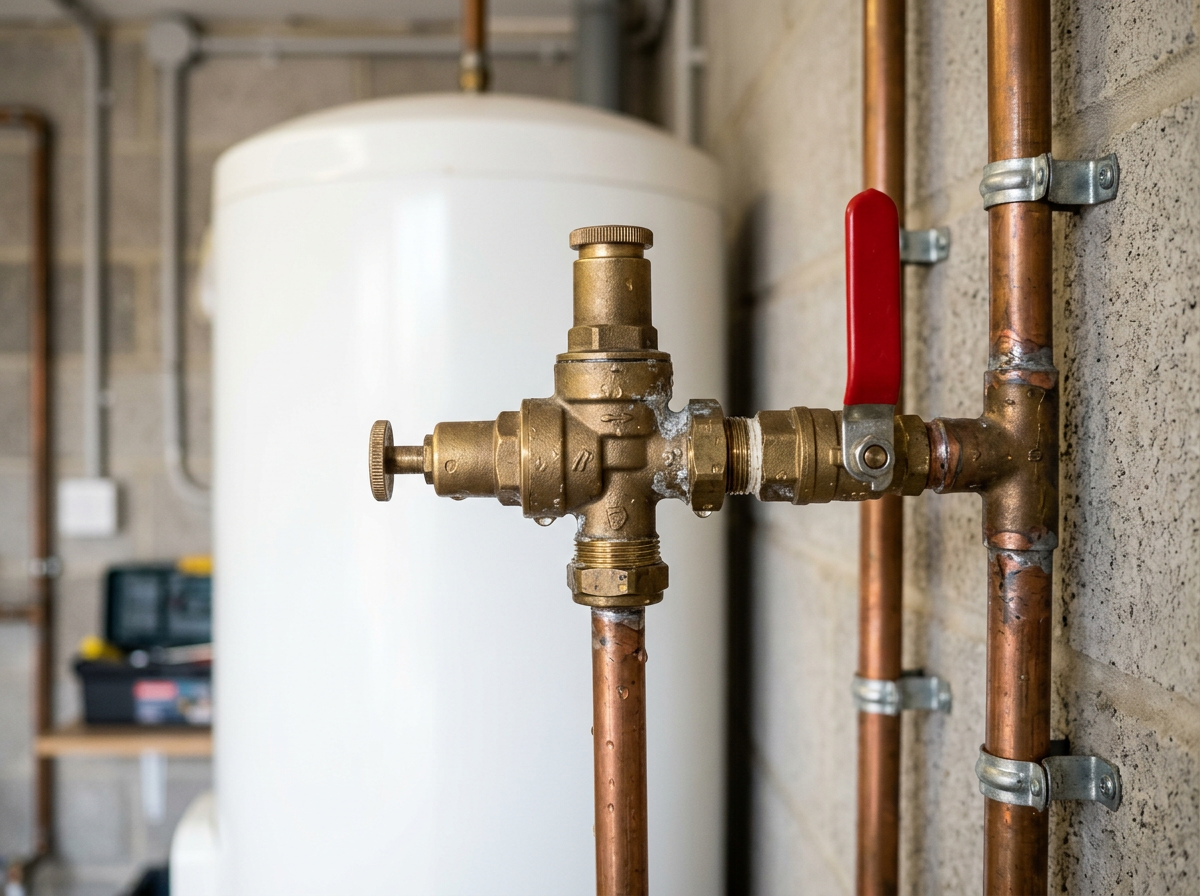
A failing pressure limiting valve, the most common silent cause of weak hot water in Sydney homes built since 2000.
Seven Causes of Low Hot Water Pressure
Almost every weak hot water complaint in Sydney traces back to one of these seven faults. They are listed roughly in order of how often we see them in homes built between 1980 and 2015.
1. Failed pressure limiting valve (PRV)
A PRV sits at the cold inlet on most modern Sydney systems and is set to 500 kPa under AS/NZS 3500. The internal cartridge wears out at the 8 to 12 year mark. When it fails, it chokes flow rather than opens it.
2. Blocked or seized tempering valve
Required on every system delivering water to a bathroom under NSW Health scalding regulations, the tempering valve mixes hot and cold to a safe 50 degrees. Scale on the wax element jams it half-shut and starves every hot tap.
3. Sediment build-up in the storage tank
In hard-water suburbs around the Hills, Sutherland, and the Central Coast, calcium sediment compacts at the base of the cylinder over time. It blocks the outlet pickup and reduces effective tank volume. A full flush usually restores normal flow.
4. Partially closed isolation valve
After any service, a previous tradesperson might have left the cold inlet valve only partly open. It looks open from a distance but is choking flow. Free to fix in 10 seconds if you spot it.
5. Internal copper corrosion
Pre-1990 Sydney homes commonly have copper hot lines that have lost half their internal diameter to scale and oxidation. Pressure drops gradually for years and is usually paired with discoloured water at first draw.
6. Aerator and shower head clogging
If only one tap is weak, this is your culprit. Hard-water deposits clog the small mesh disc inside the aerator or behind the shower head face. A 5-minute clean in white vinegar fixes it.
7. Undersized or end-of-life cylinder
A 125-litre tank that suited a young couple in 2010 cannot keep up with a family of four in 2026. Pressure feels weak because the system has run out of stored hot water mid-shower. Check our sizing guide if this sounds familiar.
Diagnose the Cause in 10 Minutes
Before you book anyone, run this five-step check. It costs nothing, needs no tools, and isolates the cause in under 10 minutes. The same flow is what a Sydney plumber will run on arrival, so doing it first either fixes the problem or saves you the diagnostic fee.
- Step 1. Run the cold tap at the kitchen sink. Strong flow means your mains supply is healthy and the problem is downstream of the hot water unit.
- Step 2. Test the hot tap at three different fixtures. If only one is weak, clean its aerator or shower head. If all three are weak, continue to step 3.
- Step 3. Walk to the hot water cylinder. Confirm the cold inlet isolation valve handle points along the pipe, not across it.
- Step 4. Find the brass pressure limiting valve at the cold inlet. Listen for a faint hiss and feel for any weeping. Either is a sign the cartridge has failed.
- Step 5. While a hot tap is running, touch the body of the tempering valve on the hot outlet. A cool valve body during hot flow is a jammed cartridge.
If steps 3 to 5 all check out, the cause is internal: sediment, scale, or corroded copper. That is a service call. If you would rather skip the diagnostic entirely, our hot water repair team covers the full Sydney metropolitan area on the same day.
What You Can Fix and What Needs a Plumber
Two of the seven causes are safe DIY jobs. The rest are licensed work under NSW plumbing regulations, and attempting them yourself voids your warranty and your home insurance.
Safe to do yourself
- Cleaning aerators and shower heads in white vinegar overnight
- Opening a partially closed isolation valve at the cold inlet
Licensed plumber only
- Replacing a pressure limiting valve or tempering valve
- Flushing the cylinder to remove sediment
- Replacing corroded copper flow lines
- Any work involving the TPR valve or gas connection
The NSW Fair Trading licensing rules are strict on this. Any work on the pressure or temperature control system must be carried out by a licensed plumber, and a Certificate of Compliance is required.
What Pressure Repairs Cost in Sydney 2026
These are real Sydney metropolitan ranges as of May 2026, supplied and fitted, including GST and a Certificate of Compliance where required. Prices vary by suburb, access, and brand of replacement part.
- Pressure limiting valve replacement: $280 to $420
- Tempering valve replacement: $320 to $480
- Full system flush and sediment removal: $250 to $380
- Replace corroded copper inlet section: $400 to $900
- Full system replacement (50 percent rule applies): $1,800 to $5,500 depending on type
A useful rule from our trade: if the repair quote is more than half the cost of a new system and the unit is past 8 years old, replace it. The relevant numbers for your suburb are in our Sydney installed price guide, and many heat pump replacements now qualify for substantial NSW rebates that close the price gap with a like-for-like repair.
A real Hills District example
A West Pennant Hills family rang us in late April 2026 about weak hot water at every tap. Cold pressure was perfect. The pressure limiting valve was 11 years old and weeping at the body. We swapped the PRV for a new 500 kPa unit on the same visit for $340 supplied and fitted. Shower flow doubled within an hour and the household avoided a no-hot-water Sunday in mid-winter.
Prevent the Problem Coming Back
Most pressure complaints are predictable. The components that fail have known service lives, and a 30-minute annual check catches every common cause before it ruins a winter morning. Build these four habits and you will rarely call a plumber for pressure again.
- Annual flush. Drain and flush the cylinder every autumn. It clears sediment before it compacts and protects flow into winter.
- Service the tempering valve every 5 years. The cartridge is consumable. Replacing it on schedule is half the price of an emergency call-out in July.
- Replace the PRV at 10 years. Do not wait for it to fail. A planned swap costs the same as a reactive one without the cold shower.
- Book a pre-winter check. Late April or early May is the right window. Our maintenance team can complete the full check in one visit.
Weak Hot Water? Get a Real Sydney Plumber Today
Our team covers the full Sydney metropolitan area, the Central Coast, and Newcastle with same-day pressure diagnostics and fixed-price repairs. No call-out fee on weekday bookings before 4pm.
Frequently Asked Questions
Why is my hot water pressure low but cold water pressure fine?
When cold pressure is normal but hot is weak, the problem is almost always downstream of your hot water unit. The most common causes are a blocked tempering valve cartridge, sediment build-up inside a storage tank, a partially closed isolation valve on the hot side, or a corroded copper flow line that has narrowed internally. The fault is rarely the Sydney Water mains supply, because the cold side proves the mains pressure is healthy.
Can a pressure limiting valve cause low hot water pressure?
Yes. A pressure limiting valve, often called a PRV, sits at the cold inlet of most Sydney hot water systems and is set to 500 kPa under AS/NZS 3500. When the internal cartridge fails, it can choke flow to the cylinder, which then starves every hot tap in the house. PRVs typically last 8 to 12 years and are one of the most common silent causes of weak hot water in homes built since 2000.
Is low hot water pressure dangerous?
Low pressure itself is not dangerous, but the underlying causes can be. A failing tempering valve can also fail in a way that lets scalding water through. A blocked TPR valve can prevent the cylinder from venting safely. And sediment build-up that drops pressure also drives up energy bills and shortens tank life. If pressure has dropped suddenly, treat it as a service call rather than a wait-and-see issue.
How much does it cost to fix low hot water pressure in Sydney?
Most Sydney pressure repairs sit between $220 and $650 depending on the cause. A pressure limiting valve replacement runs around $280 to $420 supplied and fitted. A tempering valve swap is typically $320 to $480. A full system flush to clear sediment is $250 to $380. Replacing a corroded section of copper flow pipe can range from $400 to $900 depending on access. Always get a fixed quote before work begins.
Will winter make my hot water pressure worse?
Yes, and most Sydney homeowners notice it first in May and June. Cold inlet water is denser, taps run for longer, and any partial blockage in a tempering valve or PRV becomes obvious because the system is being pushed harder. Sediment that sat undisturbed all summer also gets stirred up by heavier hot water demand. Booking a service before winter peaks is the cheapest way to avoid a no-hot-water call-out on the coldest morning of the year.