
Solar PV Hot Water Diverters in Sydney: The 2026 Guide to Slashing Winter Bills With Free Rooftop Sunshine
Sydney solar feed-in tariffs have crashed to 4 cents while overnight power costs 38. The smart fix is no longer selling sunshine to the grid. It is storing it as hot water. Here is exactly how a PV diverter works, what it costs, and the real 2026 payback for a Sydney home.

A Hornsby homeowner rang us last week. Her January Origin bill was $612, the March bill was $589, and her solar credit on both was less than $14. She had a 6.6 kW system on the roof, a healthy daytime export, and a controlled-load electric tank quietly drawing power at 1 am every morning at the very tariff rate she could not influence. The maths felt broken, because it is.
Sydney solar feed-in tariffs have collapsed. Most retailers now pay 4 to 7 cents per kilowatt hour exported, while overnight controlled-load grid power sits between 28 and 38 cents. Selling rooftop solar back to the grid in 2026 is no longer the way to lower a power bill. Storing it as heat in your existing hot water tank is. A solar PV diverter is the cheapest, fastest, and least disruptive way to do that, and the autumn months heading into winter are when it pays off the most. This guide walks through exactly how a diverter works on a Sydney roof, the three models we install most often, the real 2026 costs and payback, and the NSW rules every homeowner should know before signing a quote.
What a Solar PV Diverter Actually Does
A solar PV diverter is a small wall-mounted controller that sits between your switchboard and your hot water element. It watches the export current at the meter, and the moment your roof produces more solar than the house is using, it bleeds that surplus into the hot water tank instead of letting it flow back to the grid. The element heats proportionally, modulating from 100 watts to its full 3,600 watt rating in real time as a cloud rolls over or your dishwasher cycles on.
The result is a tank that does its heating work at noon for free rather than at 2 am at full retail tariff. Nothing inside the cylinder changes. The same element, the same thermostat, the same TPR valve. Only the source of the energy changes. For households on the latest Default Market Offer rates, the cost difference between exported solar and grid-bought power is now wider than it has ever been.
Quick rule of thumb
If your last quarterly bill showed more than 200 kWh of solar exports and your hot water is electric, a diverter pays for itself inside three winters. Sydney households with pool pumps and ducted air conditioning usually pay it off faster.
Why Sydney Homeowners Are Asking About Diverters in 2026
Three things changed at once this year, and the result has reshaped what makes sense on a Sydney roof. First, retailer feed-in tariffs fell again across IPART benchmark ranges, with most Sydney retailers landing between 4 and 7 cents per kilowatt hour. Second, retail electricity rates climbed under the latest Default Market Offer adjustment, with most homeowners now paying 32 to 38 cents per kilowatt hour during peak windows. Third, Ausgrid and Endeavour Energy started rolling out two-way export charging on sunny weekends, which means some homes are now paying their retailer to dump solar at midday.
Diverters were a niche idea five years ago when feed-in paid 17 cents and hot water cost 22. The arithmetic was barely worth it. The 2026 spread of 30 cents and rising flips the case completely. A 6.6 kW Sydney system that exports 14 kWh on a sunny May day is generating 84 cents of credit at current rates. That same 14 kWh used at home offsets $4.76 of evening tariff, and replaces an overnight controlled-load draw entirely. Pre-winter is the right time to install. Tank temperatures matter most from May through September, and a diverter commissioned in early autumn captures the full benefit before the cold mornings arrive.
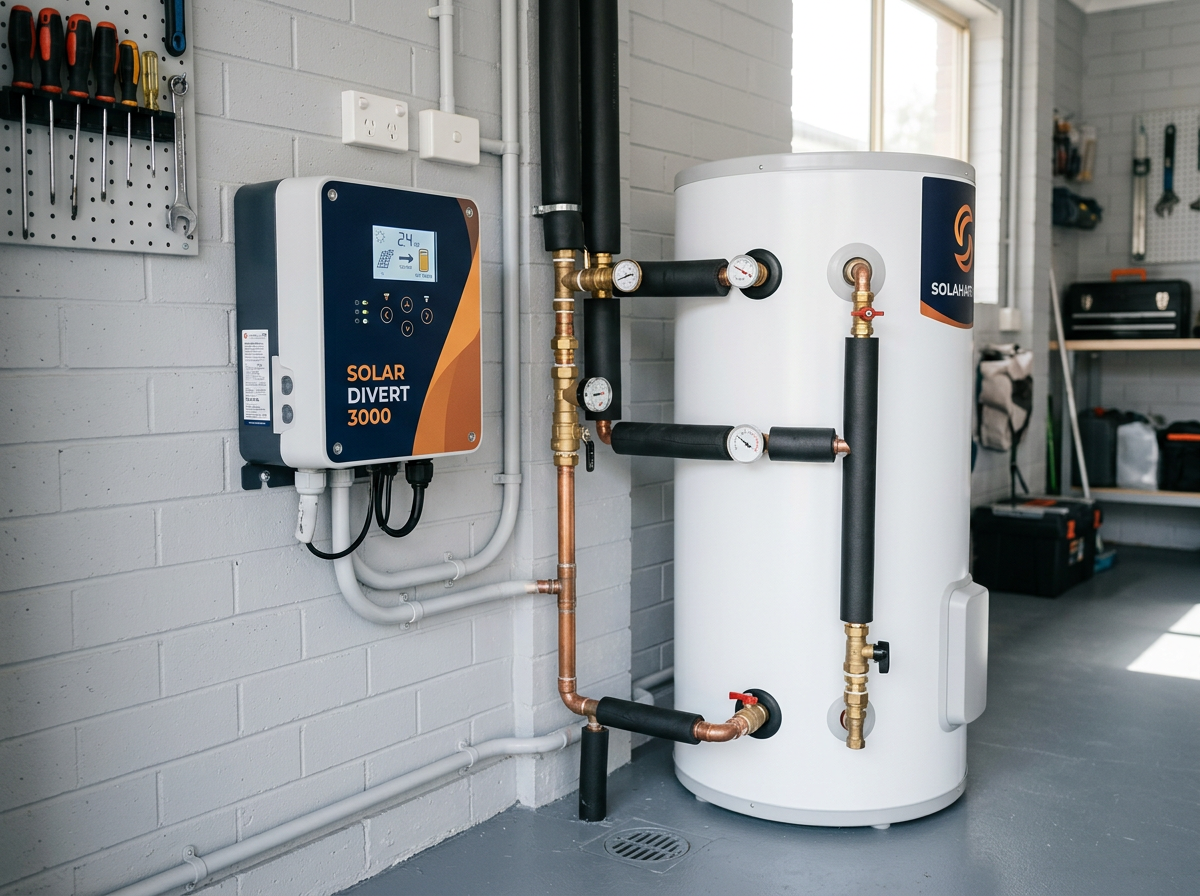
A typical Sydney installation: diverter mounted at the switchboard, copper feed to the existing electric storage tank.
How a Diverter Works on a Sydney Roof
The hardware is unfussy. A current transformer clamps around the active wire at your main switchboard. It senses the direction and amount of current at the meter every few hundred milliseconds. If current is leaving the property, the diverter knows you have surplus solar. It then opens a triac or relay on a dedicated circuit to your hot water element and modulates the load to match the available surplus exactly.
The clever part is how that modulation happens. Cheaper relay-based units, like the Catchpower Relay, switch the element on or off in chunks based on a moving average of available solar. They are simple, cheap, and effective for tanks above 250 litres where a coarse switching pattern still delivers full heat by mid-afternoon. Higher-end units, like the Fronius Ohmpilot and the Paladin, use proportional triac control. They smooth the load down to the watt and never push or pull a cent from the grid. For homes with batteries, time-of-use tariffs, or smaller 80 to 160 litre tanks, the proportional models give better results.
A typical Sydney summer day looks like this: the diverter starts ramping at around 8 am as roof output climbs above household base load. By 10 am the tank is taking 2 to 3 kW of pure solar. By 1 pm the tank has hit 60 degrees and the diverter idles, leaving the rest of the day for any remaining export. Winter days run shorter, but a north-facing 6.6 kW Sydney array still puts 8 to 12 kWh into hot water between 9 am and 3 pm even in late June.
Diverter vs Heat Pump vs Solar Thermal
This is the question every Sydney homeowner asks when they ring us, and the honest answer depends on what you already have on the roof and beside the house.
PV diverter on existing electric tank
Cheapest entry point at $1,200 to $1,800 installed. No tank replacement. Only works if you already have rooftop solar and an electric element. Expected saving: $480 to $920 a year for a typical Sydney family of four.
Heat pump replacement
Higher upfront at $3,200 to $4,600 after rebates, but draws roughly one quarter of the grid power of a resistive element. Pairs well with overnight Tariff 31. Best for homes without solar or with a tank past its life. See our heat pump cost guide.
Roof-mounted solar thermal
The original idea, with evacuated tubes or flat-plate collectors heating glycol that runs to the tank. Effective but inflexible. Cannot expand or repurpose the panels. Mostly being phased out in retrofits because PV plus diverter is cheaper and more useful.
Heat pump plus diverter combo
The smartest 2026 setup for a high-export Sydney home. Use the diverter to power the heat pump compressor on sunny days, then let it default to overnight controlled load when the sun is gone. Triple-figure savings stack with rebates.
If your tank is electric and under 12 years old, start with a diverter. If your tank is gas, look at a gas-to-heat-pump conversion. If both your tank and your solar are aged, do everything in one visit.
The Three Diverters Used Most in Sydney
A dozen brands sell diverters into Australia. Three account for about 90 percent of the units we install across Sydney, the Central Coast, and Newcastle.
Catchpower Relay
Australian designed, simple relay-based switching, about $850 hardware. Best fit for 250 to 400 litre electric tanks where chunky switching is fine. Strong Wi-Fi app and clean install. The most common pick on a budget.
Paladin
Proportional triac control, excellent ramp resolution, around $1,150 hardware. Three-phase and battery friendly. The Paladin handles homes with EV chargers, pool pumps, and ducted air conditioning gracefully because it never overshoots into grid import.
Fronius Ohmpilot
European engineered, integrates natively with the Fronius Symo and Primo inverter range, around $1,280 hardware. Premium choice when the existing inverter is already Fronius. Tight monitoring through Solar.web and remote firmware updates.
Stay clear of the cheap European grey imports without local support. Warranty claims are painful and Australian electrical compliance is not always met out of the box. The three units above all carry full RCM marking and local technical support.
What a Sydney Install Looks Like
A retrofit on an existing electric tank with existing solar is a half-day job for a licensed electrician working alongside a licensed plumber. The work breaks into five clean stages.
- Site audit. Confirm inverter size, export profile, tank element wattage, switchboard space, and tariff structure. About 30 minutes.
- Switchboard work. Install the diverter, fit the current transformer clamp, run a new dedicated circuit to the hot water element. About 90 minutes.
- Tariff change request. Move the tank off Tariff 31 or 33 to general supply for daytime, with an overnight backup window at Tariff 31 for cloudy weeks. We lodge the request with your retailer.
- Plumbing check. Inspect the TPR valve, tempering valve, and PRV. Replace any unit older than 8 years while access is open. Avoids a return trip.
- Commission and verify. Run a sunny test, confirm the diverter is modulating across the full element load, hand over the app and the Certificate of Compliance for Electrical Work.
Our team handles the full job end-to-end with one visit and one invoice. If the tank itself is past 10 years and the element is showing scale, we usually recommend a tank service or replacement at the same time so the diverter is feeding a healthy cylinder. See the anode rod guide for what that looks like.
Costs, Savings and Real 2026 Payback
These are real Sydney metropolitan ranges as of May 2026, supplied and fitted, including GST and a Certificate of Compliance for Electrical Work. Prices vary by switchboard age, brand, and whether plumbing work is bundled in.
- Catchpower Relay installed: $1,250 to $1,550
- Paladin installed: $1,650 to $1,950
- Fronius Ohmpilot installed: $1,850 to $2,250
- Switchboard upgrade if required: $650 to $1,400
- Annual saving on a typical 6.6 kW Sydney family home: $480 to $920
The math on a real Manly family we did in March 2026: 6.6 kW Trina array, 250 litre Rheem electric tank, four people, Origin retail plan. Their pre-install bill ran $2,840 a year on power. We installed a Paladin for $1,780 inclusive. Their next quarter dropped from $710 to $432, an annualised saving of $1,112. Payback under two years, then pure savings every year after that. Not every home will hit that figure, but a family with a pool pump or ducted reverse cycle will land close to it.
Pair with NSW rebates where eligible
Some homes that are also replacing the tank during the same visit qualify for state-level energy savings under the Energy Savings Scheme. Stack the diverter with a heat pump replacement and the combined rebate often covers the diverter hardware in full. See our latest NSW rebates guide for current values.
NSW Rules, Compliance and Safety
A diverter does not require network export approval because it never sends power past the meter. It does still require licensed work and proper paperwork.
- A licensed electrician under NSW Fair Trading electrical licensing must install and lodge a Certificate of Compliance for Electrical Work.
- Any plumbing work on the tank, valves, or pipework must be carried out by a licensed plumber and certified under AS/NZS 3500.
- The tank must still reach 60 degrees at least once per day to prevent Legionella growth, per NSW Health guidance. Every diverter we install is set to guarantee that minimum daily heat regardless of weather.
- The original tempering valve must remain in service to limit bathroom delivery to 50 degrees. A diverter does not change the safety chain at the tap.
DIY installation is illegal in NSW for any work behind the switchboard or on a pressurised hot water system. The fines are heavy and home insurance will void any subsequent fault. Always book a licensed installer.
Cut Your Winter Power Bill With a Sydney PV Diverter Install
Our licensed electricians and plumbers install Catchpower, Paladin, and Fronius diverters across the Sydney metropolitan area, the Central Coast, and Newcastle. Fixed-price quotes, single visit, certificate included.
Frequently Asked Questions
Will a solar PV diverter work with my existing electric hot water tank?
Almost certainly yes. Any standard electric storage tank with a resistive element, from 80 litres up to 400 litres, is compatible with a PV diverter. The diverter sits beside the meter board and modulates power to the existing element. You do not need to replace the tank, the element, or the wiring inside the cylinder. The only homes where it will not work are those with instantaneous gas units or sealed heat pumps, because there is no resistive element to feed.
How much can a Sydney household actually save with a PV diverter?
Most Sydney households on a 6.6 kW solar system save between $480 and $920 a year on electricity once the diverter is installed, based on real Ausgrid and Endeavour Energy data. The saving comes from two places: the kilowatt hours that used to flow back to the grid for 4 to 6 cents are now heating water that would otherwise cost 28 to 38 cents from the grid overnight. A family of four with morning and evening showers usually sees the bigger end of that range.
Is a diverter better than a heat pump for hot water?
Different jobs. A heat pump is more energy efficient per kilowatt hour, but it still draws power from somewhere, often overnight when prices spike. A diverter takes free surplus solar and uses it before any grid power is touched. The smartest Sydney setup pairs both: a heat pump for cold cloudy weeks, and a diverter that runs a small electric booster from rooftop solar on sunny days. Standalone, a diverter on an existing electric tank is the cheapest path to lower winter bills.
Do I need approval from Ausgrid or Endeavour Energy to install a diverter?
No network approval is required because a diverter does not export power. It only redirects solar that would otherwise have been exported. A licensed electrician must still notify the work and lodge a Certificate of Compliance for Electrical Work under NSW rules, and any plumbing work on the tank itself must be carried out by a licensed plumber. The diverter sits behind your main switch and is treated like any other domestic appliance.
Why are Sydney solar feed-in tariffs so low in 2026?
Wholesale daytime electricity prices have collapsed because so much rooftop solar feeds into the grid between 10 am and 3 pm. Most Sydney retailers now pay 4 to 7 cents per kilowatt hour exported, down from 12 to 18 cents only a few years ago. Some retailers have introduced negative export pricing on sunny weekends. A diverter sidesteps this entirely by using your own solar at home rather than selling it for almost nothing.
Will my hot water still be hot during a cloudy week?
Yes. Every quality diverter has a grid backup mode that runs on standard tariff or controlled load overnight if the tank temperature drops below the set point. A typical setup uses solar exclusively from sunrise to mid-afternoon, then tops up from cheap controlled load tariff at 1 am if needed. You never run out of hot water, and you only pay grid rates when the sun has not done the job.