
Sydney Water Bill Shock 2026: How a Hidden Hot Water Leak Could Cost You Hundreds
Bills are higher than ever, and the silent culprit is often sitting in the side return: an old hot water system slowly losing litres no one can see. Here is how to find it, fix it, and get the money back from Sydney Water.

Across Sydney this autumn, kitchen tables look the same. A quarterly Sydney Water bill is sitting on top of the mail pile, and the number is wrong. Not by a little. By a lot. The Inner West, Ryde, the lower North Shore, the Hills, Sutherland, the eastern suburbs, even quiet pockets of the Central Coast and Hunter are all reporting the same story: bills that are 30, 60, sometimes 200 percent higher than the same quarter last year.
Two things have collided. The IPART-approved Sydney Water price determination for 2025–2030 has lifted both fixed and usage charges, so every drop costs more. At the same time, the average Sydney home now relies on a hot water system that is well past the eight-year mark, and copper pipework laid in the 1980s and 1990s is failing in ways homeowners never see. The result is the worst kind of bill shock: a leak you cannot find paying a price you cannot afford. The good news is there is a fix, and there is a partial refund waiting for you called the Hidden Leak Allowance.
Why Your Sydney Water Bill Jumped in 2026
The price rise is real, and it is structural. The Independent Pricing and Regulatory Tribunal approved Sydney Water's revenue requirement for the 2025–2030 period. To pay for desalination capacity, ageing pipe replacement, and population growth, household water charges climb above CPI for several years in a row.
For most Sydney homeowners that means three things. Usage charges per kilolitre are higher. Fixed quarterly service charges are higher. And the sewer usage charge that piggybacks on water consumption is also higher. So a leak that loses 200 litres a day is no longer a $40 problem on the next bill. It is a $150 to $300 problem, and it compounds every quarter you ignore it.
This is the context that turns a slow weep at the base of a hot water cylinder into the most expensive thing in your house. Hot water also carries an energy penalty, because every litre that leaks has been heated by your electric, gas, or heat pump unit before it disappears into the soil.
A real Inner West example
A 1960s brick home in Ashfield received a $1,180 quarterly bill in March 2026, up from $390 the previous winter. A licensed plumber found a pinhole leak on the hot water flow line under the rear concrete slab, dripping at roughly 80 litres a day for around four months. The bill was right. The meter was right. The pipe was wrong.
Hot Water Systems: The Silent Bill-Killer
When Sydney homeowners hear the word leak, they picture a dripping tap or a burst flexi hose under the kitchen sink. The expensive leaks are the ones you cannot see. Most inner Sydney homes built before 1990 have copper pipes that corrode over time, and the hottest pipes corrode the fastest because heat accelerates electrolytic action with whatever sits next to them in the slab.
Hot water systems sit at the centre of this problem for four reasons. The cylinder itself can develop a slow rust weep at the base when the sacrificial anode rod is exhausted. The temperature and pressure relief valve can drip steadily and run straight to a hidden gully. Compression joints on flow and return lines fatigue and seep. And the underground or in-slab copper between the unit and the bathroom is under continuous stress from hot water at 60 to 70 degrees.
Where hot water leaks usually hide
- Inside the concrete slab between the outdoor unit and the bathroom or kitchen
- Behind the wall sheeting where pipes run vertically to a second-storey ensuite
- At the TPR valve discharge line, which often drips silently into a stormwater drain
- Under the cylinder itself when the steel tank rusts through from the inside out
- At the meter union, where vibration and ground movement loosen the seal over years
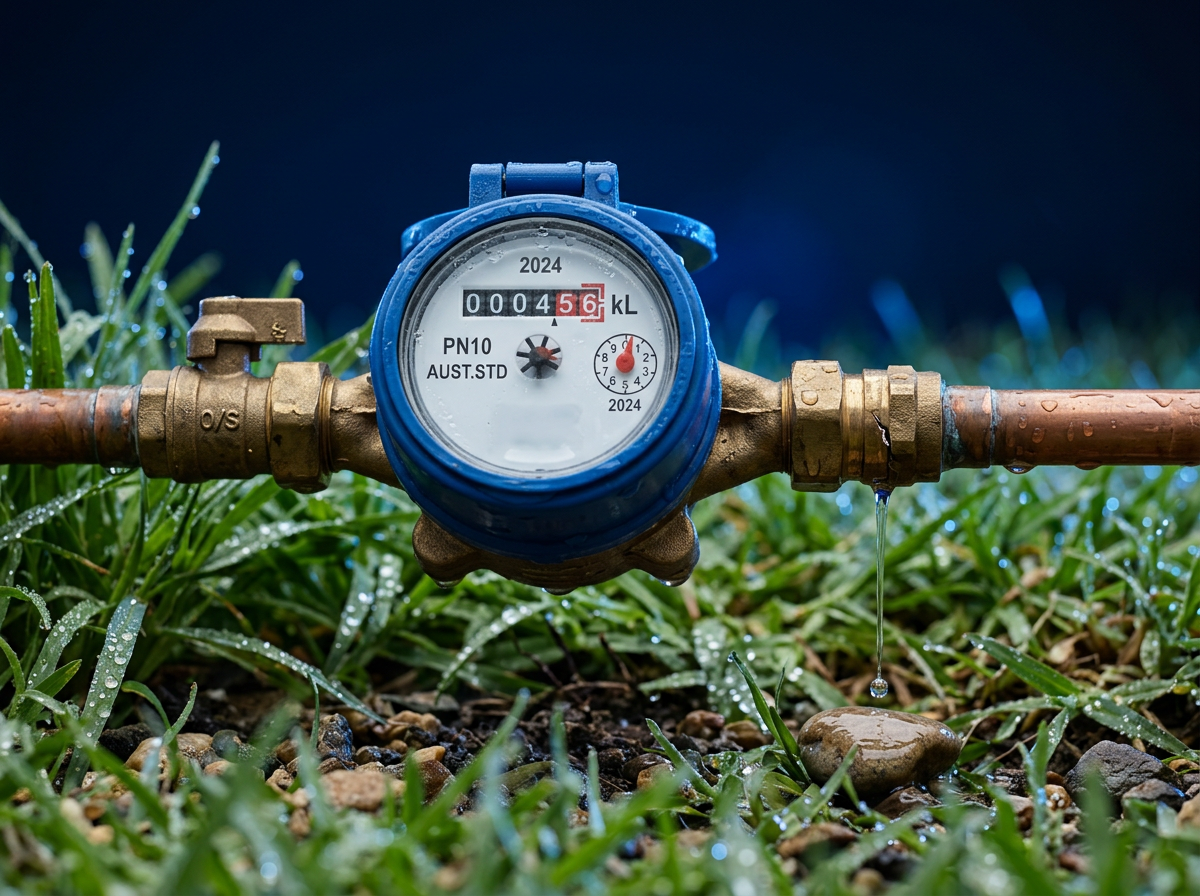
A standard Sydney residential water meter at the front boundary. The first place to check when bills jump.
Seven Warning Signs of a Hidden Hot Water Leak
Hidden hot water leaks rarely announce themselves. They whisper. Knowing the early signals can save you a four-figure bill and weeks of stress.
- A bill that climbed without a lifestyle change. No new appliance, no extra people, no extra showers, but the litres jumped.
- A patch of warm tile or carpet. Hot water heats whatever it touches, so a slab leak often shows up underfoot before it shows up as a stain.
- The hot water system runs more often than it used to. The thermostat is constantly reheating water that is escaping somewhere downstream.
- A faint hiss near the cylinder when no taps are open. That is pressurised hot water finding the path of least resistance.
- Rusty or discoloured marks at the base of the unit. Steel tanks corrode from the inside; the first external sign is staining at the skirt.
- Constant TPR valve discharge. A valve dripping more than a teaspoon an hour is a leak, not normal operation. Read our TPR valve safety guide.
- Mould or musty smell in a wall cavity adjacent to the bathroom. Hot water in a wall accelerates mould far faster than cold water leaks.
The 30-Minute Meter Test You Can Do Tonight
Before you call anyone, you can confirm the leak yourself in less time than it takes to cook dinner. This is the same test a licensed plumber will do as their first step.
- Turn off everything that uses water. Taps, dishwasher, washing machine, ice maker, garden timers. Ask the family not to flush.
- Walk to the meter at the front boundary. Photograph the dial including the small red sweep hand if your meter has one.
- Wait 30 minutes. Do not use any water at all.
- Re-read the meter. Any movement at all means water is leaving your property somewhere it should not be.
- Isolate the hot water system. Close the cold-water inlet valve at the top or side of your hot water unit. Repeat the test. If the meter now sits still, the hot water side is your culprit.
What the result actually tells you
If the meter still moves with the hot water unit isolated, the leak is on the cold water side: a toilet cistern, a buried garden line, or a cold supply pipe. If it stops, the leak is in the hot water unit, in the pipework that feeds the bathrooms and kitchen, or at the TPR discharge line. Either way, you have a clear answer in half an hour.
What It Costs to Find and Fix a Hidden Leak
Pricing varies by location and complexity, but the typical Sydney 2026 numbers look like this. Use them to set expectations before any plumber walks through the door.
| Job | Typical Sydney Cost | What You Get |
|---|---|---|
| Acoustic leak detection | $280 – $550 | Pinpoints the exact location without breaking tiles or slab |
| TPR valve replacement | $220 – $380 | New valve, drain line check, system re-test |
| Slab leak repair (re-route) | $1,400 – $3,200 | New flow line run above ground or through ceiling, abandoning the failed pipe |
| Cylinder replacement | $1,800 – $5,500 | Full new unit installed, see our 2026 Sydney price guide |
| Anode rod replacement | $220 – $450 | Extends tank life by 5+ years, see our anode rod guide |
Use the 50 percent rule when deciding between repair and replacement. If the cost to repair an old hot water cylinder approaches half the cost of a new system, replacement is the better long-term call. A modern heat pump unit with current NSW rebates usually pays back the difference within four to six years through reduced running costs.
How to Claim the Hidden Leak Allowance
The claim itself is straightforward, but the order of operations matters. Skip a step and the application can be knocked back. Follow this sequence and most claims clear within four to six weeks as a credit on the next bill.
- Get the leak repaired by a licensed plumber. The plumber must be currently licensed under the NSW Plumbing and Drainage Act 2011. An unlicensed handyman invoice will be rejected.
- Keep the itemised tax invoice. It must describe the leak location, confirm it was concealed, and list the date of repair. A vague "plumbing repair" line item is not enough.
- Download the Hidden Leak Allowance application form. Available from the Sydney Water website under accounts and billing.
- Lodge the claim within 12 months. Submit the form, the plumber's invoice, and a copy of the affected bill. You can lodge online, by post, or via your MyAccount portal.
- Watch your next bill. The credit applies to the water and sewer usage portion above your historical average. If anything looks wrong, call Sydney Water on 13 20 92.
Average refund range
Sydney households who successfully claim the Hidden Leak Allowance after a hot water system leak typically recover between $180 and $720 across the affected billing periods. Larger leaks that ran undetected over two cycles can recover more.
Frequently Asked Questions
How much did Sydney Water prices rise in 2026?
Sydney Water's IPART-approved 2025–2030 pricing determination introduced staged annual increases averaging around 18 percent above CPI for a typical household over the period. For 2025–26, most Sydney homes are paying noticeably more per kilolitre on usage charges plus higher fixed service charges, which means hidden leaks now cost far more than they did even two years ago.
What is the Hidden Leak Allowance from Sydney Water?
The Hidden Leak Allowance is a partial rebate Sydney Water offers when a concealed leak on the customer side of the meter causes an unusually high water bill. You must have the leak repaired by a licensed plumber, then submit the invoice and a Hidden Leak Allowance form to Sydney Water within 12 months. They typically refund the water and sewer usage portion above your normal consumption, often hundreds of dollars.
Can a hot water system leak without me seeing any water?
Yes. The most expensive hot water leaks happen underground, inside slabs, or behind walls where you never see a drop. A failed copper pipe under a concrete slab can lose 50 to 200 litres a day silently for months. The first sign is usually a higher bill or a warm patch on the floor, not a puddle.
How do I check my Sydney water meter for a hidden leak?
Turn off every tap and water-using appliance in the house. Find your meter at the front of your property and write down the dial reading. Wait 30 minutes without using any water. If the reading has moved, water is escaping somewhere on your property. To isolate whether the hot water system is the culprit, close the isolation valve at the cold inlet of your hot water unit, then repeat the test.
Will my home insurance cover a hidden hot water leak?
Most Australian home and contents policies cover the resulting water damage to walls, floors, and contents, but they do not cover the cost of repairing the failed pipe or hot water system itself. The wasted water charges are usually claimed back through Sydney Water's Hidden Leak Allowance, not your insurer. Always check your policy wording before assuming coverage.
How long does Sydney Water take to refund a Hidden Leak Allowance claim?
Once you submit the licensed plumber's invoice and the completed allowance form, Sydney Water typically processes the credit within four to six weeks. The refund appears as a credit on your next bill rather than a direct deposit, so factor that into your budgeting if the leak caused a significant cash-flow hit.
Suspect a Hidden Hot Water Leak? Find It Tonight
Our licensed Sydney plumbers carry acoustic leak detection gear and can confirm a hidden hot water leak in a single visit. Same-day callouts across Sydney, the Central Coast, and the Hunter. Keep the invoice and we will help you lodge the Hidden Leak Allowance claim.