
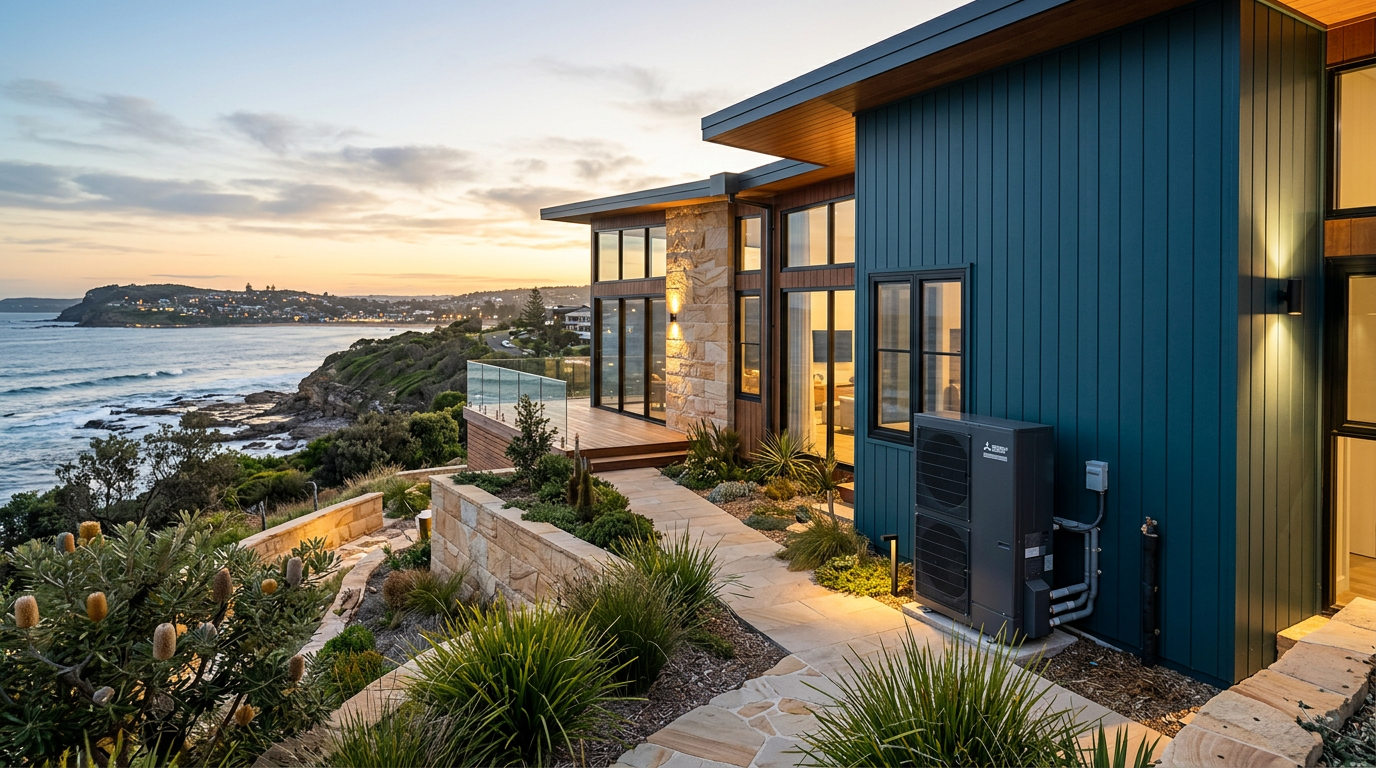
July on the Central Coast fills up. School holidays run through the middle two weeks, the Peats Ridge exit is bumper to bumper by Friday afternoon, and every second Airbnb between Terrigal and Ettalong is booked out with families chasing a quieter version of the winter break. It also fills up the shower queue. Six guests, one bathroom, one hot water system that was sized for two retirees who owned the place before it was listed — and by Sunday morning the last guest is standing under a cold rinse writing a two-star review in their head.
Hot water is the single most common complaint on Central Coast holiday-rental listings after cleanliness, and it is also the easiest thing to get right. This guide is written for owners and property managers running short-term rentals from Norah Head down to Pearl Beach. It covers sizing for peak turnover days, the tariff maths on a house that is empty half the month, coastal system choice, the NSW plumbing rules that apply to short-term rental accommodation, and the small operational details that stop hot water from ever showing up in your reviews.
Why Airbnb Sizing Rules Are Different From Owner-Occupier Sizing
A family of five in a normal Central Coast home spreads its hot water use across the day. School shower at 7am, gym rinse at 6pm, dishes at 8pm, bath for the youngest at 9pm. Standard sizing charts assume that pattern and it works well enough.
A short-term rental does not spread anything. Guests arrive at the 3pm check-in, unpack, and every adult in the house showers within a two-hour window before dinner. On check-out morning, four to six people shower back to back between 8am and 10am. In between, a family running a beach house will run three loads of towels, hose sand off two kids in an outdoor shower, and rinse wetsuits in the laundry tub. Your system sees six months of household hot water compressed into 48 hours, then sits idle for a week.
The standard sizing guide works from average daily litres per person. For a rental, you have to size for the peak simultaneous draw and the recovery time between check-ins. That usually means one class larger than a homeowner would buy for the same floor plan.
The Right Size for a Central Coast Holiday Rental
These are the working numbers we quote when a property manager or owner rings us. They assume guests behave like guests, not like the owner, and they build in enough capacity that no one takes a cold shower on turnover day.
| Property | Sleeps | Storage electric / heat pump | Continuous flow gas |
|---|---|---|---|
| 1 bedroom studio | 2 | 160 to 200 L | 16 L/min |
| 2 bedroom cottage | 4 | 250 to 315 L | 20 L/min |
| 3 bedroom beach house | 6 | 315 to 400 L | 26 L/min |
| 4 bedroom family rental | 8 | 400 to 500 L | Twin 26 L/min manifolded |
| 5 bedroom luxury rental | 10 to 12 | 500 to 630 L | Twin 32 L/min manifolded |
Two things worth calling out. First, if your storage tank recovery is slower than 60 minutes to full temperature, buy the next size up. Guests will not wait, they will just leave a review. Second, if the property has a spa or a rain-head shower with a 15 L/min flow rate, add an extra bedroom's worth of capacity before you sign the quote.
Gas, Electric or Heat Pump on the Coast?
The right answer depends on how many nights per year the property is booked and where it sits in the coastal corrosion zone. Salt exposure changes the maths, which is covered in more detail in our salt air corrosion guide.
Continuous flow gas is the traditional short-term rental default because it produces zero standby loss during the weeks a beach house sits empty. It is also compact, which matters when the property is on a small block. The downside on the Coast is that gas prices have climbed steadily since 2023 and the NSW planning system is quietly discouraging new gas connections, which flows through to buyer sentiment when the property changes hands. Best fit for properties booked fewer than 80 nights per year.
Heat pump is now the sweet spot for busy Central Coast rentals. Running cost on Ausgrid Controlled Load 1 sits around 4 to 6 cents per kWh delivered to the tank, and modern coastal-rated units from Reclaim, Sanden and Rheem run happily through Coast winters. If the property is booked more than 100 nights a year, a heat pump on Ausgrid controlled load tariffs will beat gas on lifetime cost inside four years. Just make sure you specify a coastal-rated variant if the property sits within 2 km of the surf.
Storage electric is worth considering only if the property already has solar PV, in which case a diverter and a 315 L tank can effectively run on free daytime solar. For everyone else, the standby heat loss on an empty house makes it the most expensive choice.
For the full running-cost breakdown, see our heat pump vs gas cost analysis and the 2026 controlled load tariff guide.
The NSW Rules That Apply to Your Rental
Short-term rental accommodation in NSW sits under a specific regulatory framework. Any property listed for stays under three months is caught by the register requirements set out by NSW Planning short-term rental accommodation rules, and the safety obligations are enforced through NSW Fair Trading.
For hot water specifically, the two rules that catch owners out are the tempering valve requirement and the discharge line rule.
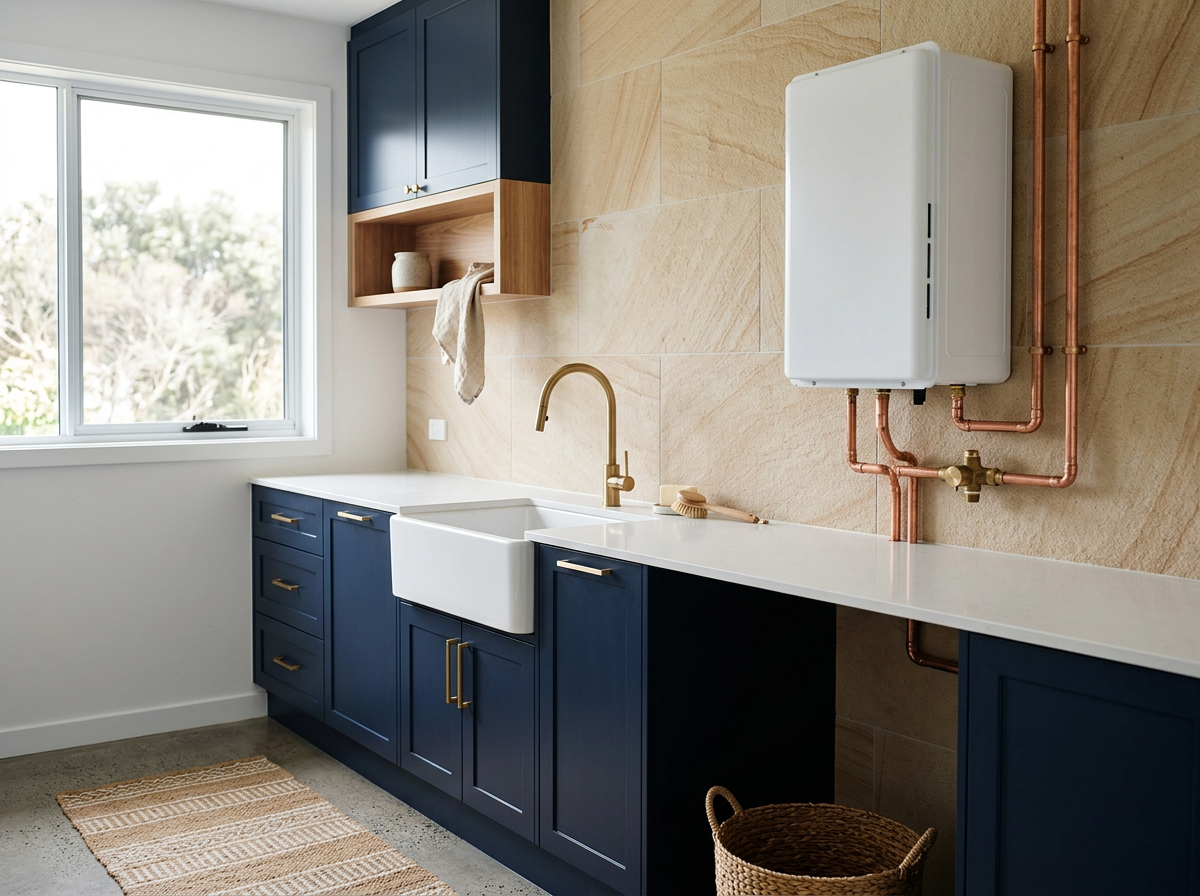
Tempering valve. Every outlet used for personal hygiene in a rental must deliver water at no more than 50 degrees Celsius. This is not new, but a lot of older Coast properties still have unrestricted 65 to 70 degree water reaching the shower, which is both a scald risk and a compliance failure. Full detail on the standard sits in our tempering valve requirements guide.
TPR discharge line. The temperature pressure relief valve on any storage tank must have a discharge pipe run to safe drainage in accordance with AS/NZS 3500.4:2021. On coastal properties this often gets ignored during renovations, and a guest calling out a puddle under the tank is a common way to fail an insurance claim.
If you own the property through a corporate structure and use it as pure investment, note that continuous commercial use pushes it out of the domestic scope of AS/NZS 3500 and into the commercial provisions. For anything with an on-site cleaning contractor, a laundry with commercial capacity, or a spa larger than 680 L, our commercial hot water page covers the specification changes.
Why Beachfront Owners Buy Coastal Systems Twice
Standard hot water systems fail earlier on the Coast than the manufacturer's warranty acknowledges. According to Bureau of Meteorology climate data for Gosford, relative humidity across the year averages above 70 percent, and Pacific winds push airborne salt several kilometres inland. That is the environment your outdoor heat pump or gas unit lives in.
For a rental property, the compounding factor is that a failed hot water unit does not just cost you the replacement — it costs you the refund on the current booking and often the next one while a new system is installed. A single mid-summer failure on a five-bedroom Terrigal listing costs more in refunded nights than the price of buying a coastal-rated system in the first place. Specify coastal from day one and price the extra $600 to $1,200 as insurance rather than an upgrade.
Winter 2026 Guest Complaints We Are Fielding Right Now
Between the Anzac Day long weekend and the end of the school holidays this July, our booking system logged 143 emergency calls from short-term rentals across the Coast. Four patterns account for nearly all of them.
- Cold shower on check-in day (52 calls). Almost always a tank sized for the previous owner rather than for turnover-day peak demand. Fixed by upsizing the storage tank or manifolding a second continuous flow unit.
- Cold water sandwich in the second shower of the morning (31 calls). A gas continuous flow issue described in detail in our cold water sandwich guide. Modern recirculation logic or a preheat buffer tank fixes it.
- Tempering valve failure (24 calls). On 8-year-old Coast systems, corrosion in the valve body causes it to seize. Guests either get scalding water or a lukewarm trickle. Replacement is a 45-minute job and costs less than one refunded night.
- Heat pump underperforming in cold snaps (18 calls). Almost always a defrost cycle running longer than expected, covered in the defrost cycle winter guide. The fix is airflow clearance and a firmware check.
The other 18 calls were a mix of pilot lights, isolation valve failures and guests turning off the wrong tap. That last one is why every listing needs a one-page laminated appliance guide in the kitchen drawer.
The Small Operational Details That Save Reviews
Once the system itself is right, four small habits stop most hot water complaints from ever becoming reviews.
- Insulate hot water lines to bathrooms. A guest turning on the shower expects hot water within 15 seconds. In an uninsulated Coast beach house with an outdoor unit and a 12 metre run to the ensuite, they can wait 45 seconds. That feels broken. Foam lagging on accessible runs is a one-hour job.
- Set the tempering valve to exactly 50 degrees. Guests notice both scalding water and lukewarm water. Fifty degrees is the maximum permitted for personal hygiene outlets and the sweet spot for perceived quality.
- Leave a one-page guide. Explain shower mixer operation, where the hot water isolation valve is, how to reset a tripped safety switch, and what to do if there is no hot water at 6am on a Sunday (which is our after-hours number). Guests who feel informed do not leave one-star reviews when something small goes wrong.
- Book an annual pre-season service. Every May before the June and July surge, we service around 90 Coast rentals. Anode checks, TPR test, flush, tempering valve verification, coastal wash-down of heat pump condensers. It costs less than one bad review's opportunity cost.
Also worth reading — Airbnb hosting standards lists working hot water as a core requirement and a repeated failure can result in a listing suspension.
The Numbers: Running Cost Across a Booked Year
This is a working estimate for a 3-bedroom Terrigal-style rental sleeping six, booked 150 nights per year at winter 2026 Central Coast energy prices. Guests use around 90 L of hot water per person per day, more than a homeowner, because they treat holidays as a licence to shower twice.
| System | Annual running cost (150 nights) | 10-year total (equipment + energy) |
|---|---|---|
| 26 L/min natural gas continuous flow | $780 to $920 | $11,500 to $13,200 |
| 26 L/min LPG continuous flow | $1,850 to $2,300 | $22,000 to $26,000 |
| 315 L heat pump on Controlled Load 1 | $310 to $420 | $7,800 to $9,400 |
| 315 L electric storage on flat tariff | $1,600 to $1,950 | $18,500 to $22,000 |
On these numbers, a coastal-rated heat pump on Controlled Load 1 is roughly $600 per year cheaper to run than natural gas and nearly $1,500 per year cheaper than LPG. Over the life of the system, that is the difference between one bathroom renovation and none. For context on how holiday-rental demand fits into wider tourism accommodation figures, the ABS tourist accommodation data is a useful reference for owners modelling occupancy against system cost.
What to Ask Your Plumber Before You Sign a Quote
Not every plumber quotes rental properties the way they quote family homes. Six questions to ask before you accept a quote:
- Is the system coastal-rated for the specific zone this property sits in?
- What is the first-hour delivery figure for six back-to-back showers?
- Where does the TPR discharge line terminate and does it meet AS/NZS 3500.4?
- Is the tempering valve new, and set to 50 degrees at commissioning?
- Does the warranty cover coastal exposure or is there an exclusion within 1 km of the surf?
- What is the turnaround if this system fails during peak season?
A plumber who cannot answer those cleanly should not be putting a hot water system on your rental. For emergency response detail during peak-season bookings, see our emergency hot water repair page. Older units and the risks of leaving a scald hazard in a guest bathroom are covered in the hot water safety guide.
Bringing It Together for the 2026 Winter Season
Central Coast holiday rentals live and die on reviews, and hot water is the one utility that guests notice only when it fails. Getting the specification right the first time is cheaper than any refund, any bad review, or any peak-season emergency callout. Size for turnover-day peak rather than average household use. Pick a coastal-rated heat pump if the property is booked more than 100 nights a year, or a continuous flow gas unit if it sits empty for most of the winter. Fit and verify the tempering valve. Book the pre-season service in May. Leave a one-page guide in the kitchen drawer.
Do those five things and hot water stops being a variable in your listing performance. It becomes a fixed background utility that guests never think about, which is exactly what a five-star Central Coast rental needs.