
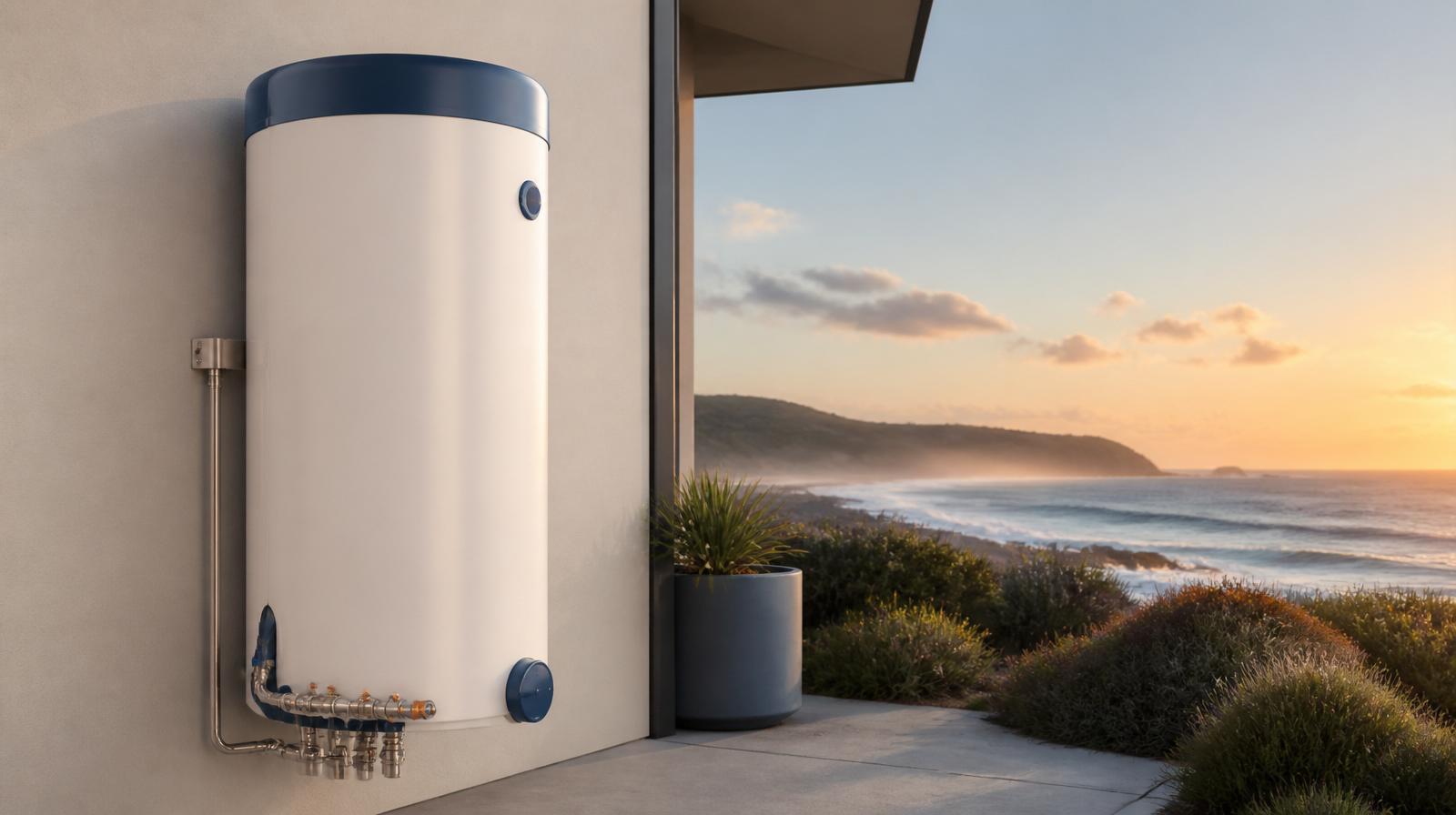
Salt Air Hot Water Systems Central Coast: Corrosion Guide
If you live between Wamberal and Ettalong, your hot water system is quietly fighting a war it did not sign up for. Every southerly that rolls in off the Pacific carries microscopic salt droplets, and those droplets settle on the jacket of your tank, the copper pipework, the brass fittings and the outdoor unit of your heat pump. Six years in, the rust starts. Nine years in, most coastal Central Coast tanks are already leaking.
This winter has been a reminder. The July 2026 east coast low that hammered Terrigal, Avoca and Copacabana with 100 km/h southerlies pushed a visible salt haze as far inland as Erina Fair, according to Bureau of Meteorology NSW warnings. Homeowners in Kincumber and Kariong who thought they were safe from ocean weather are now finding white oxidation on outdoor fittings that were shiny 18 months ago. This guide is for anyone on the coast who wants their next hot water system to last the full 12 years rather than fail on a cold Sunday morning.
Why Central Coast Salt Air Is Different
The Central Coast sits in one of the most exposed corrosion zones on the eastern seaboard. Prevailing north-easterlies through summer carry aerosolised sea salt from Norah Head to The Entrance, then winter southerlies push that same salt-laden air back over Terrigal, Avoca and MacMasters Beach. Unlike parts of northern Sydney that sit behind ridgelines, the coastal plain from Bateau Bay down to Umina has almost nothing between the surf and your side yard.
Standards Australia classifies most of the coastal strip east of the M1 motorway as Category C4 (high) atmospheric corrosivity, and the immediate beachfront from Wamberal to Killcare as C5-M (very high, marine). For context, standard mild steel loses roughly 25 to 50 micrometres of thickness per year in C4 conditions and 50 to 80 micrometres per year in C5-M zones, according to the CSIRO's atmospheric corrosion research program. A domestic hot water tank jacket is not thick. The relevant plumbing standard for coastal installations is AS/NZS 3500.4:2021.
What makes it worse on the Coast is humidity. The Pacific keeps relative humidity above 70 percent for most of the year, and salt only corrodes when it is wet. In dry inland areas, salt sits harmlessly on surfaces. Here, it deliquesces — pulls moisture from the air — and forms a permanent electrolyte film that keeps the corrosion reaction going 24 hours a day.
What Salt Actually Does to Your Hot Water System
Corrosion on the Coast is not one problem but three. Understanding which mechanism is attacking which component tells you where to spend your money.
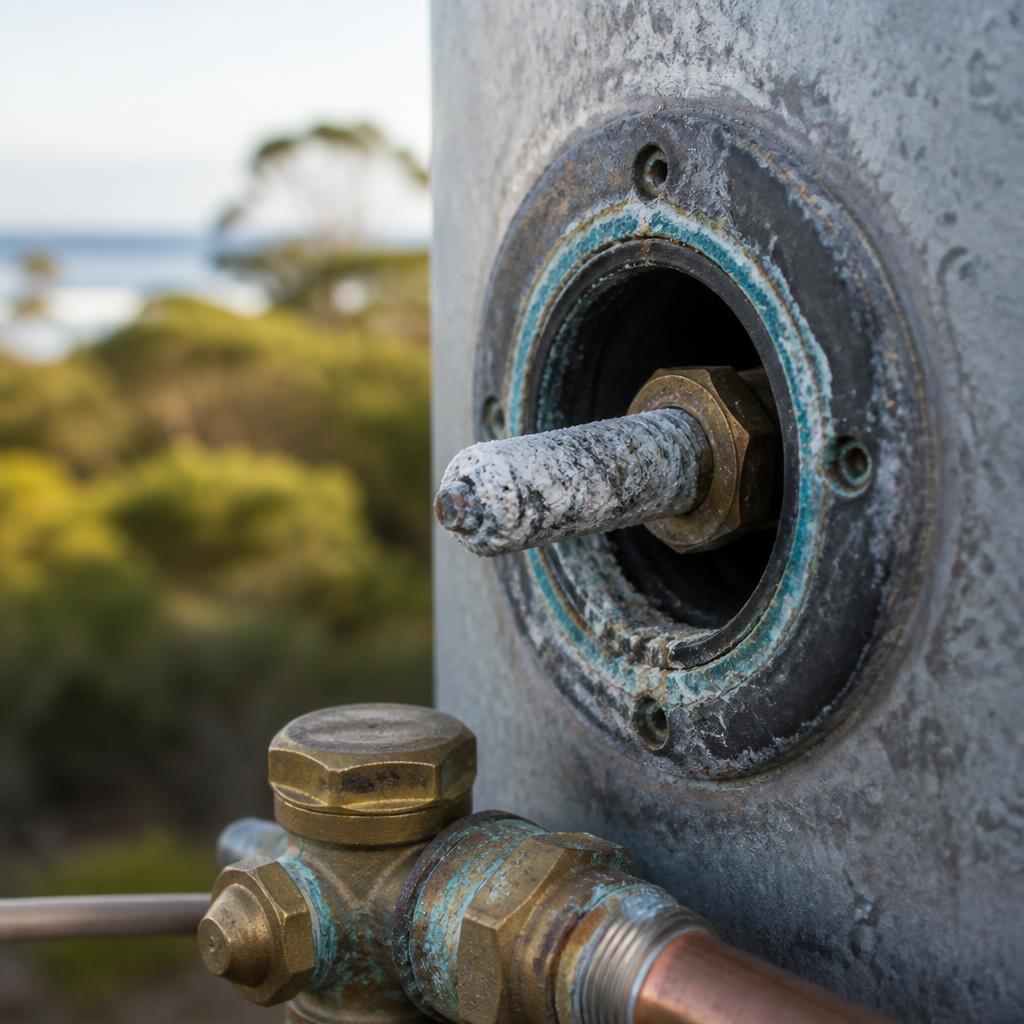
Chloride pitting is the fast killer. Chloride ions punch through the passive oxide layer on stainless steel and mild steel alike, creating deep localised pits that turn into pinhole leaks. This is what eats the base of enamel tanks after the anode is exhausted, and what perforates copper pipe elbows within a few metres of the tank.
Galvanic corrosion is the slow killer. When two different metals sit in contact with a salt-water film between them, the less noble metal sacrifices itself. Brass fittings on a galvanised steel bracket, copper flex hoses landing on a steel manifold, aluminium heat pump fins bolted to a stainless casing — all common failure points on coastal systems.
Crevice corrosion is the hidden killer. Salt water wicks into tiny gaps between fittings, under insulation and behind rubber seals, then the oxygen in that trapped water gets consumed and the pH crashes. What looks like a perfectly clean fitting from outside can be honeycombed inside. Most coastal tank failures start as crevice corrosion at the top of the tank where the cold inlet enters.
How Far Inland Does the Problem Really Reach?
There is a common assumption on the Coast that if you cannot see the ocean, you are safe. The research says otherwise. A 2019 study by the University of Newcastle on coastal NSW housing stock found measurable salt deposition rates above 20 mg per square metre per day at distances of up to 3 km from the surf zone during onshore wind events.
In practical terms, here is roughly how the Central Coast breaks down for hot water systems:
- Zone 1 (within 500 m of the surf): Wamberal, Terrigal, Avoca Beach, North Avoca, Copacabana, MacMasters Beach, Killcare, Pearl Beach, Umina Beach frontage, Ettalong Beach frontage, The Entrance, Toowoon Bay, Shelly Beach. Expect a standard enamel tank to fail at 6 to 8 years.
- Zone 2 (500 m to 2 km): Forresters Beach, Bateau Bay, Long Jetty, Killarney Vale, Berkeley Vale eastern edge, Kincumber, Empire Bay, Booker Bay, most of Umina and Woy Woy. Expect a standard tank to fail at 8 to 10 years.
- Zone 3 (2 km to 5 km): Erina, East Gosford, Point Frederick, Springfield, parts of Kariong and Wyoming, Green Point, Saratoga, Davistown, San Remo, Chittaway Point, Berkeley Vale west. Standard tanks last close to normal, 10 to 12 years, but heat pump condensers still take a beating.
- Zone 4 (beyond 5 km inland): Ourimbah, Somersby, Kulnura, Palmdale, Fountaindale, Mount White. Effectively non-coastal conditions. Standard tanks give full life.
These are working estimates from our own service records across the region, not published figures, but they line up closely with what CSIRO's coastal corrosion mapping predicts.
The Six Components Salt Attacks First
When our techs pull an old system off a coastal wall, the failures cluster in six predictable spots. If you know where to look, you can catch most of them before they turn into a flooded laundry.
1. The Cold Water Inlet Fitting
Salt-laden air pools in the small gap between the tank jacket and the inlet nipple, and crevice corrosion eats the thread from the outside in. First sign is a faint white salt bloom or a slow weep at the top of the tank. Left alone, it becomes a full pinhole leak within 12 months.
2. The Temperature Pressure Relief Valve Discharge Line
Copper discharge lines corrode from outside on the coast, not from inside. The green patina looks decorative but it is active corrosion, and the copper wall thins to the point of failure. If your discharge line is more than five years old and coated in verdigris, it needs to come off. Our full breakdown is in the TPR valve leaking guide.
3. The Sacrificial Anode Rod
Every storage tank has an anode rod that corrodes so the tank does not. Coastal water on the Central Coast, particularly the harder water on the Woy Woy and Ettalong side, chews through anodes 30 to 40 percent faster than Sydney average. If your tank is more than four years old and you have never replaced the anode, you are almost certainly running on the last of it. Full detail is in our anode rod replacement guide.
4. Heat Pump Evaporator Fins
Standard heat pump condensers have thin aluminium fins with no protective coating. Salt attacks them relentlessly, and once the fins clog with salt-corrosion product, the compressor works harder and efficiency collapses. A heat pump running at COP 4.0 when new can drop to COP 2.2 within three coastal years if the fins are not coated or rinsed.
5. Steel Mounting Brackets and Straps
Galvanised brackets rust from the cut edges inward. On a 6-year-old install in Terrigal we recently replaced, the brackets themselves were the failure — the tank was still good but the straps had rusted to the point where they no longer safely held the weight of a full tank in a seismic event.
6. Gas Regulator Diaphragms
Not corrosion strictly, but salt-laden air fouls the vent hole on external LPG and natural gas regulators, causing pressure creep and pilot outages. If your gas hot water keeps losing its pilot light on the coast, the regulator is usually the culprit rather than the pilot assembly itself. More context in our pilot light guide.
Coastal Tank Lifespan: What to Expect
Manufacturer warranties assume inland conditions. On the Central Coast, the numbers change materially. These figures come from tracking install and replacement dates across our service book from 2018 through mid-2026.
| System type | Inland lifespan | Coastal Central Coast lifespan |
|---|---|---|
| Standard vitreous enamel electric tank | 10 to 12 years | 6 to 9 years |
| Vitreous enamel with upgraded magnesium anode | 12 to 14 years | 8 to 11 years |
| Marine-grade stainless steel tank | 15 to 20 years | 12 to 15 years |
| Standard heat pump (uncoated fins) | 10 to 12 years | 5 to 7 years |
| Coastal-rated heat pump (treated fins) | 12 to 15 years | 10 to 13 years |
| Continuous flow gas (external) | 15 to 20 years | 10 to 14 years |
The takeaway is not that coastal life is doomed. It is that the cheapest system is almost never the best value on the coast, because the difference between a $1,600 enamel tank and a $2,400 stainless tank pays for itself twice over in the extra six years you get.
Choosing a System That Survives Coastal Conditions
If you are in Zone 1 or Zone 2, the specification matters more than the brand. Ask the plumber quoting your job for these features specifically:
- Marine-grade 316 stainless tank rather than 304 or vitreous enamel. Grade 316 has 2 to 3 percent molybdenum, which resists chloride pitting far better than 304.
- Coastal or marine-rated heat pump if you are going electric. Rheem Ambipower Coastal, Reclaim Energy CO2 with marine kit, and Sanden Eco-Plus all offer coastal variants for the Central Coast market.
- Powder-coated stainless brackets rather than galvanised, and stainless bolts throughout.
- Under-cover installation wherever possible. A simple awning that stops direct rain and reduces salt deposition will add 3 to 5 years to any system.
- Extended coastal warranty. Manufacturers routinely void standard warranties within a certain distance of the surf. Rheem, Rinnai and Dux all sell coastal warranty extensions for a small premium.
For a broader look at what fits which household, our system sizing guide and 2026 brand comparison cover the trade-offs across gas, electric and heat pump.
A Six-Step Coastal Maintenance Routine
The single biggest predictor of coastal tank life is not the brand you buy but whether anyone maintains it. Almost no one does. Here is the routine we recommend to every Central Coast customer:
- Every 3 to 4 months (Zone 1) or 6 months (Zone 2): gently rinse the jacket, fittings and heat pump condenser fins with the garden hose on a low pressure setting. Do this after any prolonged easterly or southerly event.
- Every 12 months: visually inspect all copper pipework, brass fittings and the TPR discharge line for green patina or white salt bloom. Photograph anything suspect so you can compare year on year.
- Every 2 years: have a licensed plumber inspect the anode rod. Replace it if more than 60 percent consumed. In Zone 1, this often means annual replacement.
- Every 4 to 5 years: replace the TPR valve regardless of appearance. Australian Standard AS/NZS 3500 recommends five years inland; on the coast we push the interval down to four.
- Every 5 years: full flush of the tank to remove sediment. Coastal water carries more mineral load and sediment insulates the element, driving up bills. Detailed steps are in our flushing guide.
- Every 6 to 7 years: honest assessment of whether repair still makes sense. If the tank is Zone 1 and past year seven, budget for replacement rather than another patch.
When Repair Stops Making Sense
We fix a lot of coastal systems that should have been replaced two years earlier. The rule of thumb we give homeowners is simple: if the repair cost is more than 40 percent of a new installed system and the tank is past 70 percent of its expected coastal lifespan, replace it.
For a 7-year-old enamel tank in Terrigal with a leaking cold inlet fitting, that means a $650 repair on a $1,800 replacement is a no. For the same fault on a 3-year-old stainless tank in Erina, the repair is an obvious yes. The variable is not just age but coastal exposure zone, and most plumbers who service inland areas do not factor this correctly. Our lifespan guide lays out the full decision tree.
If your system has already failed and you are without hot water, our Central Coast emergency guide covers what to do in the first hour and how our same-day service works from Woy Woy up to Wyong.
Winter 2026: Why This Season Matters
Two things make winter 2026 the year to check your coastal system rather than defer. First, the July east coast low delivered the heaviest salt spray event we have seen since June 2022, and coastal systems installed between 2018 and 2020 are now hitting the age where that acute exposure tips them from working to leaking. Second, the NSW Energy Savings Scheme rebates for heat pump replacement have been increased for 2026, with coastal-rated units eligible for up to $1,600 off the installed cost through accredited providers.
If you were planning to replace anyway, doing it before spring means claiming this year's rebate before the scheme's expected mid-2027 tightening. Our 2026 NSW rebates guide walks through eligibility, and the gas-to-heat-pump switching guide covers the wider payback maths.
For homeowners in Zone 3 or 4 who have been assured their systems are safe, use this winter as the trigger for a first proper visual check. The corrosion signs are always there before the leak arrives.
Get a Free Coastal System Health Check
Our team runs a no-cost visual inspection for Central Coast homes between Wyong and Woy Woy: anode status, fittings condition, corrosion zone assessment, remaining lifespan estimate and honest advice on whether to maintain, repair or replace. If you have not had eyes on your system in the last two years, it is worth booking one. It takes about 20 minutes on site and there is no obligation attached.