

Step into a Hornsby backyard at six on a June morning and the heat pump beside the laundry will sound nothing like it did in February. The fan is slower, there is a faint hiss of refrigerant reversing direction, and a column of steam rolls off the top of the unit and drifts across the frosted grass. The homeowner usually calls us thinking the unit is broken. It almost never is. What they are watching is a defrost cycle, and on a Sydney winter morning it is doing exactly what the engineers in Osaka or Brisbane designed it to do.
This guide pulls apart the defrost cycle for Sydney homeowners running a heat pump hot water system through winter 2026. We cover what is actually happening inside the cabinet, how it affects your morning hot water, the real coefficient of performance numbers we measure on Sydney callouts in June and July, and the short list of faults that turn a normal defrost into a service call. The figures lean on our own field data across about 4,000 jobs a year, cross-checked against the national water heater energy ratings.
What a Defrost Cycle Actually Does
An air-source heat pump works by passing cold outdoor air across a finned aluminium evaporator. Refrigerant inside the coil sits below the air temperature, absorbs heat from the passing air, then carries that heat to a compressor and into the storage tank. The colder the air, the colder the refrigerant has to be to absorb anything at all, and on a Sydney winter morning that surface temperature is comfortably below freezing.
Moisture in the air condenses on the cold fins and freezes into a thin layer of frost. Once frost builds up past about two millimetres, airflow through the coil drops and efficiency collapses. The unit then runs a defrost cycle: it briefly reverses refrigerant flow so the evaporator becomes hot, the frost melts, the meltwater drains away, and normal heating resumes. The whole event takes between four and twelve minutes depending on brand and ambient temperature.
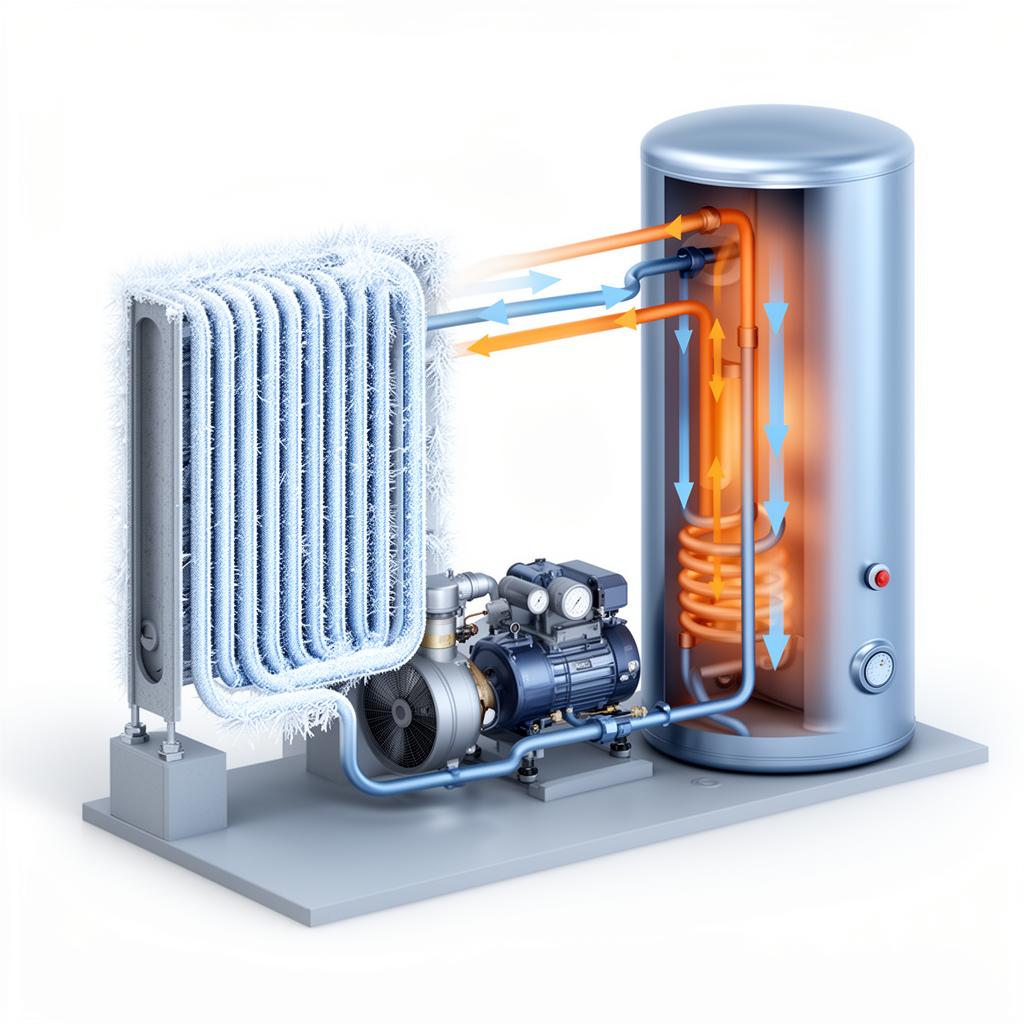
Where the Heat for Defrost Comes From
This is the part most homeowners miss. The heat used to melt the frost is pulled from the storage tank, not from the grid. A Sydney 270L unit typically loses 1 to 3 litres of effective hot water capacity per defrost event. Across six defrosts on a cold night, the tank can sit four to eight degrees cooler at sunrise than it did at midnight, which is why morning showers can feel marginal even though the system is running fine.
How Often Does It Happen in Sydney?
Defrost frequency is governed by ambient air temperature and humidity. Sydney sits in a sweet spot for heat pumps: cold enough to need defrost on most winter mornings, but rarely cold enough to trigger the heavy defrost schedules common in Canberra or Bathurst. The basin overnight lows tracked by the Bureau of Meteorology typically run 4C to 9C through June and July, with humidity above 75 percent on the coastal side.
Here is what we measure in the field on a typical Sydney winter morning, sampled across Reclaim, Sanden, iStore, Rheem Ambiheat and Chromagen units in suburbs from Penrith to Bondi.
| Overnight low | Typical defrost interval | Defrost duration | Daily defrost share of run time |
|---|---|---|---|
| 12C and above | Rare or none | n/a | 0 to 2% |
| 8C to 11C | 60 to 90 minutes | 4 to 7 minutes | 5 to 9% |
| 4C to 7C | 30 to 60 minutes | 6 to 10 minutes | 10 to 16% |
| 0C to 3C (Western Sydney) | 20 to 35 minutes | 8 to 12 minutes | 16 to 24% |
Western Sydney callers in Penrith, Riverstone and Castle Hill see noticeably more defrost activity than Eastern Suburbs callers in the same week, simply because dawn temperatures sit two to five degrees lower inland. That gap is also why a North Shore install and a Western Sydney install behave so differently on the same nameplate model.
What This Does to Your Coefficient of Performance
Coefficient of performance, or COP, is the ratio of heat energy delivered to electrical energy drawn. A brochure COP of 5.0 means one kWh of electricity moves five kWh of heat into the tank. Brochure figures are quoted under the AS/NZS 5125.1 test condition of 19C dry bulb air and a 15C inlet water, which is essentially a mild Sydney spring day. Real winter mornings sit nowhere near that.
The table below shows what we measure on Sydney callouts at sunrise, against the same units in October. The Auckland and Brisbane technical white papers from the major heat pump brands line up closely with these numbers, and our reading is consistent with the federal Your Home guidance on heat pump hot water.
| Unit class | Brochure COP | Sydney July sunrise COP | Sydney October midday COP |
|---|---|---|---|
| CO2 refrigerant (Sanden, Reclaim) | 4.8 to 5.2 | 3.0 to 3.4 | 4.3 to 4.7 |
| R290 propane (iStore, Aquatech) | 4.5 to 5.0 | 2.8 to 3.2 | 4.0 to 4.5 |
| R134a older models | 3.5 to 4.0 | 2.0 to 2.6 | 3.2 to 3.6 |
| Integrated tank-top (Rheem Ambiheat HDi) | 3.8 to 4.2 | 2.4 to 2.9 | 3.5 to 3.9 |
Even at the bottom of that range a Sydney heat pump is still two to three times more efficient than the resistive electric element it usually replaces, and it remains cheaper to run than gas storage once the daily standby losses we covered in our standby heat loss guide are counted.
Why Your Tank Feels Cooler in the Morning
Three things stack up overnight in winter. First, recovery time per kWh of heating is longer because air-to-refrigerant heat transfer is slower. Second, each defrost subtracts a small amount of heat back out of the tank. Third, standby losses through the tank walls scale with the gap between water temperature and outdoor air, and the gap is larger in July than in February.
The net effect is that a 270L tank sitting at 60C at 10pm can be sitting at 52C to 55C by 7am even with no draw-off, simply because the unit has been firefighting the cold. That is rarely a fault. It is the system doing its job. If the morning shower feels weak, the answer is usually to shift the controlled-load run window, not to call a plumber. We walk through this in detail in our Sydney hot water tariffs guide.
Six Signs a Defrost Cycle Is Going Wrong
Normal defrost is invisible to your bills and your showers. These six symptoms suggest something has shifted from routine winter behaviour into a service call.
- Continuous steam for more than 20 minutes. The condensate drain has iced over, water is pooling at the base, and the next defrost cannot complete.
- A solid ice cap on the top of the evaporator. The defrost sensor or four-way valve has failed and frost is no longer being cleared.
- Loud rhythmic clunking at the start of every cycle. The reversing valve is sticking. Left untreated this fails the compressor inside a season.
- The booster element light is on at sunrise every day. The unit cannot keep up because of an airflow blockage, low refrigerant charge, or a tank thermostat fault.
- Lukewarm water by 8am despite low household demand. Almost always a stuck check valve or a failing compressor. Diagnostics in our common faults guide isolate the cause in ten minutes.
- Tripping the RCD overnight. Moisture has entered the electrical compartment, often via a degraded grommet. Stop the unit at the isolator and call a licensed plumber.
Installation Choices That Make Sydney Winters Easier
Heat pump performance through winter is set the day the unit is bolted to the slab. The decisions that matter most are airflow clearance, position relative to prevailing wind, and the routing of the condensate drain. Our installers follow these rules on every Sydney job and they account for the difference between a unit that defrosts six times overnight and one that defrosts twelve times overnight.
- Keep 600 mm of clear air in front of the evaporator and 200 mm at the rear. Most warranty claims we see for poor winter performance trace back to a unit pushed into a corner.
- Face the evaporator away from the prevailing southerly winter wind. In Sydney that means an east or north aspect wherever possible.
- Run the condensate drain to grade with a continuous fall and no horizontal kinks. An iced-up trap is the single most common winter callout.
- Mount the unit on a concrete pad or galvanised feet at least 100 mm above grass level so leaf litter and lawn clippings cannot clog the lower fins.
- Insulate the hot outlet pipework with closed-cell lagging on the first three metres. Bare copper above a heat pump leaks the very heat the unit just spent electricity to make.
Installation rules are tightened further when the unit sits inside an urban noise-sensitive zone, which is most of Sydney. Our heat pump noise rules guide covers the EPA limits and setbacks in plain language.
Should You Engage the Booster Element in Winter?
Most modern heat pumps ship with a 2.4 to 3.6 kW resistive element that can be activated manually or automatically when the tank falls below a set threshold. The element runs at a COP of 1.0, which is the same as any old-fashioned electric storage unit. Using it routinely defeats the whole reason you bought a heat pump.
The sensible setting for a Sydney winter is to leave the booster on Auto with the trigger threshold at 42C or lower, and only override it manually before known high-demand events: a houseful of visitors, a back-to-back washing and shower day, or after several consecutive nights below 5C. Used that way it adds maybe $8 to $15 to a quarterly bill and avoids the cold-shower call. Left on permanently it can add $80 to $120 a quarter, as we documented in our running cost comparison guide.
Defrost, Bills and Sydney Water
A defrost cycle on a healthy unit does not waste water. A defrost cycle on a unit with a leaking pressure relief valve absolutely does, because every reheat after defrost can push the valve open and discharge two to six litres straight down the drain. With Sydney Water lifting usage charges again this year, a chronically dripping relief valve is more expensive in 2026 than it has ever been.
If your water bill has climbed at the same time as your power bill, the diagnostics in our Sydney Water bill shock guide are the right starting point. Sydney Water runs a Hidden Leak Allowance program that can rebate verified concealed leaks, and a confirmed faulty TPR often qualifies.
What an Annual Winter Service Includes
A pre-winter heat pump service in Sydney costs $190 to $280 and is the cheapest insurance against a July cold-shower morning. A proper visit checks every system that matters once the dawn temperature drops.
- Evaporator fin inspection and a soft brush clean of leaf litter and pollen.
- Condensate drain flush and trap inspection, with a check for fall and freeze risk.
- Refrigerant pressure check against the manufacturer winter curve, not just the summer figure.
- Defrost sensor and four-way valve test using the service mode in the controller.
- Tank anode rod inspection. A failing anode signals tank wall thinning, which raises standby loss and reduces effective capacity.
- Tempering valve function test at the bathroom outlet, confirming the 50C delivery limit required under NSW plumbing standards.
- Booster element resistance test and threshold review.
Households that book a service before the end of June consistently see fewer winter callouts and a measurably lower hot water bill across the cold quarter. NSW Fair Trading requires any work on a heated water service to be carried out by a licensed plumber, so this is not a DIY job.
The Bottom Line for Sydney Homes
Defrost is the price of admission for using a heat pump in winter and on a Sydney climate it is a bargain. Even with the COP losses, six to twelve defrost cycles a night and a slightly cooler tank at sunrise, the system is still two to three times cheaper to run than the electric element it replaced, and it gets you off gas at a point in the cycle where Sydney gas charges keep moving in one direction. The fixes that matter most are install position, condensate drainage, an annual service, and a sensible booster threshold.
If your unit is steaming for an hour, icing over, or pulling lukewarm water by breakfast, book a service this week rather than next month. With the NSW heat pump rebate still active for eligible swap-overs through 2026, the timing has rarely been better to fix an underperforming unit or replace an ageing one. The full rebate landscape is in our NSW hot water rebates 2026 guide, and the gas-to-heat-pump cost story sits in our switch guide.