

Walk out to the side of your Sydney house on a cold June morning and put a hand on the casing of your hot water tank. It will be warm, even though nobody has run a tap since the night before. That warmth is your energy bill, escaping into the back garden one slow watt at a time. With Sydney Water lifting its prices again this year and Ausgrid controlled load rates ticking up, the cost of a tank sitting idle has stopped being a rounding error.
This guide unpacks standby heat loss for Sydney homes: what it actually is, how many dollars it adds to a typical Inner West, North Shore or Western Sydney bill through winter 2026, and the five practical fixes that move the dial. The numbers below are drawn from national water heater energy ratings and our own field data across roughly 4,000 Sydney callouts a year.
What Standby Heat Loss Actually Is
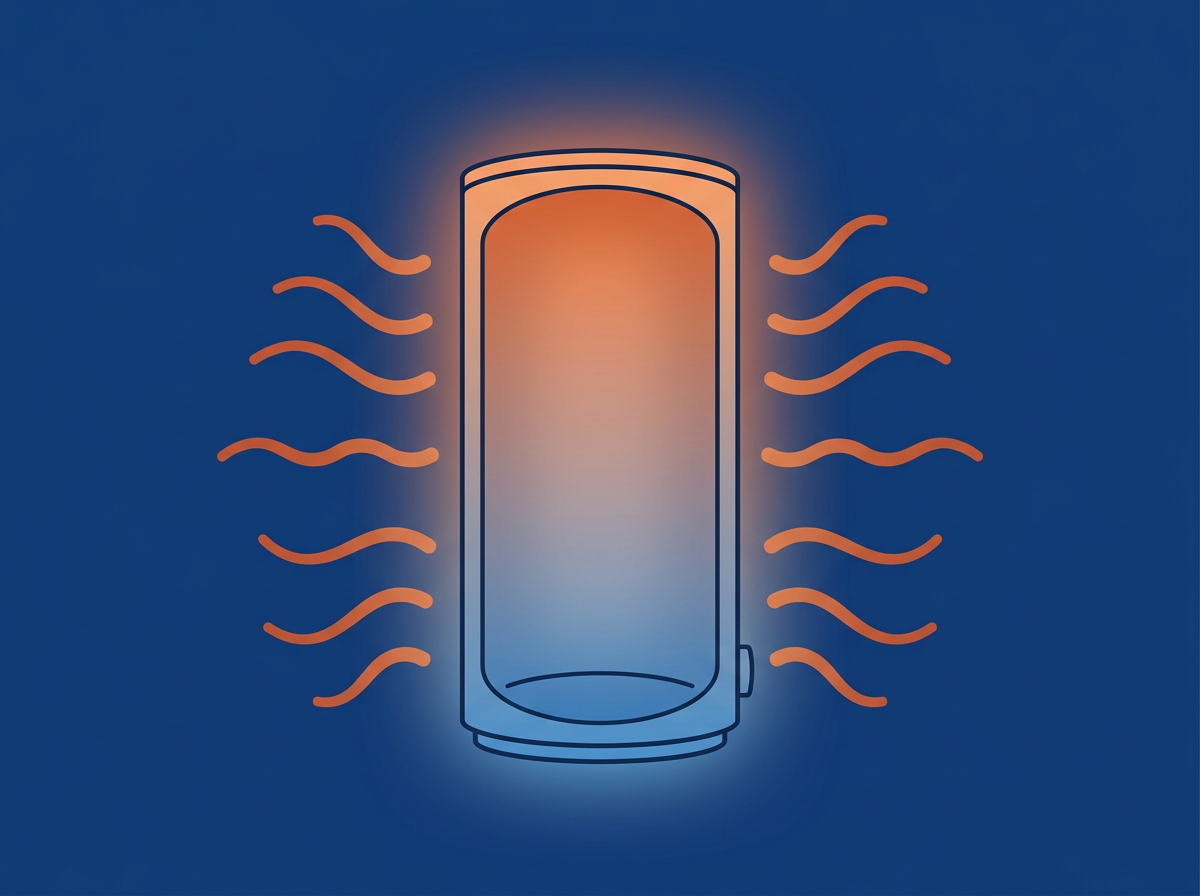
A storage hot water tank holds 125 to 400 litres of water at roughly 60C. The air around the tank is cooler, so heat constantly leaks out through the insulation jacket, the steel lid, and any uninsulated pipework above the tank. The thermostat senses the drop and switches the element or burner back on to top the temperature up.
That recovery cycle costs money. Every kilowatt-hour spent reheating water that nobody used is pure waste. On a well-built modern unit the loss is small. On an older tank in an exposed Sydney garage it can be the single largest line item on your power bill.
The Physics in One Sentence
Heat loss is proportional to the temperature difference between the tank and the air around it. Double the gap and you roughly double the loss. That is why a tank that costs $90 a year in standby losses in February can quietly cost $160 by July, without anyone changing a single setting.
Why Sydney Winter Makes It Worse
Most Sydney hot water tanks live in one of three places: a brick or fibro garage, an external side passage, or a small laundry alcove. None of those spaces are heated. Through June, July and August, overnight lows across the basin sit between 4C and 9C, with garages and side passages often a degree or two colder than the official Observatory Hill readings published by the Bureau of Meteorology.
A 60C tank sitting in 8C air has a 52C temperature gap. The same tank in 24C summer air has a 36C gap. The winter loss is roughly 1.4 times the summer loss for the same hardware. Layer that on top of Sydney Water price rises that took effect on 1 July 2025 and the squeeze on cold-season bills is sharper than most homeowners realise.
The Real Numbers for a Sydney Home
Here is what standby losses look like across the three most common Sydney setups, priced on the 2026 Ausgrid controlled load 1 rate of about 16 c/kWh and the AGL gas rate of about 4.2 c/MJ. If you want a deeper breakdown of which tariff applies to your meter, read our Sydney hot water tariffs guide.
| System | Typical daily standby loss | Winter annualised cost (Sydney) |
|---|---|---|
| 250L electric storage, pre-2010, garage | 2.8 - 3.4 kWh | $165 - $200 |
| 250L electric storage, post-2015, garage | 1.5 - 2.0 kWh | $90 - $120 |
| 170L gas storage, external | 22 - 30 MJ | $340 - $460 |
| 270L heat pump, external | 0.6 - 1.0 kWh | $45 - $75 |
| Continuous flow gas (no tank) | Pilot only, 0 if electronic ignition | $0 - $35 |
The gas storage line surprises most people. Gas tanks vent combustion gases up a central flue, and that flue acts as a permanent chimney pulling heat out of the water 24 hours a day. That is why federal energy advice consistently rates gas storage as one of the lower-efficiency options once standby losses are counted.
How to Tell If Your Tank Is Bleeding Energy
You do not need a thermal camera to work this out. Three checks tell you almost everything.
- The hand test. After six hours with no hot water use, put a flat palm on the side of the tank. It should feel barely warm, like skin temperature. If it feels distinctly hot, the insulation is failing or was never adequate.
- The flow pipe test. Touch the copper outlet pipe one metre downstream from the tank after the same six-hour rest. A warm pipe means hot water has migrated up the line by convection, which is a slow standby leak in its own right.
- The bill test. Pull two recent quarterly bills, one from autumn and one from winter. If your hot water charge climbed by more than 25 percent without a change in household routine, standby losses are a likely culprit.
Cross-check what you find against our winter hot water checklist for the full sweep.
Five Fixes That Actually Move the Bill
1. Lag the First Three Metres of Hot Pipework
More than half of avoidable standby loss in older Sydney installs leaves through bare copper pipework in the first three metres above the tank. Closed-cell polyethylene lagging from any hardware store, fitted with cable ties, takes 30 minutes and costs under $40. We cover sizing and material choice in detail in our pipe insulation guide.
Expected saving on a typical Inner West install: $40 to $90 a year, and the lagging pays for itself in the first winter.
2. Fit an Insulation Jacket on Pre-2010 Tanks
Tanks built before about 2010 used 25 mm of polyurethane foam in the jacket. Modern tanks use 50 mm or more. If your unit is older than 15 years and the casing feels warm to the touch, an R1.5 jacket wrap from a plumbing supplier will cut standby losses by 25 to 45 percent.
Important caveat: never cover the thermostat access panel, the data plate, the burner inlet on a gas unit, or the top of any tank with a flue. A licensed plumber can fit a jacket properly in under an hour.
3. Wind the Thermostat Back to 60C, Not Higher
Many older Sydney tanks were installed with thermostats turned up to 70C or 75C to extend the apparent capacity of an undersized unit. Every 10C above 60C adds roughly 11 percent to standby losses while doing nothing useful, because the tempering valve at the outlet pulls everything back to 50C anyway. Australian Standard AS 3498 requires storage water to be held at 60C minimum for Legionella control, so 60C is the floor, not a target.
This is a five-minute adjustment with a screwdriver, no parts cost, and a typical saving of $40 to $80 a year on an electric tank.
4. Move the Tank Out of the Worst Spot
We see hundreds of Sydney tanks tucked into open side passages with a flimsy plastic awning and southerly wind blowing straight across them. Relocating the tank into the garage, or fitting a proper enclosure with a vented door, often cuts winter standby loss by a third. This is a quote-on-inspection job, but the payback is real on any tank with five or more years of life left.
5. Replace the Tank If It Is Past 10 Years
Standby losses on a 12-year-old electric tank can be triple those of a current model with the same nameplate capacity. If your unit is approaching end of life anyway, replacement is the biggest single fix on this list. A modern heat pump in particular runs roughly a quarter of the standby cost of even a brand new electric storage tank, which is one reason our gas-to-heat-pump switch guide keeps trending in our most-read list.
Full installed costs by system type are in our 2026 Sydney installed price guide, and the running-cost comparison sits in our running cost guide.
What About Turning the System Off Overnight?
Homeowners often ask whether they should switch the hot water circuit off at the meter board overnight to dodge standby losses. The honest answer for Sydney homes on a controlled load tariff is no. Controlled load 1 only energises in the cheapest off-peak window anyway, and forcing the tank to reheat fully every morning shifts the load into peak rates and usually costs more.
For households on a single anytime tariff with a continuous tank, a timer that disables the circuit between 9pm and 5am can shave 5 to 12 percent off the hot water portion of the bill. Ausgrid publishes the current controlled load rates and your retailer can confirm which tariff is on your meter.
Heat Pump Standby Losses Are a Different Animal
Heat pumps have the same physical insulation challenge as any other tank, but their efficiency multiplier makes the running cost of standby loss much smaller. A heat pump with a coefficient of performance of 3.5 only spends one unit of electricity to replace 3.5 units of lost heat, so a 1 kWh thermal loss becomes a 0.29 kWh billed loss.
Cold weather does eat into that ratio. Sydney winter morning COP for typical units sits closer to 2.6 to 3.0, which is still excellent but not the brochure figure. We covered the real cold-weather performance in our Sydney winter heat pump performance guide.
How Standby Loss Hides Inside a Sydney Water Bill
Standby loss is an electricity or gas cost, not a water cost, but it interacts with your water bill in one ugly way. A tank with failed insulation also tends to be a tank with a tired temperature pressure relief valve, and a TPR that drips overnight pushes hot water straight down the drain. That shows up as higher water charges and higher energy charges at the same time.
If your water and energy bills have both crept up this winter, run the diagnostics in our Sydney Water bill shock guide before assuming the cause is general price rises. Sydney Water offers a Hidden Leak Allowance for verified concealed leaks, and a dripping TPR can qualify.
What a Service Visit Actually Checks
An annual hot water service in Sydney costs $180 to $260 and is the cheapest insurance you can buy against runaway standby losses. A proper visit covers:
- Thermostat calibration check and adjustment back to 60C.
- TPR valve operation test and seat inspection.
- Anode rod inspection - a corroded anode often signals tank shell thinning, which raises losses.
- Sediment flush, because 20 mm of sediment on the tank floor forces the element to work harder and longer.
- Pipework insulation inspection on the hot outlet riser.
- Tempering valve function test at the bathroom outlet.
Most Sydney homes that have never had a service see a 15 to 25 percent reduction in hot water energy use after the first one, almost entirely from standby loss recovery.
The Bottom Line for Sydney Homes
Standby heat loss is the quiet line item that grows in winter and never shows up itemised on a bill. For most Sydney homes the figure sits between $90 and $200 a year. For older gas storage tanks in exposed positions it can pass $400. The fixes are well understood, mostly cheap, and almost all pay back inside one winter.
Pick one fix from the list above and book it in this month. Pipe lagging on the first three metres, a thermostat wind-back to 60C, and an annual service together cost less than $300 fitted and routinely save Sydney households $150 to $300 across a single winter. With NSW Fair Trading reminding consumers to use licensed plumbers for any work on a heated water service, the smart play is to bundle the easy wins into one visit and walk away with a meter that turns slower.