
Hot Water After a Power Outage: Sydney Storm Guide
The first big southerly of the season rolls up the coast late on a warm September afternoon, the sky over the Hills goes green, and half a dozen streets in Kellyville, Dural and Glenorie lose power inside ten minutes. By morning the fridge is beeping, the modem is dead, and someone in the house is standing under a shower asking why the water went cold. Storm season in Sydney runs from about now through to March, and hot water is one of the first things people notice missing.
Most of what happens next is avoidable. Whether you still have hot water depends on the type of system you own, how well it holds heat, and whether the outage did anything worse than switch it off. Restarting it safely afterwards has an order to it, and skipping steps is how people burn out an element or void a warranty.
This guide covers how long your stored hot water realistically lasts, what to do while the power is out, how to restart electric, gas and heat pump systems, the storm damage we actually see on jobs, and the water bill surprise that shows up six weeks later.
Why Sydney Storm Season Is Rough on Hot Water
Sydney gets its severe thunderstorms in a fairly reliable window. Warm, humid air builds through spring, the westerly troughs come through, and the Hills, the Blue Mountains foothills, the Northern Beaches and the Central Coast take the brunt. The Bureau of Meteorology warnings page is the fastest way to see what is heading your way.
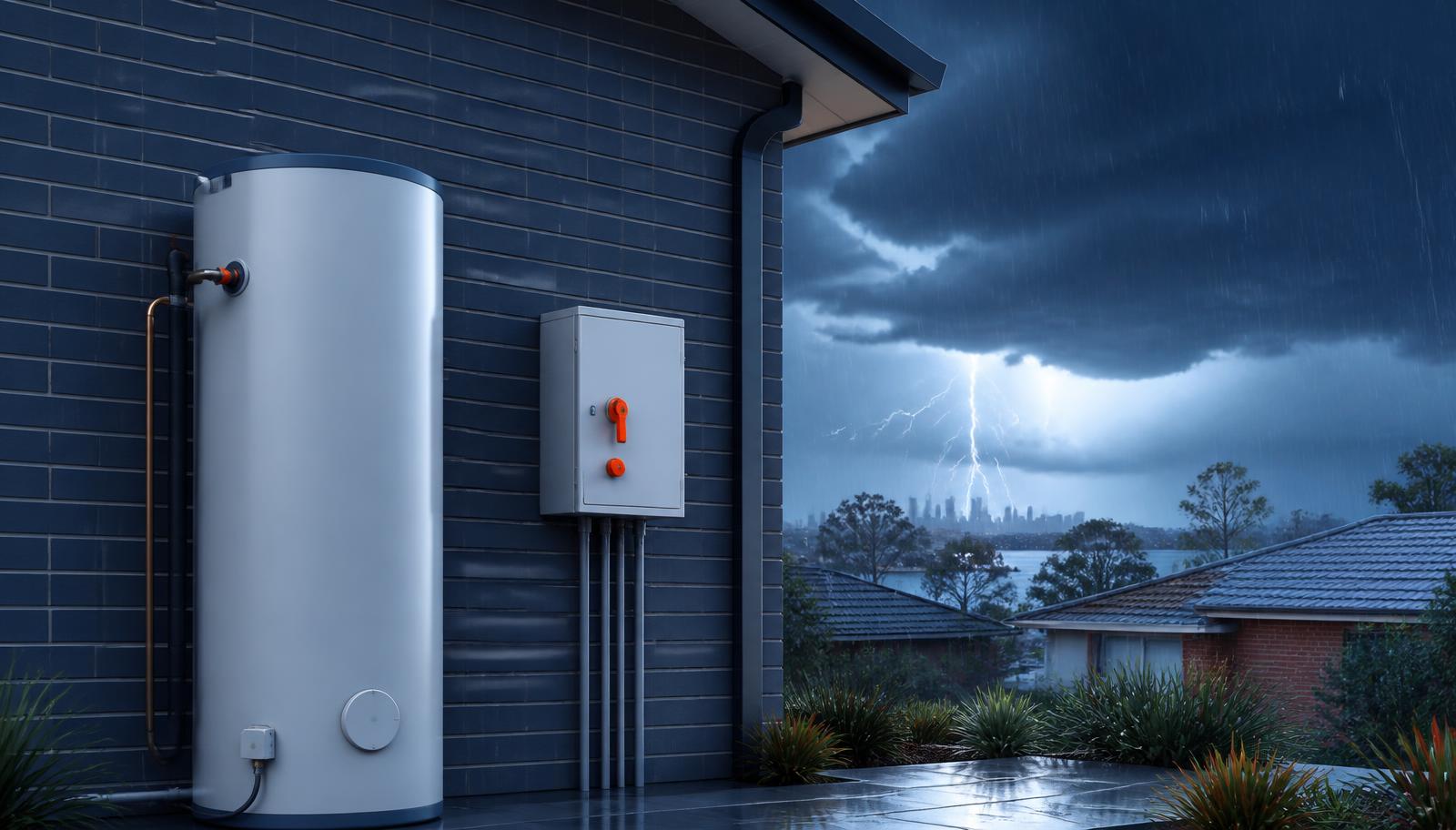
Hot water systems sit right in the path of the damage. Continuous flow gas units are almost always mounted on an external wall. Heat pumps live outdoors by design. Electric storage tanks are usually against the side fence, on a slab that collects run off when the gutters overflow.
Add a voltage surge as the network reconnects, and you have three failure paths at once: no power, water where it should not be, and a fried control board. That combination is why our call volume through October and February climbs well above a normal month.
How Long Hot Water Lasts in a Blackout
If you have a storage tank, the good news is that a blackout does not empty it. The water in the tank stays hot for a long time because the insulation is doing its job whether or not the element is running.
A modern, well insulated tank loses roughly one to two degrees an hour when it is not being heated. Start at 60 degrees and you are still above 50 degrees the next morning. That is a comfortable shower for most households, provided nobody runs a bath.
| System type | Hot water during outage | Practical limit |
|---|---|---|
| Electric storage (any size) | Yes, stored heat only | 24 to 48 hours, one tank of water |
| Gas storage with pilot light | Yes, keeps heating | Indefinite while gas supply holds |
| Gas continuous flow | No, needs mains power | Cold water only |
| Heat pump | Yes, stored heat only | 24 to 36 hours, one tank |
| Solar thermal with electric boost | Yes if the sun is out | Depends on cloud cover |
The catch is that stored heat is a fixed budget. Once the tank is drained, cold mains water refills it and there is nothing to reheat it with. Older tanks with tired insulation shed heat far faster, which is one more reason to know how long hot water systems last before you rely on one in an emergency.
Why Your Gas Unit Went Cold Straight Away
Owners of Rinnai, Rheem and Bosch continuous flow units are often surprised that a gas appliance stops working in a blackout. These units use electronic ignition, a fan and a circuit board, all of which run on 240 volts. No power means no ignition, no matter how much gas is at the meter.
Older gas storage tanks with a standing pilot light are the exception. They keep burning through the outage and will happily reheat a tank while the street is dark. If reliability during storms matters to you, that difference is worth weighing up in our instantaneous versus storage comparison.
What To Do While The Power Is Out
Your goal during the outage is simple: protect the heat you already have and avoid damaging anything.
- Switch the hot water isolator at the meter box to off if the outage looks like it will run for hours. This protects the unit from the surge when supply returns.
- Use hot water sparingly. Short showers, no baths, no dishwasher, no washing machine on a hot cycle.
- Keep the bathroom door shut and the exhaust fan off so the room holds warmth.
- Do not run a tap to test whether the system is heating. Every litre you draw is replaced with cold mains water.
- Register the outage and check restoration estimates with Ausgrid outage tracking if you are in Sydney, the Hunter or the Central Coast.
- If water is rising near the unit, stay clear of it and follow the advice from the NSW SES.
One thing people get wrong: turning the thermostat up before an outage does not bank extra heat safely. Anything above 60 degrees in the tank raises scalding risk at the tap and puts more strain on the relief valve, which we cover in our hot water safety guide.
Restarting Your System Once Power Returns
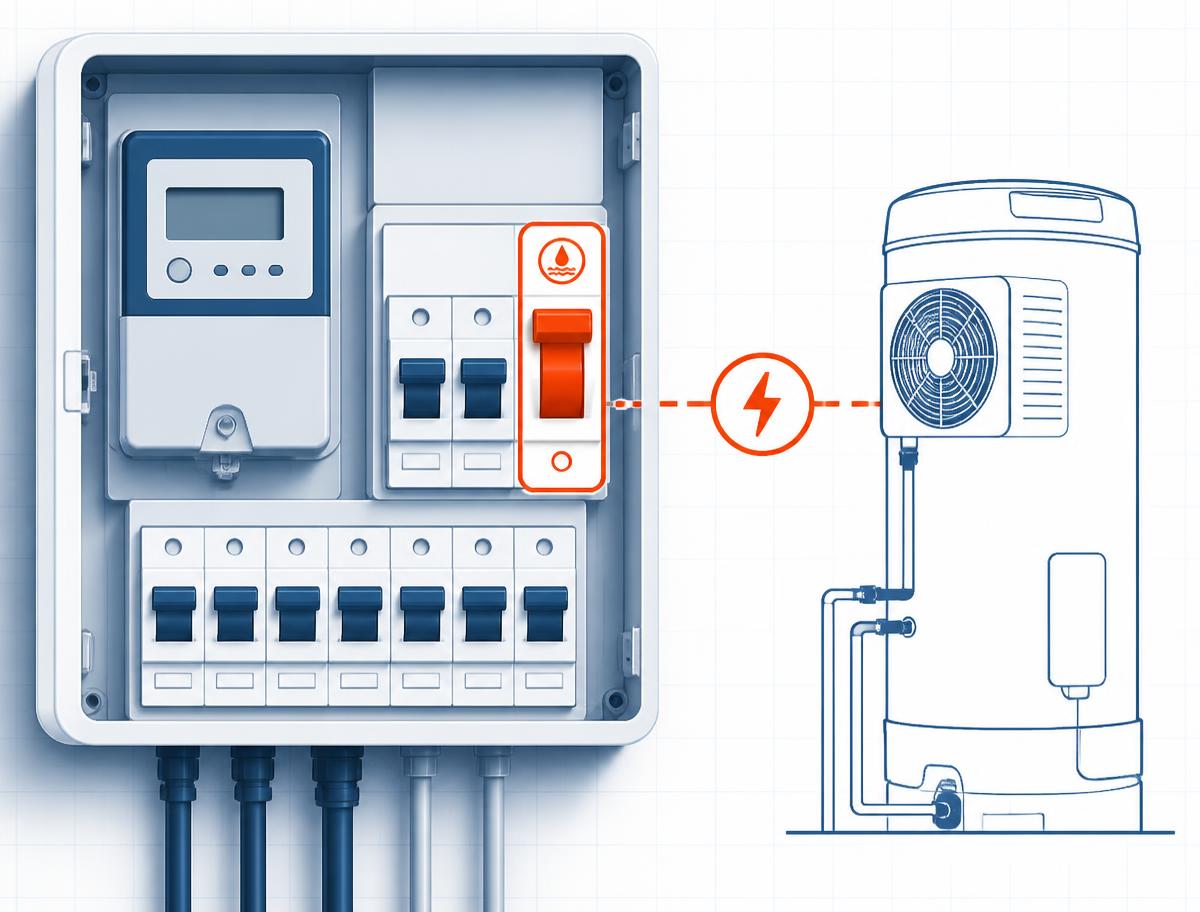
Do these in order. The order matters because it puts the inspection before the electricity, not after it.
- Open the meter box. Look for a tripped safety switch or breaker. Check the separate controlled load circuit as well, which is often labelled off peak or hot water.
- Walk out to the unit and look at it. Water inside the casing, scorch marks, a gas smell, a fallen branch or silt around the base all mean stop.
- Restore power from the top down. Main breaker first, then the hot water isolator, then the appliance control panel.
- For gas units, follow the relight sticker. Every brand has its own sequence printed on the unit, and guessing it can lock the appliance out.
- Prove ignition. Run a hot tap for a minute on a continuous flow unit and listen for the burner. On a storage tank, listen for the element or compressor starting.
- Give it time. A 250 litre electric tank takes three to four hours to recover from cold, a heat pump can take five to eight hours in cool weather.
If the breaker trips the moment you switch it back on, stop there. That is almost always water in the element or thermostat, and repeated resets will damage the switchboard as well as the heater. Our no hot water checklist takes you through the rest of the safe checks.
Error Codes After a Storm
Continuous flow units often throw a fault code once power comes back. Codes in the 10, 11 and 12 range usually point to ignition failure, while 61 and 71 point at the fan or the gas valve circuit. A single code after a surge is worth one reset attempt. A repeat code is a service call, and our gas error code guide explains what each family of codes means.
Why Hot Water Comes Back Later Than Everything Else
Plenty of Sydney homeowners call us because the lights are back but the water is still cold. In most cases nothing is broken. Electric storage tanks in NSW commonly run on a controlled load tariff, and that circuit is only energised during set off peak windows.
If the power came back at 9am and your controlled load window starts at 11pm, the tank will not begin heating until that night. That is a tariff behaviour, not a fault. You can see how the tariffs are structured in our Sydney controlled load tariff guide, and compare retail plans on the government run Energy Made Easy site.
If you need heat sooner, most systems have a boost function or your electrician can move the tank to a continuous tariff. Boosting costs more per kilowatt hour, so treat it as a storm week measure rather than a permanent setting.
The Storm Damage We Actually See
Not every post storm call is a simple reset. These are the four failures that fill our diary through spring and summer.
- Surge damaged control boards. Continuous flow and heat pump units carry electronics that do not survive a voltage spike. A replacement board on a heat pump often runs past $900 fitted, which pushes older units into replacement territory.
- Water inside the casing. Horizontal rain drives through vent openings on wall mounted units. The unit may run for a day or two and then fail once corrosion reaches a connector.
- Flooded tank bases. Silt and run off sitting around a storage tank rots the outer jacket and gets into the thermostat pocket. This is the most common cause of a breaker that keeps tripping after a storm.
- Blocked or crushed relief drain lines. Leaf litter and debris block the discharge line, so the valve cannot relieve pressure properly. Our relief valve guide explains what normal discharge looks like.
Surge protection is cheap by comparison. A switchboard mounted surge diverter fitted by a licensed electrician generally costs a few hundred dollars and protects the heat pump, the oven and the solar inverter at the same time.
Heat Pumps Need The Longest Runway
Heat pumps are the slowest system to recover after an outage, and spring mornings make that worse. The compressor pulls warmth out of the surrounding air, so a 12 degree morning after a storm front gives it far less to work with than a mild afternoon. Recovery on a 270 litre unit can stretch past eight hours in those conditions.
That is normal behaviour, not a fault, but it catches households who expect the instant recovery of a gas unit. If your family showers before 7am, run the boost function the evening the power returns rather than waiting for the standard heating window. Our heat pump performance guide shows how ambient temperature changes recovery times.
One more heat pump specific check after a storm. Clear leaves and bark off the evaporator fins on the side of the unit, because a blocked airflow path makes an already slow recovery slower and pushes the compressor harder than it should work.
The Bill Trap That Shows Up Six Weeks Later
Here is the part people miss. Storms move ground, split old copper joints and stress fittings that were already tired. A pipe that starts weeping in October does not announce itself, it just runs quietly under the slab or behind the tank until the quarterly bill lands.
Sydney Water charges have been climbing through the current price period, so the same leak costs more than it did two years ago. A slow leak on the hot side is worse again, because you pay for the water and for the energy used to heat it before it disappears into the soil.
The safeguard most people have never used is the Sydney Water hidden leak allowance. If a concealed leak on your property pushed your usage well above normal, and you had it repaired by a licensed plumber within a set period, Sydney Water can credit part of the excess usage back to your account.
Two things decide whether you get that credit. You need the leak found and fixed promptly, and you need a plumber's invoice that states clearly what was repaired and when. Keep the invoice, keep the photos, and apply through your Sydney Water account rather than waiting for the next bill.
A simple post storm check takes five minutes. Turn every tap off, make sure no appliance is running, then watch the leak indicator dial on your water meter. If it is still creeping, water is leaving your system somewhere it should not be. Our water bill and hidden leak guide walks through the full test.
Insurance, Warranty and Who Pays
Storm damage to a hot water system is usually covered by home building insurance, while age related failure is not. The distinction insurers care about is whether an external event caused the damage, so photograph the debris, the water line on the wall and the unit itself before anything is cleaned up.
Manufacturer warranty is a separate question. Most warranties exclude damage from flooding, lightning and voltage surge, and several will be voided outright if an unlicensed person opened the unit to dry it out. If you have a dispute with an energy retailer about outage related damage, the Energy and Water Ombudsman NSW handles those complaints at no cost.
Any repair on a heated water service in NSW is licensed plumbing work. You can check a licence in seconds through NSW Fair Trading before letting anyone touch the unit, and it is worth doing when door knockers appear after a big storm.
Storm Proofing Before The Season Peaks
September and October are the right months for this work, before the heavy storms of December and January. None of it is expensive.
- Clear gutters and downpipes near the hot water unit so run off is not pouring over the casing.
- Check that the unit sits on a slab or plinth above the surrounding ground level.
- Clear the relief valve drain line outlet of leaves, mulch and soil.
- Have a surge diverter fitted at the switchboard if you own a heat pump or continuous flow unit.
- Trim branches overhanging the unit, particularly gums on Central Coast and bushland edge blocks.
- Book a service if the system is over five years old and has never been checked, using our maintenance guide as a reference.
- Photograph the unit, the data plate and the surrounds now so you have a before image for any insurance claim.
If you are already weighing up a replacement, storm resilience belongs in the decision. A gas storage tank keeps working in a blackout, a heat pump does not, and a continuous flow unit stops the moment the street goes dark. Our team can talk through the trade offs alongside running costs on the hot water installation page.
What To Do Tonight
Storms in Sydney are predictable in season and unpredictable in timing, which is the worst combination for anything sitting outside your house. Spend twenty minutes this week clearing the drain line, checking the plinth and finding the hot water switch in your meter box so you can reach it in the dark.
If the last storm already left you with a system that trips, throws a code or refuses to relight, do not keep resetting it. That is the point where a $300 repair turns into a tank replacement, and we would rather see it before that happens.