
Hot Water System Leaking From the Bottom in Sydney
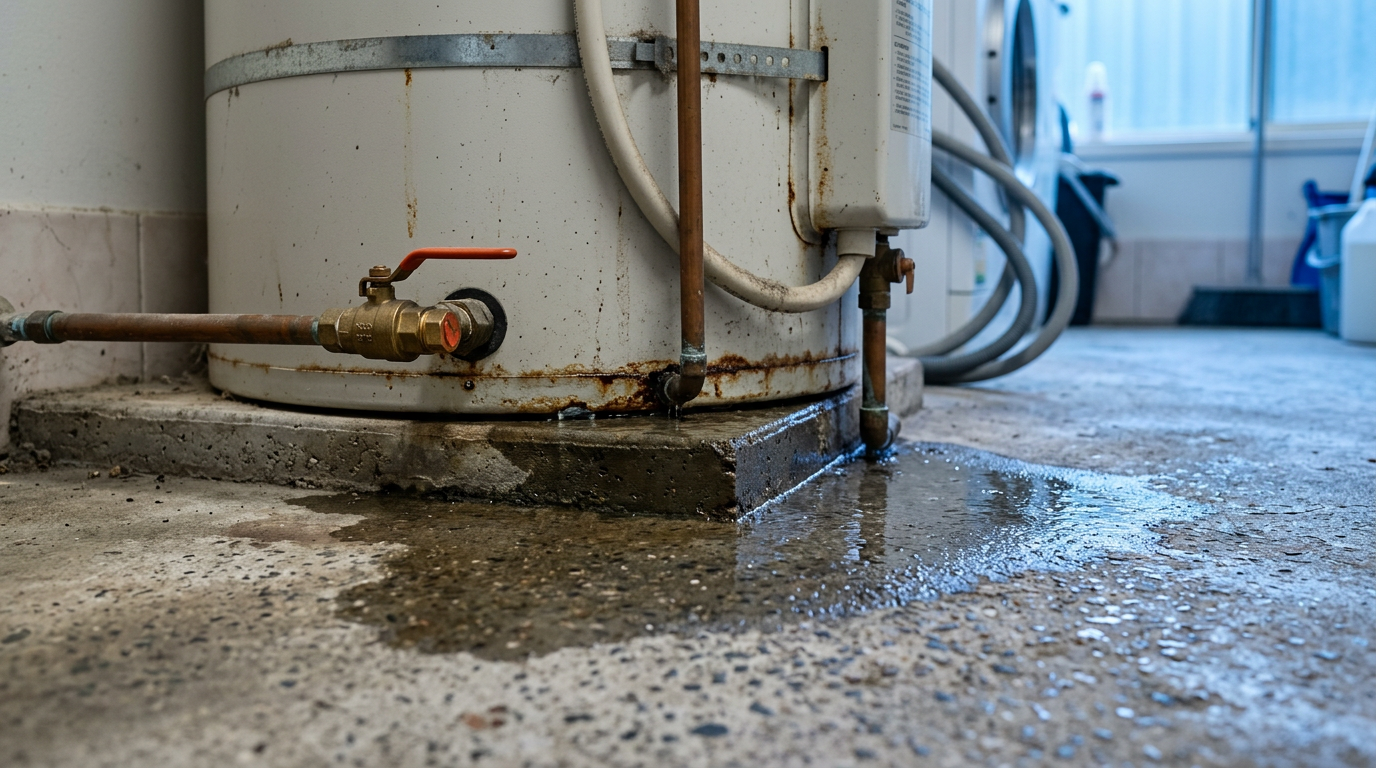
You went out to the laundry for a load of towels and stood in it. A thin sheet of water spreading out from under the tank, following the fall of the slab toward the door, with a faint rust ring where the skirt meets the floor. Nothing burst. Nothing banged. It has just been quietly happening while Sydney sat through the coldest fortnight of the year.
July is when we take the most calls about water under a tank, and the reason is simple. Mains water entering Sydney homes in mid winter is around ten degrees colder than it was in February, so the heater runs longer and cycles harder to reach the same 60 degrees. Steel that was holding on through autumn starts giving way once it is expanding and contracting twice as often.
The good news is that not every puddle means a new hot water system. Roughly half the base leaks we attend are a fitting, a valve or a badly graded drain line, and those are a same day repair. This guide shows you how to tell the difference before you spend anything, what each outcome costs in Sydney right now, and what to do in the next ten minutes if the water is still spreading.
First Ten Minutes: Make the Puddle Safe
Do this before you start diagnosing anything. Water and a 3.6 kilowatt heating element in the same space deserve respect.
- Kill the power or the gas. For an electric unit, switch off its dedicated circuit at the switchboard, not just the isolator on the wall. For gas, close the gas isolation valve at the appliance.
- Close the cold isolation valve. There is a lever or gate valve on the cold pipe entering the top of the tank. Turning it off stops the mains feeding the leak.
- Do not open the drain valve. Draining a hot tank without isolating it first drops scalding water across your feet.
- Move what matters. Cardboard boxes, paperwork and anything with a plug on it comes off the floor now.
- Photograph everything. Wet floor, wet skirting, wet carpet edge. Insurers want the water damage documented before it dries.
If water is spreading toward a power point, running through a wall cavity or dripping to a level below, that is an emergency. Our emergency hot water repair crews run 24 hours across Sydney, the Central Coast and Newcastle for exactly this call.
The Four Things That Leak at the Base
Water pooling underneath a cylinder comes from one of four places. Three of them are cheap. One of them is not.
1. The drain valve
That brass tap at the bottom of the tank is the most common culprit and the least serious. Sediment builds up against the seat over years, the washer hardens, and it starts weeping. You will see water forming on the valve body itself and dripping straight down.
A plumber replaces it in under an hour once the tank is drained. Budget roughly $220 to $380 in Sydney including the drain down and refill. Tightening it yourself with a shifter is a bad idea, because an old brass valve body can shear and turn a drip into an open tank.
2. The cold inlet or hot outlet connection
Water tracking down the outside of a copper pipe and dripping off at the base looks exactly like a tank leak until you dry it and watch. Compression fittings and flexible connectors loosen through thermal movement, especially where a previous installer used a flexi hose rated below the working pressure.
These are straightforward repairs. What matters is why it loosened. High mains pressure across much of Sydney is the usual answer, and our guide to high water pressure explains how to test yours with a $25 gauge.
3. The relief valve discharge line
Every storage unit has a temperature pressure relief valve with a copper line running to a safe discharge point. If that line has back fall, has been cut short, or discharges under the tank instead of outside, normal relief water ends up on your floor and looks like a leak.
Relief discharge should be a cupful during each heating cycle, not a continuous run. A valve that never stops is a fault in its own right, covered in our leaking relief valve guide.
4. The cylinder itself
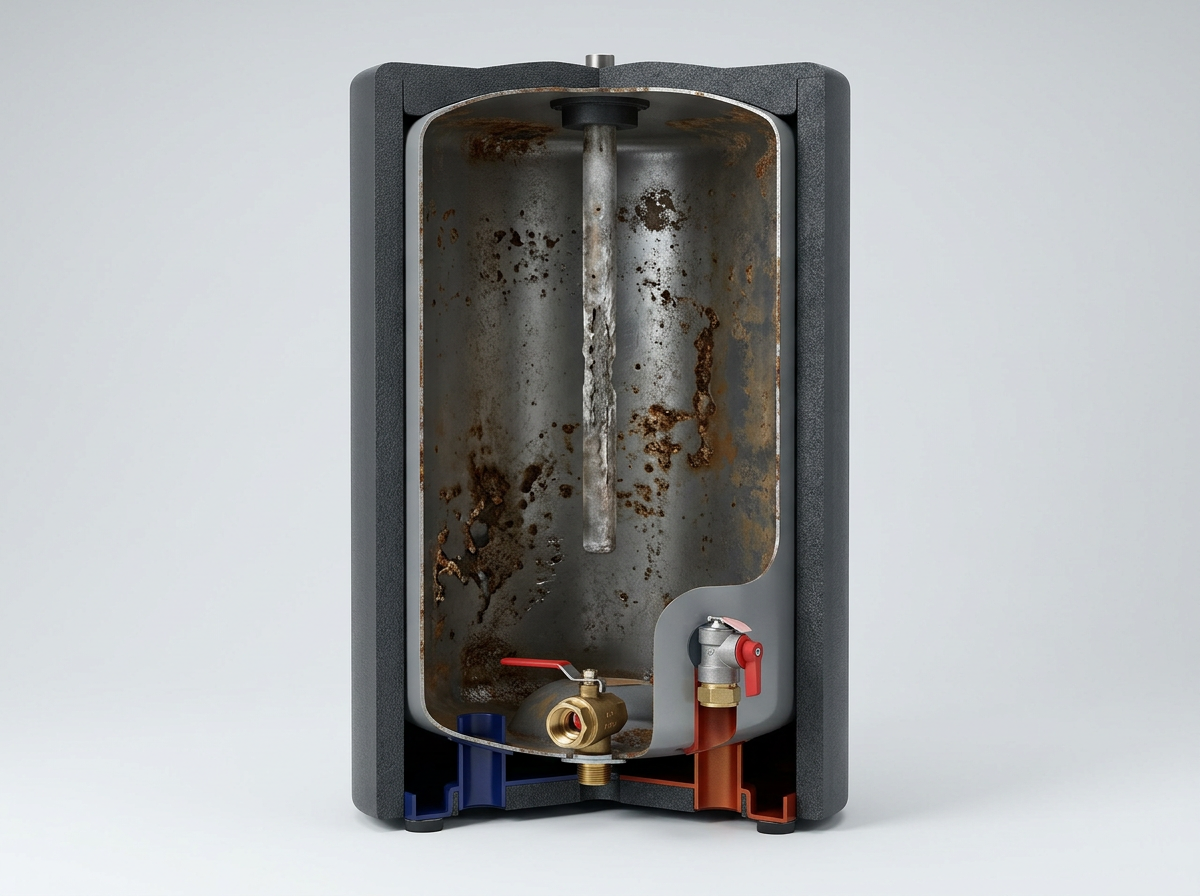
This is the outcome nobody wants. Water weeping from the seam where the outer jacket meets the floor, from under the skirt, or appearing without any wet fitting above it, means the inner steel cylinder has perforated. Insulation soaks it up first, which is why the leak often looks small for a week and then suddenly is not.
A perforated cylinder cannot be patched, welded, sealed or epoxied. The steel is enamel lined and pressure rated, and any repair attempt fails within days. Replacement is the only answer.
How to Tell Which One You Have
Thirty minutes and a roll of paper towel will usually settle it.
- Mop the slab bone dry and lay paper towel in a ring around the full base of the unit.
- Wipe every fitting dry: drain valve, cold inlet, hot outlet, relief valve and the union nuts on each side.
- Wait fifteen minutes without running any hot water in the house.
- Check the towel first. Wet directly under a fitting means a fitting leak. Wet in a broad arc under the jacket means the cylinder.
- Follow the relief line outside and see whether it actually discharges clear of the building.
- Look for rust staining on the skirt, on the floor, or in the water itself. Rust is the tell.
One extra test that catches people out. Run a hot tap for two minutes, let the tank refill and reheat, then check again in an hour. Cylinder leaks often only show once the tank is under a full heating cycle and internal pressure is at its peak.
Why Sydney Tanks Rot From the Bottom Up
Corrosion does not start where you find the water. It starts at the base of the cylinder, because that is where sediment settles.
Sydney's supply is soft by Australian standards, but every tank still collects a layer of mineral sludge and rust particles across the floor of the cylinder. That layer traps heat against the steel, insulates the base from the water above it, and creates the local hot spots where enamel cracks. Once the lining cracks, the sacrificial anode is the only thing standing between your water and bare steel.
Anodes are consumable. In most Sydney homes a magnesium anode is spent somewhere between year five and year eight, and almost nobody replaces one. From that point the cylinder corrodes on borrowed time. Our anode rod replacement guide explains how a $250 inspection can add years to a tank that is otherwise heading for the kerb.
What makes it worse in a Sydney home
- High mains pressure. Large parts of the network run above 500 kPa overnight, which stresses seams that are already thinning.
- Coastal air. Salt laden air in beachside suburbs attacks the outer jacket and fittings, particularly on units in open carports.
- Never being flushed. A yearly flush moves the sediment layer out before it insulates the base.
- Undersized tanks. A unit that cycles constantly to keep up with the household ages faster than one that heats and rests.
- Winter duty. Colder inlet water in July means longer burn or element times, every single day of the season.
Age matters more than anything on that list. Most Sydney storage units give ten to twelve years, and the numbers behind that sit in our guide to how long hot water systems last.
Electric, Gas and Heat Pump Leak Differently
What you find under the unit depends on what sort of unit it is, and the diagnosis changes with it.
Electric storage
These are the tanks that most often perforate at the base, because the element sits low in the cylinder and sediment settles directly around it. A wet floor under an electric unit with rust in the water is almost always terminal. Check the element flange gasket too, a low round plate behind the access cover, which can weep without the cylinder being gone.
Gas storage
Gas units have a flue running up through the middle of the tank, and that flue is a second corrosion path. Water dripping into the burner compartment underneath, or a burner that keeps going out for no obvious reason, points to a cylinder leak rather than a fitting. Never keep running a gas storage unit that is dripping into its own burner tray.
Heat pump
Heat pumps confuse people, because they produce condensate as a normal part of operating. A clear, cool trickle from a small drain line during a heating cycle is the unit working correctly. Water that is warm, rusty or arriving from the tank body rather than the condensate line is a genuine fault. In a Sydney winter that condensate volume climbs, so more homeowners notice it in July than in January.
Instantaneous units
Continuous flow units have no cylinder to perforate, so a leak underneath is nearly always a fitting, an isolation valve, or a cracked heat exchanger. The first two are cheap. A cracked exchanger on an out of warranty unit usually means replacement.
Repair or Replace: The Honest Numbers
Current Sydney pricing, supplied and installed by a licensed plumber, including removal of the old unit where applicable.
| Leak source | Fix | Typical Sydney cost |
|---|---|---|
| Drain valve weeping | Valve replacement, drain and refill | $220 to $380 |
| Loose inlet or outlet fitting | Refit or replace connector | $180 to $340 |
| Relief valve or discharge line | New valve, line re-graded | $260 to $460 |
| Perforated electric cylinder | Like for like storage replacement | $1,400 to $2,400 |
| Perforated gas storage cylinder | Gas storage replacement | $1,900 to $3,100 |
| Upgrade at failure | Heat pump installation | $3,000 to $5,500 before incentives |
There is a rule of thumb worth holding onto. If the unit is under eight years old and the leak is a fitting, repair it. If the unit is over ten and the leak is the cylinder, replace it and do not spend a cent chasing the old one. Between those two points, the deciding factor is usually whether the anode has ever been changed.
A failure is also the cheapest moment you will ever get to upgrade, because the labour to remove the old unit is already being paid for. The NSW hot water upgrade incentive can take a meaningful bite out of a heat pump changeover, and our Sydney installed price guide breaks down every system type side by side.
Warranty, Insurance and Who Pays
Two separate conversations, and people routinely confuse them.
The manufacturer warranty
Cylinder warranties on Australian storage units typically run five to ten years, and they cover the tank, not the labour. Brands including Rheem will generally supply a replacement cylinder if the original fails inside its term, while you pay for removal, installation and any parts outside the tank.
Claims get refused for predictable reasons: no pressure limiting valve fitted, no expansion control valve where one is required, no proof of installation by a licensed plumber, or the unit being installed outside its rated conditions. Keep the original invoice. Our warranty guide covers what each brand actually honours.
Your home insurance
Most policies cover the damage the water caused and exclude the appliance that caused it. Soaked floorboards, a ruined gyprock wall and a wet carpet are usually claimable. The corroded tank is treated as wear and tear.
Two things protect a claim: photographs taken before you clean up, and a plumber's report naming the failure and the date. If the tank has already burst rather than seeped, our burst tank and insurance guide walks through the claim sequence.
Do not count on a water bill credit either. The Sydney Water hidden leak allowance is written for concealed underground leaks, not for a visible appliance leak in a laundry. If your bill has jumped and you cannot see the cause anywhere, our water bill and hidden leak guide explains how the allowance is assessed.
Getting the Replacement Done Properly
A rushed winter swap out is where compliance corners get cut, and you carry the consequence at sale time.
- Licensed installer only. Verify the licence through NSW Fair Trading before work starts.
- A compliant safe tray and drain where the unit sits inside the building or above a habitable space.
- A tempering valve delivering no more than 50 degrees to bathrooms, as required by the National Construction Code Volume Three.
- New relief and expansion valves, never the old ones reused on a new cylinder.
- Heated water service installed to AS/NZS 3500.4, with the certificate of compliance handed to you.
- The old unit removed and taken away, not left beside the fence.
Ask for the sizing conversation as well. A household that has grown since the last tank went in should not be handed the same capacity by default. If you want the technical detail before the plumber arrives, our hot water installation page covers what a compliant Sydney install includes.
Stopping the Next One
Tanks give warning. Almost every leaking cylinder we replace showed at least one of these signs first.
- Rusty or brown hot water when the cold runs clear.
- Rumbling or kettling as the burner or element heats through a sediment layer.
- Hot water running out faster than it did last winter.
- Rust staining or bubbling paint on the outer jacket, particularly near the base.
- A relief valve that has started weeping when it never used to.
Two habits prevent most of it. Flush the tank once a year to clear the sediment layer off the base, and have the anode checked at the five year mark. Between them they cost less than one emergency callout and they are the difference between a tank that reaches twelve years and one that fails at eight, usually on the coldest weekend of the year when the Sydney forecast is sitting in single figures overnight.
The Short Version
Dry the floor, lay paper towel, and give it fifteen minutes. Wet under a fitting is a repair. Wet under the jacket is a replacement, and no product from a hardware shelf will change that.
Isolate the cold valve and kill the power the moment you find water, because the cost of a leaking tank is almost never the tank. It is the flooring, the wall sheeting and the weekend spent drying a room out.
If there is water under your unit this morning, take a photo, turn the cold valve off and get someone licensed to look at it today rather than after the next cold snap.