
Burst Hot Water Tank Sydney: First Hour & Insurance 2026
A burst storage tank empties roughly 250 litres of scalding water into your garage or laundry inside fifteen minutes. The next sixty minutes decide whether you pay a $2,400 plumber bill or a $24,000 ceiling and floor replacement on top. Here is the exact Sydney homeowner playbook, written from the jobs we attend every winter week.

A Marrickville homeowner called us at 4:48 am last Thursday. Her husband had stepped onto the laundry tiles in bare feet and into two centimetres of hot water already flowing under the back door. The 16 year old electric storage tank in the garage had split along the bottom weld at some point overnight, and the mains pressure had pushed roughly 800 litres through the brick wall and across the kitchen subfloor before either of them noticed. The plumber bill that morning was $2,640. The insurance claim for the kitchen floor, the laundry cabinetry and three days of structural drying came in at $19,300.
Sydney loses thousands of hot water tanks every winter. The cold months between May and August are by far the worst, because falling overnight temperatures stress weakened steel and the same tanks that limped through summer fail under their first 8 degree morning. Most of the damage that follows is preventable in the first hour, and most insurance claims are won or lost on what you photograph in the first ten minutes. This guide walks through both, then explains the Sydney Water Hidden Leak Allowance that almost no homeowner knows about until they read the fine print on their next quarterly bill.
Why Sydney Tanks Burst More Often in Late Autumn
A storage tank fails in one of three places: the bottom weld, the inlet stub or the temperature and pressure relief outlet. All three are governed by the same physics. Hot water expands. Cold incoming mains contracts. The steel shell flexes a fraction of a millimetre with every heating cycle, and over twelve to fifteen years that fatigue accumulates exactly where the anode rod has stopped doing its job. Late autumn drops the incoming mains temperature in Sydney from around 22 degrees in February to about 13 degrees by mid May. The differential the tank now lifts water through almost doubles, the recovery cycle runs longer, and the metal works harder than it has in eight months.
The first cold front of the season is the trigger. We see burst tank callouts spike in the second week of May and stay elevated through the end of July. Tanks built before 2014 with single magnesium anodes are the most exposed, especially on the harder water zones of the Hills District, Penrith and Camden where scale builds faster. Heat pump cylinders fare better because the booster element only fires under fault conditions. Old electric and gas storage cylinders carry almost the entire burst-rate burden in our service data.
The First Hour: Five Steps That Save Your Floor
Speed wins. A 250 litre cylinder empties in about fifteen minutes once the shell has split, but the mains keeps refilling it at twenty litres a minute until you stop the supply. Run through these five steps in order, do not skip any of them, and do not stop to clean up until the water is off and the photos are taken.
- Step one: kill the water supply. Close the cold isolation valve on the inlet pipe to the tank. If it is seized, head to the front boundary meter pit and shut the main stop tap.
- Step two: kill the power or gas. Trip the breaker labelled hot water at the meter board, or close the gas appliance isolation valve. A dry-firing element can crack a tank from the inside in minutes.
- Step three: photograph everything. Wide shot of the tank, close up of the leak, the valve positions, the puddle path, the ceiling below if you have a top-floor cylinder. Twelve photos minimum. Phone timestamps matter.
- Step four: contain and ventilate. Towels along the water path, mop up standing water away from cabinetry, open the garage door, lift the edges of saturated carpet to slow soak-through.
- Step five: call the plumber and the insurer. Plumber first on 0420 102 207, insurer second within 24 hours. Ask the insurer for the claim number before any restorer is booked.
Do not open the hot taps to drain the tank
It feels logical and it is wrong. Opening hot taps pulls fresh mains water through the failing tank and out through whatever cracked, which extends the flood instead of reducing it. The only way to stop the flow is at the source.
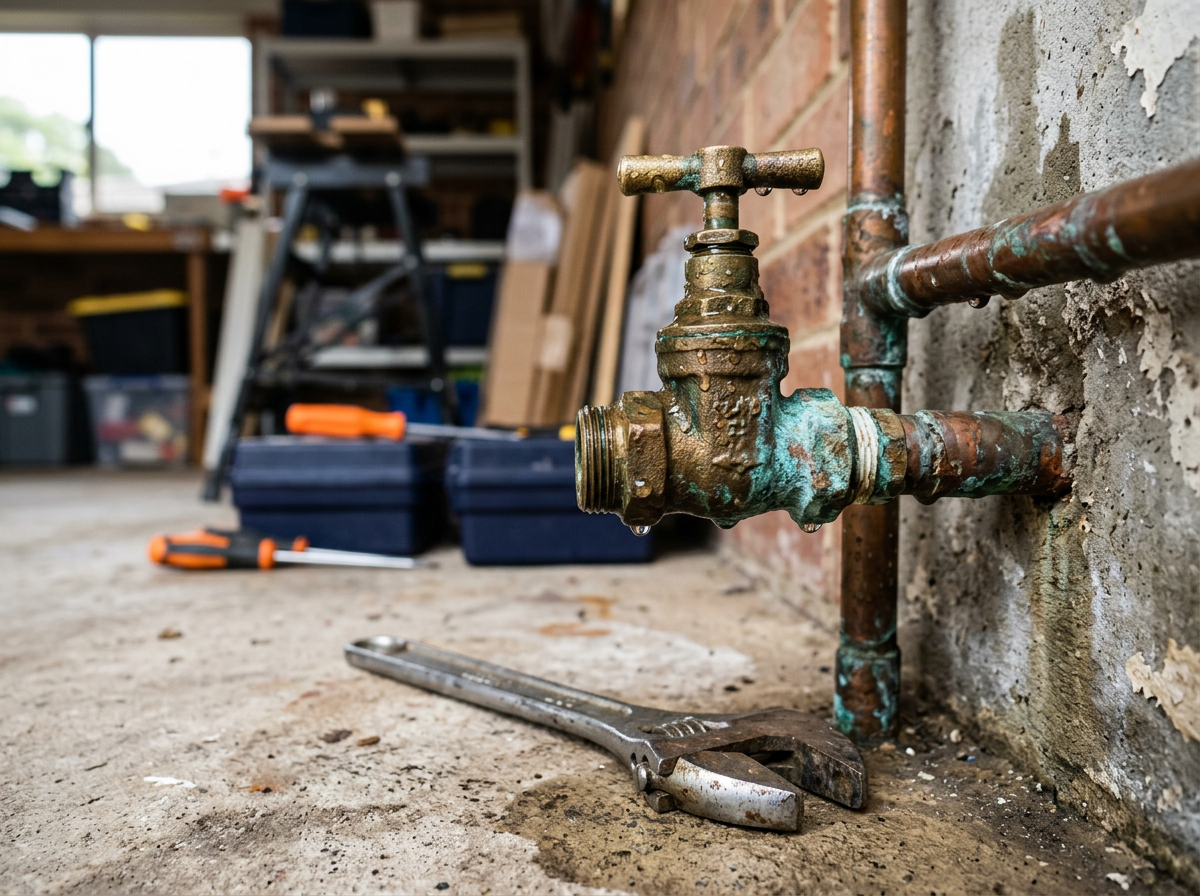
Green patina on the isolation valve is the field tell of a slow leak that has been weeping for months. Most burst tanks show this exact pattern before the wall fails.
How to Find Your Stop Tap and Isolation Valve
Half the burst-tank panic we attend would not happen if every household had walked their stop tap once before the emergency. Sydney installs sit in three common places. Free-standing homes have a brass main stop tap inside a small concrete pit at the front boundary, usually within a metre of the footpath, often hidden by mulch or lawn growth. Townhouses and villas in inner suburbs put it inside the front garden bed, sometimes inside a green plastic box. Apartments and units have the building isolation in a service riser cupboard on each floor, and the strata-supplied master shut-off is on the supply level for the whole building.
The tank itself has a separate cold inlet isolation valve, a quarter-turn brass lever or a small wheel, sitting on the cold pipe within 300 millimetres of where it enters the cylinder under AS/NZS 3500.1. Close that valve first because the rest of the house keeps cold water, the toilet still flushes, and the kitchen tap still works. The boundary stop tap is the back-up if the tank-side valve is seized, which is common in cylinders older than ten years that have never been turned.
Walk both right now while reading this. Take five minutes. Lift the meter pit lid, identify the brass key shape on the stop tap, and confirm whether you need a meter key or whether a strong hand will move it. If the valve is corroded shut, call us to swap it out for around $180 supplied and fitted. It is the cheapest insurance in Sydney plumbing.
The Warning Signs You Almost Certainly Ignored
A tank rarely bursts without warning. The four signs below appear weeks to months before the failure, and every one of them is fixable for under $400 if you call when you notice it. We attend burst calls where the homeowner mentions, almost in passing, that the unit had been doing the rumbling thing for two months. By then the seam is already opening.
- Rust-coloured water from hot taps. The internal lining has failed. Sediment and corrosion are leaving with your shower water.
- Rumbling, popping or kettling sounds. Sediment is overheating against the element and flexing the base. Our noises guide diagnoses each sound.
- Slow weep at the base of the tank. A dinner-plate-sized damp patch on the concrete that comes back after you mop it. The wall is already compromised.
- Steady drip from the TPR valve. Either the pressure is too high or the valve is failing. Read our safety guide on TPR behaviour.
- Water bill jumped without explanation. A concealed weep can add 30 to 80 kilolitres a quarter before the tank gives way. Cross-check our water bill leak guide.
Claiming on Home Insurance: What Sydney Insurers Want
Australian home and contents policies treat a burst hot water tank as a sudden escape of liquid event, which is covered on almost every standard policy sold by NRMA, Allianz, Suncorp, AAMI, Budget Direct and Youi. The water damage to the building, the cabinetry, the carpet and the contents stored under the tank are all generally covered. The tank itself is usually excluded if the failure was caused by wear, corrosion or age, which is true of almost every burst we attend. The repair invoice for the cylinder replacement is your cost. The damage cleanup and rebuild is the insurer's cost.
Speed and paperwork win these claims. Lodge within 24 hours, include the photos, the licensed plumber report and your invoice. The Australian Securities and Investments Commission consumer guide on home insurance claims outlines your entitlement to written reasoning if a claim is reduced. The Insurance Council of Australia consumer hub tracks claim turnaround benchmarks across major insurers.
- The plumber report. Must be a licensed Australian plumber, must state the cause as sudden failure, must include the tank age and serial.
- Twelve to fifteen photos. Tank wide and close, valve positions, water path, soaked materials. Date-stamped on the original phone.
- Original receipts. Plumber invoice, emergency drier hire, hardware spend, alternative accommodation if displaced.
- Hold the tank for assessment. Do not let it go to scrap until the insurer confirms photos are enough. A few stand-by days save the claim.
When the insurer asks for their preferred restorer
Most major Sydney insurers run a panel of carpet driers and builders. You can accept the panel or use your own provided you get pre-approval in writing. Mixing the two midway is what causes disputes. Decide on day one and stay on that track.
Sydney Water Hidden Leak Allowance for a Burst Tank
Sydney Water increased prices again in 2026, and the surprise on most quarterly bills after a burst tank is the usage charge, not the plumber invoice. A 250 litre cylinder that leaked for six hours before discovery pushes 7,200 litres through your meter. A slow concealed weep over six weeks before the catastrophic failure can add 60,000 litres on top. At current Sydney Water residential pricing that is between $180 and $420 added to a single bill.
The good news is the Sydney Water hidden leak allowance covers exactly this scenario for owner-occupied properties. You submit the licensed plumber repair invoice, the photos of the failed tank and the meter reading the day of the repair. Sydney Water credits the abnormal usage portion of the bill, usually within two billing cycles. Tenants apply through the landlord. Strata-managed units apply through the owners corporation. Our Sydney Water bill guide walks through the form and the response times.
Replace or Repair: The Honest Answer
A burst storage tank cannot be repaired. The shell is structural, the warranty is void the moment the seam opens, and any plumber who tells you they can patch a cylinder is asking you to fund the next failure. Repair only applies to fittings, valves, elements and thermostats around the tank, none of which caused the burst.
The real decision is whether to replace like-for-like with another electric or gas storage cylinder, or switch to a heat pump while the system is already down. The case for heat pump grows stronger every year. The 2026 Energy Savings Scheme rebate covers $700 to $1,800 of the install, federal Small-scale Technology Certificates add another $400 to $900, and running costs drop by roughly 60 to 70 percent against an old electric tank. Read our switch to heat pump guide and our 2026 rebates guide before signing any emergency quote.
If the property is rented, NSW law requires hot water restoration as an urgent repair under the Residential Tenancies Act. Our landlord obligations guide covers timeframes and reimbursement. If the bill is the deciding factor, our installed price guide gives the current Sydney range across every system type.
Preventing the Next Burst Before Next Winter
Every replacement cylinder we install comes with a five point owner brief, because the same maintenance habits that double a tank's life are almost never on the warranty card. Print this list and stick it inside the meter cupboard door.
- Test the TPR valve twice a year. A 5 second tug on the lever every autumn and spring. Standards Australia AS/NZS 3500.4 references this in clause 5.10.
- Replace the anode rod at year five. The single highest return on plumbing spend. Detail in our anode rod guide.
- Flush the tank every two years. Removes sediment that overheats the element and flexes the base. See our flush guide.
- Turn the isolation valve quarterly. A quarter turn off, then back on. Stops the brass seizing into the open position.
- Book the pre-winter check in late April. A 20 minute inspection in autumn beats a 4 am flood in July. Our winter checklist is the same one we work through on site.
Burst Tank Right Now? Call a Sydney Emergency Plumber
Our licensed Sydney, Central Coast and Newcastle team carries common 250 to 315 litre cylinders, fittings and TPR valves in every van through winter. Same-day replacement, insurance-ready reports and Sydney Water Concealed Leak Allowance paperwork supplied on completion.
Frequently Asked Questions
What should I do in the first five minutes after a hot water tank bursts in my Sydney home?
Turn off the cold water isolation valve on the pipe entering the top of the tank. If you cannot reach it or it is seized, walk to your front boundary, lift the meter pit lid and turn the main stop tap clockwise until the flow stops. Switch off power at the circuit breaker labelled hot water or gas at the appliance isolation valve. Lay every towel you own across the path the water is taking and call a licensed Sydney plumber. Photograph the tank, the puddle and any wet ceiling before anything is touched. Those photos decide your insurance claim later.
Will home insurance cover a burst hot water tank in Sydney?
Most Sydney home and contents policies cover sudden water damage caused by a burst storage tank, including ceiling repair, flooring replacement and contents under the tank. The tank itself is usually excluded if it failed from rust or age, which is why the photos and the plumber report matter. Policies almost never cover gradual leaks left running for weeks. Lodge the claim within 24 hours, keep every receipt for emergency works, and ask the insurer in writing whether they require a preferred restorer before you call a carpet drier.
How much does a same-day burst hot water replacement cost in Sydney in 2026?
Emergency same-day replacement of a 250 to 315 litre tank in Sydney runs between $1,950 and $3,400 supplied and fitted, depending on system type. Electric storage is the cheapest swap at $1,950 to $2,400. Gas instantaneous lands at $2,400 to $3,000. Heat pump replacement sits at $3,000 to $4,200 before the Energy Savings Scheme rebate. Out of hours weekend or after 6 pm callouts add a $180 to $320 service fee on top. We hold most common 250 to 315 litre Rheem and iStore units in van stock through winter to avoid overnight delays.
Can I claim the cost of wasted water on my Sydney Water bill after a burst tank?
Yes. Sydney Water runs a Hidden Leak Allowance for concealed bursts inside the property, including failed hot water cylinders. You apply through your retail water bill account, provide the licensed plumber report, the photos and the repair invoice, and Sydney Water credits the abnormal usage portion of the bill after assessment. The allowance covers genuine sudden failures, not slow drips that ran for months. Most claims are processed within two billing cycles. Keep the replaced tank in your yard until the assessor confirms photographs are sufficient.
Is a rumbling or banging noise a warning that my hot water tank is about to burst?
Yes. Loud rumbling, popping or kettling sounds from a Sydney electric or gas storage tank usually mean sediment has built up across the base, the element is overheating and the steel shell is flexing each cycle. Repeated flex causes microfractures along the weld seam, which eventually open under mains pressure and flood the room. A tank that has gone noisy this winter and is older than eight years is on borrowed time. A safe drain, flush and inspection costs about $220 and tells you whether the cylinder has months or years left.
How long does a Sydney plumber take to arrive for an emergency burst tank?
Our average winter response across the Sydney metropolitan area is 45 to 90 minutes from the call. Inner west and lower north shore jobs are usually under an hour. Outer western Sydney and Sutherland Shire run 60 to 120 minutes depending on traffic. The Central Coast and Newcastle response sits at 60 to 110 minutes. We carry common cylinders, fittings and TPR valves in every van so the second visit is rarely needed. Calling early matters because the team that arrives first usually finishes first.