

Hot Water Pipe Insulation Sydney: Winter Heat Loss Guide
It is the second week of June in Sydney. The mornings sit around 7°C in Parramatta, 5°C up at Penrith, and 9°C by the harbour. Walk down the side of almost any home built before 2010 and you will see the same thing: bare copper hot water pipes running from the tank to the bathroom wall, sweating heat into the cold air on every run. That heat costs you money, and from 1 July 2024 Sydney Water rolled out a four-year price path that lifts the average household bill by hundreds of dollars by 2028. Energy prices are doing the same thing.
Lagging your hot water pipes is the single cheapest fix on the whole house. It takes a couple of hours, costs less than a takeaway dinner if you do it yourself, and pays for itself before next winter. This guide walks through where Sydney homes lose hot water heat, the right materials for our climate, what a licensed plumber charges to do it properly, and the NCC and Australian Standard rules that govern the work.
Why Uninsulated Hot Water Pipes Cost Sydney Homes So Much in Winter
Hot water is the second biggest energy cost in the average Australian household, behind only space heating. Your Home, the Australian Government's residential design guide, puts hot water at roughly 21% of household energy use. Every metre of bare copper pipe between your tank and your tap is bleeding part of that 21% into thin air.
In winter the loss accelerates. A 60°C pipe sitting in 7°C morning air has a 53°C temperature gradient driving heat outward. That same pipe in February sits in 25°C air and the gradient is less than half. The colder the air around the pipe, the faster the heat escapes, and the harder your hot water system has to work to keep the stored water at temperature.
CSIRO and industry testing put the heat loss from a single metre of bare 20 mm copper pipe at around 30 watts when carrying water at 60°C in a 10°C environment. Multiply that by 8 to 15 metres of external and subfloor run in a typical Sydney home, run it 24 hours a day, and you are looking at several kilowatt-hours of wasted energy every single day of winter.
The Sydney Water Price Rise Is Already Hitting Your Hot Water Bill
Most homeowners think of hot water as an energy bill. It is also a water bill. Every shower, every dishwasher cycle, every load of warm laundry draws fresh water through your meter. From 1 July 2024 the Independent Pricing and Regulatory Tribunal approved a four-year Sydney Water price determination that lifts the typical household water bill by roughly $228 by 2027–28. You can read the determination summary on the IPART website.
The connection to pipe insulation is direct. When hot water arrives at your tap cold, you stand there running the tap until it warms up. That wasted water is being charged at the new higher Sydney Water rate, and the energy used to reheat the tank is being charged at the higher network rate. Insulating the run keeps the water in the pipe warm between uses, so the wait is shorter and the volume wasted is lower. The same insulation that cuts your energy bill cuts your water bill.
For a household of four taking eight showers a day, cutting a 20 second warm-up wait down to 5 seconds saves around 30 litres of hot water per day. Over a year that is roughly 11,000 litres of hot water you no longer have to pay Sydney Water for, then pay your retailer to heat.
What Pipe Insulation Actually Does (And What It Doesn't)
Pipe lagging is a closed-cell foam sleeve that wraps around your hot water line. It does three jobs:
- Slows heat loss. A 13 mm wall of closed-cell foam cuts the heat loss rate from a bare copper pipe by roughly 80 to 85% under Sydney winter conditions.
- Reduces standby cycling. When your tank loses less heat through the pipes, the element or burner kicks on less often during the night.
- Stops condensation drip. On the cold inlet side it also blocks the summer condensation that rots subfloor timber over a few years.
Pipe insulation does not fix every hot water complaint. If your problem is genuinely slow flow, you have a pressure or pipe sizing issue. Read our low hot water pressure Sydney guide before you start lagging. If your tank itself is old and losing heat through the shell, no amount of pipe lagging will fix that, and you should check our hot water system lifespan guide.
Where Heat Loss Happens in a Typical Sydney House
Before you buy a single metre of foam, work out where the losses actually are. In nearly every Sydney home, the heat loss is concentrated in four zones.
1. External Pipe Runs
The pipework between an outdoor tank or continuous flow unit and the entry point into the house is the worst offender. It is exposed to ambient temperature, wind chill, and rain. Most older Sydney homes have one to three metres of bare copper here. UV exposure also breaks down any insulation that is not rated for outdoor use, so this section needs UV-stable foam and self-amalgamating tape.
2. Subfloor Pipework
Federation cottages in the Inner West, Californian bungalows on the North Shore, and weatherboard homes on the Northern Beaches almost all have hot water pipes running through the subfloor. The air under your floorboards in July can sit at 6 to 9°C all day. Every metre under there is leaking heat into the soil, not into your house.
3. Roof Cavity and Wall Chases
Two-storey homes and townhouses often route the upstairs bathroom feed through the roof cavity. Roof cavities in Sydney swing from 4°C on a July night to 50°C on a February afternoon. Insulating those runs cuts winter loss and prevents the foam itself from going brittle in summer.
4. Bare Valves and Fittings
Plumbers often lag the straight pipe runs and skip the elbows, tees, and tempering valves. A single uninsulated brass tempering valve has more surface area than half a metre of pipe and is a big heat sink. Cut short collars of foam to fit over every valve and fitting.
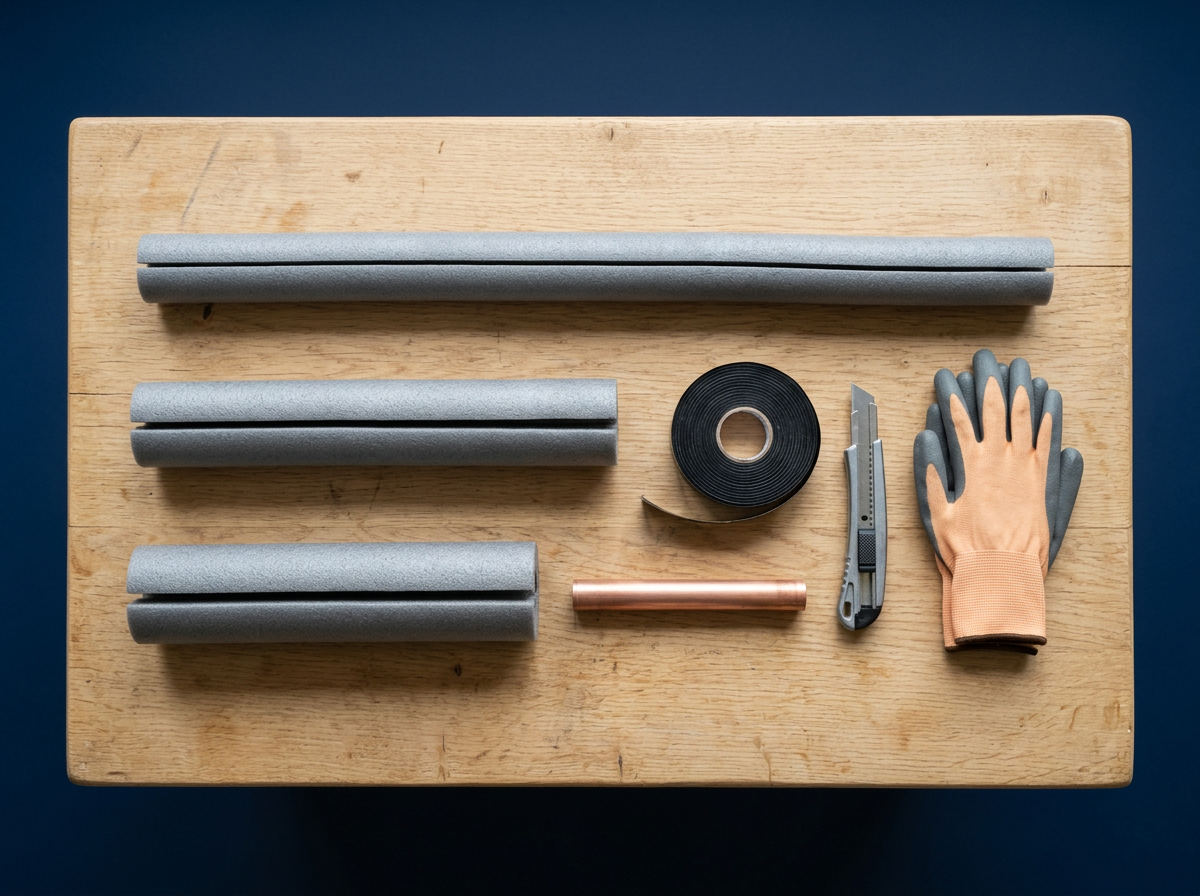
The complete pipe lagging kit: closed-cell foam in matched diameters, UV-rated self-amalgamating tape, sharp utility knife, vinyl gloves, copper offcut for sizing.
The Right Insulation Material for Sydney Conditions
Not all pipe lagging is equal. The wrong product on the wrong pipe will fail within a season. Three materials cover almost every Sydney home.
Closed-Cell Polyethylene Foam (the Default)
Grey pre-slit polyethylene foam is what you see on the shelf at Bunnings and every plumbing wholesaler. It handles continuous operating temperatures up to 95°C, comes in wall thicknesses from 9 mm to 25 mm, and slides over an existing pipe in seconds. For internal hot water runs in a Sydney home, 13 mm wall thickness is the practical minimum. For external or subfloor runs, step up to 19 mm or 25 mm.
Nitrile Rubber Foam (Heat Pump and Gas Continuous Flow)
Nitrile rubber lagging handles higher surface temperatures and is more flexible around tight bends. It is the right choice for the discharge side of a gas continuous flow unit, which can briefly hit 80°C, and for refrigerant lines on heat pump systems. If you have a heat pump, read our heat pump winter performance guide first; insulating the right line on a heat pump matters more than for a storage tank.
Fibreglass with Aluminium Foil (Commercial and Very Hot Lines)
For solar hot water lines running at 80°C plus, or anywhere the pipe surface gets close to 100°C, fibreglass with a foil jacket is the standards-compliant material. It is rarely needed on a residential job but if you have a flat-plate solar system, ask the installer specifically about the collector loop insulation.
How to Insulate Your Hot Water Pipes: 7-Step Guide
Fitting closed-cell foam to existing accessible pipework is a homeowner job. Anything that involves cutting into pipes, replacing valves, or any work on a gas appliance must be done by a licensed plumber under NSW Fair Trading licensing rules.
- Map the pipe run. Trace every hot water pipe from the tank or continuous flow unit to each fixture. Note every external metre and every section in an unconditioned subfloor or roof cavity.
- Measure pipe diameter. Wrap a tape measure around the pipe and divide by π, or just measure the outside diameter directly. Most Sydney homes have 15 mm or 20 mm copper. Buy lagging with the matching internal diameter so it sits snug.
- Cut foam to length. Cut each section slightly longer than the pipe it covers. Mitre the ends at 45 degrees where two sections meet at a bend so the join is sealed, not gapped.
- Slit and slip. Open the pre-slit seam, push the foam over the pipe, and close the seam. Stagger joining seams between sections by 100 mm so there is no straight heat-loss channel along the run.
- Seal the seams. Wrap UV-rated self-amalgamating tape over every seam, every join, and around fittings. Standard duct tape will not survive a Sydney summer outside; it goes brittle and falls off in one season.
- Cover valves and elbows. Cut short collars of foam to fit over stop valves, tempering valves, and elbows. Leave the temperature pressure relief valve discharge line clear so it can still drain.
- Check the result. Run a hot tap for two minutes, then touch the outside of the lagging on an external run. It should feel close to ambient air temperature. If the outside of the foam is warm, the lagging is too thin and needs an upgrade.
What It Costs to Have a Plumber Lag Your Pipes in Sydney
Most homeowners are quoted somewhere between $180 and $480 to have a licensed plumber lag the full hot water run on a typical Sydney house. The variation comes down to access, total length, and whether the job is bundled with other maintenance like an anode check or a tempering valve service.
| Job | Typical Sydney price (fitted) |
|---|---|
| External tank-to-house run only (1 to 3 m) | $140 to $220 |
| Full house hot water lag (8 to 15 m, accessible) | $280 to $480 |
| Subfloor and tight-access lag (crawl required) | $420 to $720 |
| Bundled with anode rod inspection | Add $180 to $320 |
| DIY materials only (lagging, tape, knife) | $35 to $90 |
At Sydney's current electricity tariff of around 35 cents per kWh and the post-July 2024 Sydney Water usage rate, a typical four-person household recoups a $300 plumber-fitted job inside 18 to 22 months. For comparison costs across the rest of your system, see our hot water running costs comparison.
NCC 2022 and AS/NZS 3500 Rules That Apply
Pipe insulation on a new install or replacement in NSW is not optional. The National Construction Code 2022 Volume Three, also known as the Plumbing Code of Australia, sets minimum R-values for hot water pipework based on pipe diameter and operating temperature. AS/NZS 3500.4 (the heated water services standard) sets the matching technical requirements.
The short version for a Sydney residential job:
- All hot water pipework in a new or replacement installation must be insulated for its full accessible length.
- Insulation must be UV-stable for any section exposed to direct sunlight.
- The first metre of pipe leaving the heater on both flow and return must always be insulated, even on retrofits.
- Insulation must not cover the TPR valve discharge line, the gas pilot vent, or any electrical control housing.
If you are replacing your unit this winter, the installer must lag the new pipework to NCC standard as part of the job. If the quote does not mention pipe insulation, ask the installer to put it in writing. For the full cost picture on a new unit, our 2026 Sydney hot water system cost guide breaks down installed prices by system type.
Hidden Leaks Behind Insulation: The Sydney Water Allowance You Should Know About
Pipe lagging hides what it covers. A pinhole leak on a concealed hot water line can run for months under a foam sleeve before anyone notices, and the bill that arrives is brutal. The good news is that Sydney Water runs a Hidden Leak Allowance, which gives an eligible customer a credit on the water and wastewater usage portion of their bill once a licensed plumber has found and fixed the leak.
Eligibility is straightforward but specific. You must have a confirmed concealed leak (a leak that was not visible without cutting into a wall, floor, or insulation), proof of repair by a licensed NSW plumber within a set timeframe, and the leak must not have been previously claimed. Full criteria sit on the Sydney Water hidden leak allowance page.
Before you lag a previously bare run, do a quick check. With every tap in the house off and no toilets cycling, walk to your water meter and watch the small red triangle. If it is spinning, you already have a leak and you should fix it before you cover the evidence. Our full Sydney Water bill leak guide walks through the claim process step by step.
When Pipe Insulation Is Not Enough
Lagging is the cheapest hot water fix, not the only one. If your system is already inefficient at the source, insulating the pipes will help, but the bigger gains sit further upstream.
- Tank older than 10 years. Storage tanks lose heat through the cylinder itself as the internal insulation degrades. Pipe lagging cannot fix tank loss. Check our system lifespan guide.
- Electric resistive on full peak. The system itself is the problem. A heat pump conversion under the federal and NSW rebate schemes will save more in one winter than a decade of pipe lagging.
- Continuous flow with long pipe runs. Insulation helps, but a recirculation loop helps more for very long runs. See our recirculation systems guide.
- Frequent winter cold-water sandwich. This is usually a tempering valve, mixer, or sizing issue, not an insulation issue.
The right sequence for most Sydney homes this winter is: check your system age and condition first, fix any leaks, then lag every accessible metre of hot water pipe. Our winter hot water checklist walks through the full sequence.
Frequently Asked Questions
Do hot water pipes really need insulation in Sydney's mild climate?
Yes. Sydney winter mornings regularly sit below 10°C and subfloor temperatures stay even colder. The temperature gradient between a 60°C pipe and that air is more than enough to drive significant heat loss every hour of the night. NCC 2022 mandates insulation on every new and replacement install for this exact reason.
How long does pipe insulation last?
Indoor closed-cell foam typically lasts 15 to 20 years. UV-rated external foam with proper self-amalgamating tape lasts 8 to 12 years before the outer surface starts to chalk and crack. Cheap unrated foam used outdoors fails inside 18 months.
Can I use pool noodles as a cheap substitute?
No. Pool noodles are not rated for the surface temperatures of a hot water pipe and will collapse and melt against a 60°C copper line. Use only pipe lagging rated to at least 95°C continuous service.
Should I insulate the cold inlet too?
Yes for the first metre into the heater on a continuous flow unit, where it prevents condensation, and yes for any cold line that runs through a hot space such as a roof cavity in summer. For long horizontal cold runs in subfloors, lagging is optional and rarely cost-effective.
Does insulating pipes void my hot water warranty?
No. Fitting external foam around the pipework does not touch any sealed part of the unit and does not affect warranty. Cutting into pipes or modifying valves does. See our warranty guide.
Get Your Sydney Hot Water Pipes Insulated to NCC Standard
Pipe insulation is the highest-return, lowest-risk winter upgrade any Sydney homeowner can make. It costs less than a service call, pays for itself before next winter, and is a code requirement on every replacement install from 2026. If you would rather have it done properly the first time, with UV-rated materials, mitred bends, sealed seams, and a quick leak check at the meter before anything gets covered, our licensed team handles full-house pipe lagging across Sydney, the Central Coast, and Newcastle.
Book a winter pipe insulation check with the team that does it every day. We will quote on the spot, fit UV-rated lagging to NCC 2022 standard, and check your meter for any hidden leak before we cover a single metre. Call 0420 102 207 or request a quote online.